Sunday, October 13, 2019

October 13, 1919. Rumors on Wilson's Health.

While it would be denied by those close to Wilson that very day, the truth was leaking out on Wilson's condition.


A treaty regarding aircraft was entered into in Paris.

The Convention relating to the Regulation of Aerial Navigation. October 13, 1919.

On this day in 1919 an international commission arrived upon the first international agreement addressing and regulating aircraft usage.
The treaty read:

CONVENTION RELATING TO THE REGULATION OF AERIAL NAVIGATION SIGNED AT PARIS, OCTOBER 13, 1919
 
THE UNITED STATES OF AMERICA, BELGIUM, BOLIVIA, BRAZIL, THE BRITISH EMPIRE, CHINA, CUBA, ECUADOR, FRANCE, GREECE, GUATEMALA, HAITI, THE HEDJAZ, HONDURAS, ITALY, JAPAN, LIBERIA, NICARAGUA, PANAMA, PERU, POLAND, PORTUGAL, ROUMANIA, THE SERB-CROAT-SLOVENE STATE, SIAM, CZECHOSLOVAKIA AND URUGUAY, 

           Recognising the progress of aerial navigation, and that the establishment of regulations of universal application will be to the interest of all; 
            Appreciating the necessity of an early agreement upon certain principles and rules calculated to prevent controversy;

           Desiring to encourage the peaceful intercourse of nations by means of aerial communications;

           Have determined for these purposes to conclude a convention, and have appointed as their Plenipotentiaries the following, reserving the right of substituting others to sign the same convention:

           Who have agreed as follows :

CHAPTER I.
GENERAL PRINCIPLES.

 
Article 1.
            The High Contracting Parties recognise that every Power has complete and exclusive sovereignty over the air space above its territory.
            For the purpose of the present Convention, the territory of a State shall be understood as including the national territory, both that of the mother country and of the colonies, and the territorial waters adjacent thereto.
Article 2.
            Each contracting State undertakes in time of peace to accord freedom of innocent passage above its territory to the aircraft of the other contracting States, provided that the conditions laid down in the present Convention are observed.
            Regulations made by a contracting State as to the admission over its territory of the aircraft of the other contracting States shall be applied without distinction of nationality.
Article 3.
            Each contracting State is entitled for military reasons or in the interest of public safety to prohibit the aircraft of the other contracting States, under the penalties provided by its legislation and subject to no distinction being made in this respect between its private aircraft and those of the other contracting States from flying over certain areas of its territory.
            In that case the locality and the extent of the prohibited areas shall be published and notified beforehand to the other contracting States.
 
Article 4.
            Every aircraft which finds itself above a prohibited area shall, as soon as aware of the fact, give the signal of distress provided in paragraph 17 of Annex D and land as soon as possible outside the prohibited area at one of the nearest aerodromes of the State unlawfully flown over.
 
CHAPTER II. 
Nationality of Aircraft. Article 5.
            No contracting State shall, except by a special and temporary authorisation, permit the flight above its territory of an aircraft which does not possess the nationality of a contracting State.
 
Article 6.
            Aircraft possess the nationality of the State on the register of which they are entered, in accordance with the provisions of Section I (c) of Annex A.
 
Article 7.
            No aircraft shall be entered on the register of one of the contracting States unless it belongs wholly to nationals of such State.
            No incorporated company can be registered as the owner of an aircraft unless it possess the nationality of the State in which the aircraft is registered, unless the president or chairman of the company and at least two-thirds of the directors possess such nationality, and unless the company fulfills all other conditions which may be prescribed by the laws of the said State.
 
Article 8.
            An aircraft cannot be validly registered in more than one State.
 
Article 9.
            The contracting States shall exchange every month among themselves and transmit to the International Commission for Air Navigation referred to in Article 34 copies of registrations and of cancellations of registration which shall have been entered on their official registers during the preceding month.
Article 10.
            All aircraft engaged in international navigation shall bear their nationalily and registration marks as well as the name and residence of the owner in accordance with Annex A.
 
CHAPTER III. CERTIFICATES OF AIRWORTHINESS AND COMPETENCY.
 
Article 11.
            Every aircraft engaged in international navigation shall, in accordance with the conditions laid down in Annex B, be provided with a certificate of airworthiness issued or rendered valid by the State whose nationality it possesses.
 
Article 12.
            The commanding officer, pilots, engineers and other members of the operating crew of every aircraft shall, in accordance with the conditions laid down in Annex E, be provided with certificates of competency and licences issued or rendered valid by the State whose nationality the aircraft possesses.
Article 13.
            Certificates of airworthiness and of competency and licences issued or rendered valid by the State whose  nationality  the  aircraft  possesses,  in accordance with the regulations established by Annex B and Annex E and hereafter by the International Commission for Air Navigation, shall be recognised as valid by the other States.
            Each State has the right to refuse to recognise for the purpose of flights within the limits of and above its own territory certificates of competency and licences granted to one of its nationals by another contracting State.
 
Article 14.
            No wireless apparatus shall be carried without a special licence issued by the State whose nationality the aircraft possesses. Such apparatus shall not be used except by members of the crew provided with a special licence for the purpose.
            Every aircraft used in public transport and capable of carrying ten or more persons shall be equipped with sending and receiving wireless apparatus when the methods of employing such apparatus shall have been determined by the International Commission for Air Navigation.

            The Commission may later extend the obligation of carrying wireless apparatus to all other classes of aircraft in the conditions and according to the methods which it may determine.
 
CHAPTER IV. ADMISSION TO AIR NAVIGATION ABOVE FOREIGN TERRITORY.
 
Article 15.
            Every aircraft of a contracting State has the right to cross the air space of another State without landing. In this case it shall follow the route fixed by the State over which the flight takes place. However, for reasons of general security, it will be obliged to land if ordered to do so by means of the signals provided in Annex D.
            Every aircraft which passes from one State into another shall, if the regulations of the latter State require it, land in one of the aerodromes fixed by the latter. Notification of these aerodromes shall be given by the contracting States to the International Commission for Air Navigation and by it transmitted to all the contracting States.

            The establishment of international airways shall be subject to the consent of the States flown over.
Article 16.
            Each contracting State shall have the right to establish reservations and restrictions in favour of its national aircraft in connection with the carriage of persons and goods for hire between two points on its territory.
            Such reservations and restrictions shall be immediately published, and shall be communicated to the International Commission for Air Navigation, which shall notify them to the other contracting States.
Article 17.
            The aircraft of a contracting State which establishes reservations and restrictions in accordance with Article 16, may be subjected to the same reservations and restrictions in any other contracting State, even the latter State does not itself impose the reservations and restrictions on other foreign aircraft.
Article 18.
            Every aircraft passing through the territory of a contracting State including landing and stoppages reasonably necessary for the purpose of such transit, shall be exempt from any seizure on the ground of infringement of patent, design or model, subject to the deposit of security the amount of which is default of amicable agreement shall be fixed with the least possible delay by the competent authority of the place of seizure.
 
CHAPTER V. RULES TO BE OBSERVED ON DEPARTURE WHEN UNDER WAY AND ON LANDING.
 
Article 19.
            Every aircraft engaged in international navigation shall be provided with :
            (a) A certificate of registration in accordance with Annex A ;
            (b) A certificate of airworthiness in accordance with Annex B ;
            (c) Certificates and licences of the commanding officer, pilots and crew in accordance with Annex E ;
            (d) If it carries passengers, a list of their names ;
            (e) if it carries freight, bills of lading and manifest ;
            (f) Log books in accordance with Annex C ;
            (g) If equipped with wireless, the special licences prescribed by Article 14.
 
Article 20.
            The log books shall be kept for two years after the last entry.\
 
Article 21.
            Upon the departure or landing of an aircraft, the authorities of the country shall have, in all cases, the right to visit the aircraft and to verify all the documents with which it must be provided.
 
Article 22.
            Aircraft of the contracting States shall be entitled to the same measures of assistance for landing, particularly in case of distress, as national aircraft.
Article 23.
            With regard to the salvage of aircraft wrecked at sea the principles of maritime law will apply, in the absence of any agreement to the contrary.
Article 24.
            Every aerodrome in a contracting State, which upon payment of charges is open to public use by its national aircraft, shall likewise be open to the aircraft of all the other contracting States.
            In every such aerodrome there shall be a single tariff or charges for landing and length of stay applicable alike to national and foreign aircraft.
 
Article 25.
            Each contracting State undertakes to adopt measures to ensure that every aircraft flying above the limits of its territory and that every aircraft wherever it may be, carrying its nationality mark, shall comply with the regulations contained in Annex D.
            Each of the contracting States undertakes to ensure the prosecution and punishment of all persons contravening these regulations.
 
CHAPTER VI. PROHIBITED TRANSPORT.
 
Article 26.
            The carriage by aircraft of explosives and of arms and munitions of war is forbidden in international navigation. No foreign aircraft shall be permitted to carry such articles between any two points in the same contracting State.
 
Article 27.
            Each State may, in aerial navigation, prohibit or regulate the carriage or use of photographic apparatus. Any such regulations shall be at once notified to the International Commission for Air Navigation, which shall communicate this information to the other contracting States.
 
Article 28.
            As a measure of public safety, the carriage of objects other than those mentioned in Articles 26 and 27 may be subjected to restrictions by any contracting State. Any such regulations shall be at once notified to the International Commission for Air Navigation, which shall communicate this information to the other contracting States.
 
Article 29.
            All restrictions mentioned in Article 28 shall be applied equally to national and foreign aircraft.
CHAPTER VII. STATE AIRCRAFT.
Article 30.
            The following shall be deemed to be State aircraft :
            (a) Military aircraft.
            (b) Aircraft exclusively employed in State service, such as Posts, Customs, Police.
            Every other aircraft shall be deemed to be private aircraft.
            All State aircraft other than military, customs and police aircraft shall be treated as private aircraft and as such shall be subject to all the provisions of the present Convention.
 
Article 31.
            Every aircraft commanded by a person in military service detailed for the purpose shall be deemed to be a military aircraft.
 
Article 32.
            No military aircraft of a contracting State shall fly over the territory of another contracting State nor land thereon without special authorisation. In case of such authorisation the military aircraft shall enjoy, in principle, in the absence of special stipulation, the privileges which are customarily accorded to foreign ships of war.
            A military aircraft which is forced to land or which is requested or summoned to land shall by reason thereof acquire no right to the privileges referred to in the above paragraph.
 
Article 33.
            Special arrangements between the States concerned will determine in what cases police and customs aircraft may be authorised to cross the frontier. They shall in no case be entitled to the privileges referred to in Article 32.
 
CHAPTER VIII. INTERNATIONAL COMMISSION FOR AIR NAVIGATION.
Article 34.
            There shall be instituted, under the name of the International Commission for Air Navigation, a permanent Commission placed under the direction of the League of Nations and composed of: 
            Two Representatives of each of the following States : The United States of America, France, Italy and Japan;

            One Representative of Great Britain and one of each of the British Dominions and of India;

            One Representative of each of the other contracting States.

            Each of the five States first-named (Great Britain, the British Dominions and India counting for this purpose as one State) shall have the least whole number of votes which, exceeding by at least one vote the total number when multiplied by five, will give a product of the votes of all the other contracting States.

            All the States other than the five first-named shall each have one vote.

           The International Commission for Air Navigation shall determine the rules of its own procedure and the place of its permanent seat, but it shall be free to meet in such places as it may deem convenient. Its first meeting shall take place at Paris. This meeting shall be convened by the French Government, as soon as a majority of the signatory States shall have notified to it their ratification of the present Convention.

            The duties of this Commission shall be:

            (a) To receive proposals from or to make proposals to any of the contracting States for the modification or amendment of the provisions of the present Convention, and to notify changes adopted;

            (b) To carry out the duties imposed upon it by the present Article and by Articles 9, 13, 14, 15, 17, 27, 28, 36 and 37 of the present Convention ;
            (c) To amend the provisions of the Annexes A—G ;
            (d) To  collect  and  communicate  to  the contracting States information of every kind  concerning  international  air navigation ;
            (e) To collect  and  communicate to the contracting States all information relating to wireless telegraphy, meteorology and medical science which may be of interest to air navigation ;
            (f) To ensure the publication of maps for air navigation in accordance with the provisions of Annex F ;
            (g) To give its opinion on questions which the States may submit for examination.

            Any modification of the provisions of any one of the Annexes may be made by the International Commission for Air Navigation when such modification shall have been approved by three-fourths of the total possible votes which could be cast if all the States were represented and shall become effective from the time when it shall have been notified by the International Commission for Air Navigation to all the contracting States.

            Any proposed modification of the Articles of the present Convention shall be examined by the International Commission for Air Navigation, whether it originates with one of the contracting States or with the Commission itself. No such modification shall be proposed for adoption by the contracting States, unless it shall have been approved by at least two-thirds of the total possible votes.

            All such modifications of the Articles of the Convention (but not of the provisions of the Annexes) must be formally adopted by the contracting States before they become effective.

            The expenses of organisation and operation of the International Commission for Air Navigation shall be borne by the contracting States in proportion to the number of votes at their disposal.

            The expenses occasioned by the sending of technical delegations will be borne  by  their respective States.
 
CHAPTER IX. FINAL PROVISIONS.
Article 35
            The High Contracting Parties undertake as far as they are respectively concerned to cooperate as far as possible in international measures concerning:
            (a) The collection and dissemination of statistical, current, and special meteorological information,  in  accordance  with  the provisions of Annex G ;
            (b) The publication of standard aeronautical maps, and the establishment of a uniform system of ground marks for flying, in accordance with the provisions of Annex F ;
            (c) The use of wireless telegraphy in air navigation, the establishment of the necessary wireless stations, and the observance of international wireless regulations.
 
Article 36.
            General provisions relative to customs in connection with international air navigation are the subject of a special agreement contained in Annex H to the present Convention.
            Nothing in the present Convention shall be construed as preventing the contracting States from concluding, in conformity with its principles, special protocols as between State and State in respect of customs, police, posts and other matters of common interest in connection with air navigation. Any such protocols shall be at once notified to the International Commission for Air Navigation, which shall communicate this information to the other contracting States.
 
Article 37.
            In the case of a disagreement between two or more States relating to the interpretation of the present Convention, the question in dispute shall be determined by the Permanent Court of International Justice to be established by the League of Nations, and, until its establishment, by arbitration.
If the parties do not agree on the choice of the arbitrators, they shall proceed as follows:

            Each of the parties shall name an arbitrator, and the arbitrators shall meet to name an umpire. If the arbitrators cannot agree, the parties shall each name a third State, and the third State so named shall proceed to designate the umpire, by agreement or by each proposing a name and then determining the choice by lot.

            Disagreement relating to the technical regulations annexed to the present Convention, shall be settled by the decision of the International Commission for Air Navigation by a majority of votes.

            In case the difference involves the question whether the interpretation of the Convention or that of a regulation is concerned final decision shall be made by arbitration as provided in the first paragraph of this Article.

Article 38.

            In case of war, the provisions of the present Convention shall not affect the freedom of action of the contracting States either as belligerents or as neutrals.

Article 39.
            The provisions of the present Convention are completed by the Annexs A to H, which, subject to Article 34 (c), shall have the same effect and shall come into force at the same time as the Convention itself.

Article 40.
            The British Dominions and India shall be deemed to be States for the purposes of the present Convention.

            The territories and nationals of Protectorates or of territories administered in the name of the League of Nations shall, for the purposes of the present Convention, be assimilated to the territory and nationals of the Protecting or Mandatory States.

Article 41.
            States which have not taken part in the war of 1914-1919 shall be permitted to adhere to the present Convention.
            This adhesion shall be notified through the diplomatic channel to the Government of the French Republic, and by it to all the signatory or adhering States.
Article 42.
            A State which took part in the war of 1914 to 1919 but which is not a signatory of the present Convention, may adhere only if it is a member of the League of Nations or, until January 1, 1923, if its adhesion is approved by the Allied and Associated Powers signatories of the Treaty of Peace concluded with the said State. After January 1, 1923, this adhesion may be admitted if it is agreed to by at least three-fourths of the signatory and adhering States voting under the conditions provided by Article 34 of the present Convention.
            Applications for adhesion shall be addressed to the Government of the French Republic, which will communicate them to the other contracting Powers. Unless the State applying is admitted ipso facto as a Member of the League of Nations, the French Government will receive the votes of the said Powers and will announce to them the result of the voting.
  
Article 43.
            The present Convention may not be denounced before January 1, 1922. In case of denunciation, notification thereof shall be made to the Government of the French Republic, which shall communicate it to the other contracting Parties. Such denunciation shall not take effect until at least one year after the giving of notice, and shall take effect only with respect to the Power which has given notice
The Gasoline Alley crowed was debating a new car.


Churches of the West: St. John the Baptist Episcopal Church, Big Piney Wyoming

Churches of the West: St. John the Baptist Episcopal Church, Big Piney W...:

St. John the Baptist Episcopal Church, Big Piney Wyoming.


This classic Prairie Gothic church was built by the Episcopal Diocese of Wyoming in Big Piney in 1914.  Much of the western part of the state, as I'm learing, was settled really for the first time about that time.

Blog Mirror: OLOBEDIENCE, and thoughts on sacrifice.

Catholic Stuff You Should Know ran this episode back in August:

OLOBEDIENCE*


The topic is the departure of Father Michael O'Laughlin, then of Holy Protection Byzantine Catholic Church in Denver, for a new parish in California, to which he'd been assigned by his Bishop.

The discussion is the radical nature of obedience which Priests are heir to, and quite frankly, while in the modern world they seem not to realize it, to which Catholics in general are also heir to.  In the podcast, and in our minds in general, Priests are necessarily the topic of this to a greater degree, as they give up so much for their vocations.

But then, in pondering it, it struck me.  This may be a real difference between those who retain fealty to their faiths in general and the modern secular world, and it may moreover be a marked difference between the world today and the way the world once was, not all that long ago.  And in that, as scriptures note, we gained in what we lost, in former days, and in the modern world, through our secular concepts of gain, we're massively losing a lot.

_________________________________________________________________________________

*That's not a typo, it's sort of pun.  Father O'Laughlin is called "Olo" by his companions.

Saturday, October 12, 2019

Best Posts of the Week of October

The best posts of the week of October 6, 2019.

Foods, Seasons, and our Memories. A Hundred Years Ago: The Last Fresh Vegetable Month


"shortsighted and irresponsible."


It's broken.


October 9, 1919. The Reds Win A Tainted Series, Air Racers Already in State, and a Tragedy


Oberg Pass. The Site of the first aircraft fatality in Wyoming.


Blog Mirror: Small planes, big mountains: Retracing the 1919 ‘Air derby’


Blood on our hands


The Secondary Waves of the Great War.


What about Fruit? Foods, Seasons, and our Memories, Part Two. A Hundred Years Ago.


An actual reason, if not a necessarily a moral one, or even a good one, to stand aside in northern Syria. . . Realpolitik


Old Equipment


The Turkish Spin and a proposal that will be ignored.


In October?


The University of Wyoming has, apparently a Sustainability Club.

I have nothing against sustainability, although my views on it are probably a lot more informed by a long sense of history as well as agrarian sensibilities than most people's are.  Be that as it may, I can't help but note the irony of this.

Laramie is cold and October is the start of the cold months.  Maybe that emphasizes a certain type of solarness, if you will, but it's also the time when you begin to appreciate your furnace.  And at 6:00 p.m., the sun is going down.

Additionally, while the Union Pacific depot in Laramie is an eventing location, it's also right next to the railyard.


Well. . . maybe that does make sense.  Railroads are extremely efficient means of transportation and modern diesel trains are about the most efficient means of long hauls we have, by a long margin.  Indeed, the Burlington Northern a couple of years ago made a push as advertising itself as a "green" means of transporting goods, and it wasn't really wrong.

Today In Wyoming's History: October 12

Today In Wyoming's History: October 12: October 12 is National Farmers Day in the United States.

October 12, 1919. The Truth on Wilson's Condition breaks, Maynard Wins the Air Derby, A Hero Born.


While its commonly believed that "nothing" was really know about Wilson's condition, the opposite is actually true. The news broke on how bad it was on this day in 1919.


What would be done about it, in terms of his role, wasn't apparent.  It was generally assumed that the Vice President would be taking over his duties.


And the Air Derby wrapped up, with Lt. Maynard, who was not a "parson", but who had been a Protestant seminary student before the war, the victor.

On this day, in Japan, the Olympus Corporation, (オリンパス株式会社 Orinpasu Kabushiki-gaisha), the famous manufacturer of optics, and now also electronics, was founded.  And Dorie Miller, who would become famous for his heroics at Pearl Harbor, was born.


Miller was born in Waco Texas on this day to parents who were farmers, which was his occupation prior to joining the Navy at age 20.  He served in the mess section as that was a section open to blacks in the segregated Navy of the era, but his race did not preclude the 6'3" Miller from becoming the West Virginia's heavyweight boxing champion.

On duty in the West Virginia on December 7, 1941, he heroically manned a machine gun and aided the wounded during the Japanese strike on Pearl Harbor.  He was killed less than two years later when the ship which he was then on, the Liscome Bay, was struck by a Japanese torpedo and went down with heavy loss of life.

Miller was a recipient of the Navy Cross for his heroism at Pearl Harbor. He was the first African American to receive the medal.

Friday, October 11, 2019

Blog Mirror: M&ATA NATIONAL CHAMPIONSHIPS AT THE SHEEPSHEAD BAY SPEEDWAY, OCT. 11, 1919 (FILM)

From a century ago, today:

M&ATA NATIONAL CHAMPIONSHIPS AT THE SHEEPSHEAD BAY SPEEDWAY, OCT. 11, 1919 (FILM)

October 11, 2019. International Day of the Girl Child.


The Turkish Spin and a proposal that will be ignored.

According to Turkey, it's invading northern Syria in order to allow 2,500,000 Syrian refugees to return home.

Saladin, the Kurd who conquered the Middle East (and who spent more time fighting fellow Muslims than he did Christians, although he certainly fought Christians too).  He lived in the last era in which things were on the downside for the Kurds, 800 years ago.

Hmmm . . . all for humanitarian reasons you see.

The endless spins that the current situation in Northern Syria creates are mind boggling.  We armed a Syrian rebel group composed of Kurdish militias to take on the Syrian government under the quixotic belief that disparate light infantry bands could take on a modern armored army back by the Russians without direct U.S. involvement.  That was naive in the extreme, and no less of military expert (and I mean that sincerely) as John McCain lobbied for it. 

We should have know that was absurd from the onset. 

Toppling the Syrian Baathist regime was always going to require direct western military involvement to be followed by at least a decade, if not more, of western occupation of the country.

No matter, we ended up committing some troops and, beyond that, we gave moral and material support to the one entity in the war that wasn't either comprised of Islamic extremist or incompetents, the Kurds.

The Kurds can't be blamed for rising up in rebellion on their own ground.  They now have a quasi state in Iraq and they've been where they are on the ground in Syria for eons.  They'd have their own country now if Woodrow Wilson's alterations of the map of Turkey that ended up in the Treaty of Sevres had come into full fruition.  That would have required more American involvement in diplomacy in 1919-20, more military backbone for an already tired France and Britain at the same time (heck, they were both already bogged down in Russia and the British were fighting a war in part of its own "united" kingdom, who can blame them for not getting tied down in Turkey), less greed and blood lust on the part of Greece, and less bizarre territory avarice on the part of Italy.

That would have been asking for a lot.

So, the Ottoman's fell and the Allies carved up the Ottoman Empire as they saw fit, splitting the Ottoman Kurdistan into three separate state administered by three different sovereigns, to which we might add that a World War One neutral, Persia, already was another entity they had to deal with.

And so now, one of our NATO allies is invading a region occupied by one of our Syrian rebellion allies, which we armed, with the invading army using military equipment designed by us and our ally, Germany (most Turkish weapons, but not all, are produced in Turkey) because our President decided to stand aside after we'd already made all the inconsistent commitments. Added to this, this means that Turkey is now effectively the military ally of the Syrian government which will come in and occupy northern Syria as soon as the Turks have subdued the Kurds.

What can be done about this now?

Well, maybe not much. 

Republican Senator Lindsey Graham, one of Trumps most solid supporters, is outwardly outraged and has sponsored a bill to sanction Turkey.  It'll pass. Wyoming's Congressman Liz Cheney, who has been more independent regarding Trump than we might suppose, is also supporting it.

But what will sanctions do now?  It won't force Turkey out of Syria and it won't stop their invasion.  Shoot, by the time any sanctions come into effect, the Turks will be out and the Syrians back in.

Just how successful have our sanctions in the region been anyway?  Iran hasn't collapsed.  Syria's government is going to win its civil war.

No, what the sanctions will likely do is to drive Turkey into the arms of the arch conspirator Vladimir Putin.  And we don't need that.  It'll be a marriage of convenience, but Putin will be just fine with that.

A better proposal, now that we have blood on our hands and have allowed this mess to occur, would be to require the Turks to remain where they are supervised by a United Nations peacekeeping force. That would be a direct UN intervention in the Syrian civil war and it might be hard to bring about. Absent that, as Turkey remains a NATO ally, the next best proposal would be for a joint NATO force to occupy the region until a real peace settlement can be reached. Failing that, we should see about occupying it in place of the Turks, which the Turks probably wouldn't be too keen on now. And failing all of that, the Turks should just stay there in a supervised fashion until Syria joins the 21st Century with it being made clear that should they screw up, they'll have no friends in the west at all.

But none of this will occur.

Old Equipment

For people who are students of military equipment, the tragedy in northern Syria brought about by the United States turning its back on the Kurds provides an odd window into the past.  It's hard not to be fascinated by it, even while at the same time.  Indeed, it's hard not to feel bad about that even while doing it.

Turkey is not a wealthy nation.  It has a really good army, but the quality of that army is in its fighting men (and they are men) and its culture.  The Ottoman army performed badly in World War One, but that was mostly due to its poor officer corps, a reflection on the decrepit nature of the Ottoman leadership in general.  Well lead, on occasion they were, they preformed very well.  The Allied defeat at Gallipoli provides plenty evidence of that.  And following the fall of the Ottomans the Turkish army certainly proved itself capable of besting the Greeks and troubling the British and French.

The Turkey that was born out of the fall of the Ottoman Empire sat World War Two out, as we've noted previously, although technically it became an Allied power in February, 1945, when it belatedly declared war on Germany. That declaration didn't mean anything militarily, it merely served to put Turkey on the winning side which, given its hostility to the Soviet Union, was a wise diplomatic move.  Turkey did see action in the Korean War, however, where its troops performed brilliantly.  There's no doubt that Turkey has a good army and its soldiers are excellent.

Turkish soldiers memorial in South Korea.

Since the Korean War the only action that the Turkish army has seen has been in Cyprus in 1974, an event that almost resulted in a full scale old fashioned territorial war between Greece and Turkey, two NATO members.  That fortunately didn't develop, but there's little doubt which of the two armies was more capable.  Other than that, the Turkish army has seen action only against Kurdish militias, which is a different type of war.

For that matter, Kurdish militias are very good at what they do as well, which has traditionally been guerrilla warfare.  More recently, in Iraq and Syria, they've filled the roll of light infantry, but that's really what they are at best.  They don't have the capabilities to take on an armored regular army like Turkey's.

But in saying all of that, the oddity, as noted, is that the equipment in evidence is strangely like watching an army from the 1980s, or even the 1970s.  For those who follow military equipment, as we've stated, it's oddly fascinating.

Turkey uses armor, and it deploys it in all such actions as we are seeing.  On the television news there's been scene after scene of the Turkish army unloading tanks for deployment.  The tanks they keep showing are M60s.

Turkey's main tank is the M60, of which it has about 1,000.  The M60 was an excellent tank, but it was already on its way out of US Army service (it hung around in the Marine Corps longer) when I was a Guardsmen in the 80s.


The second most common Turkish tank is the US M48.  The U.S. used the M48 heavily in the Vietnam War, at which time M60s were already coming on (no need to use the best tank in an environment in which tank to tank combat is unlikely).  The M48 was a really good tank, but its a bit odd to see them still in a "western" nation's front line service.

M48 Patton
 
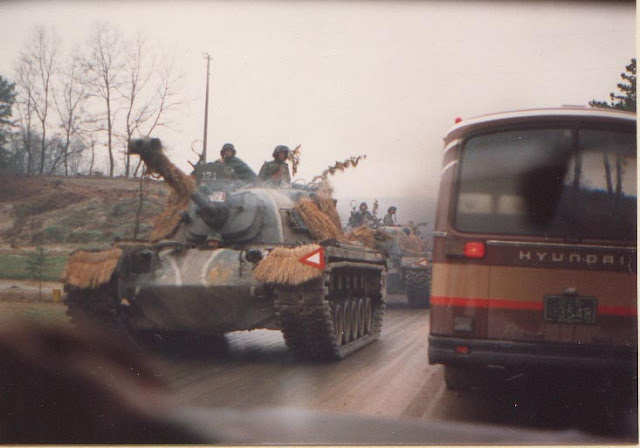
South Korean Army M48, March 1987.

The third US tank in a row to be named in honor of Gen. Patton, the M48 featured the new familiar Pershing chassis but omitted the bow machinegun, the first main U.S. tank to make that omission.  It was in fact an entirely new design, obviously based on the old M26 lineage, and was an enormously successful tank.

M48 Patton in South Vietnam.

The M48 would be the principal US tank in the late 1950s and go on to see heavy use by the US and its allies for many years.  It was the tank the US principally used in Vietnam.  The last variant of it, the M48A5, was sufficiently close to its successor, the M60, that it was up-gunned to the 105mm gun the M60 used and it can be very difficult to tell the two apart.  Indeed, the M48A5s actually replaced the M60 in service with the US Army and South Korean army in Korea in the late 1970s, showing how close they really were.

M48A5, equipped with a 105mm gun and much resembling its successor, the M60.

The Turks use smaller numbers of the GERman Leopard 1 and 2.

The Leopard I

The Leopard I?  That's a post war German tank.
 Later variants of the Leopard I in Germany.  This one has been up armored. The original Leopard Is were fairly lightly armored.  Let's see, six wheels that look remarkably like the six on all of the Pershing descendants. .. rear sprocket drive like the Pershing and its descendants, roller wheels to support the treads up on top (not visible here. . . . hmmm.

Yep, it is.

Inclusion of the Leopard I here is going to make its fans angry, but the Leopard I resembles the M48 more than it does any German tank of World War Two, something that isn't true of all post war German equipment.

One of the most famous of the post war tanks, the Leopard I came in after West Germany had been equipped with M47s and M48s.  Wanting to field its own design, West Germany first worked with France to come up with a tank design and then abandoned the pursuit. Going on its own, it came up with the Leopard I.
 Earlier variant of the Leopard I with a cast turret that looks remarkably like that on a M46/M47/M48.

You will not be able to find (or at least I couldn't) anything that will claim that the Leopard I was based on part on the Pershing tank chassis and the M47 and M48 tanks.  But the similarities are remarkable.  Most notably the chassis is nearly identical. something that departed enormously from all prior German tanks.  The original turrets were also remarkably like those of the period M48s.  Perhaps, just perhaps, there was no influence, but that would certainly counter they way they looked at the time of their introduction.

The Leopard 2 is still a front line tank in many armies and the last German tank to be introduced.  It's a contemporary design to the M1 Abrams.  The Turks have about 350 of them, about the same number as Leopard 1s. While I can't say, I'd be surprised if they deployed them in Syria for the same reason that its not surprising that we didn't deploy M60s to Vietnam.  No reason to send in your most modern tank where its not going to encounter another tank.

The Turks are currently building their own tanks, but they just started. The Altay Turkish tank reflects a global trend of nations once again building their own armor, rather than importing it, a return to past practices.  The Altay is based on the South Korean K2 Black Panther, which also reflect that trend. But the Altay just entered service.

Reliance on German weapons is something that the Turks have done since the Ottoman days.  At some point Turkey ceased to be an international weapons shopper when it was still the Ottoman Empire and became a German client.  For that reason it fought World War One with German designs.  In the Interbellum it still used them, and when the Germans took Poland in 1939 the Turks took quite a few unfinished Polish 98 Mausers and finished them themselves.

After World War Two the Germans were briefly out of the weapons business, but when they returend to it Turkey returned as a customer of its small arms. While Turkey has a vareity of odds and ends in small numbers, the G3 and the MG3 are its main infantry squad weapons.  If you see a Turkish soldier armed with something else, there's a reason for it.  Both are excellent weapons and ideal for the conditions they're being used in.  Both date back quite some time now, although neither could be considered obsolete.  Only in pistols does Turkey really depart from pattern here, using a locally produced variant of the Baretta 92F, which of course itself is based on the Walther P-38.

Artillery wise, Turkey uses a smattering of things, but those things include a lot of Cold War era American artillery pieces, including the M110, which is something I'm pretty familiar with from my earlier days.
The M110.

Aircraft wise, Turkey has been an American customer and its primary combat aircraft is the F16, made under license in Turkey.  Turkey was going to buy F35s, but a purchase of Russian anti aircraft missiles caused the US to cancel the deal. This in fact has been emblematic of recent problems between the US and Turkey, as Turkey has flirted with looking East after the US pretty much ignored the problems created by Turkey shooting down a Russian airplane flying out of Syria awhile back. 

I frankly doubt Turkey will continue to look east. ..  in that fashion.  There's a huge Central Asian Turkish population to Turkey's east and Turkey can't ignore that and Russia is unlikely to do so.

Turkey also isn't ignoring the Kurds, of course, which gives us the reason for the current Turkish offensive in northern Syria, an action which the Syrian government is taking advantage of, and that takes us to the Kurds.

Kurdish combatants have long been users of the AKM, which people commonly imagine to be the AK47.  This is a remnant of the days in which the various Kurdish militias fell on the leftward side of the Cold War map and therefore were entitled to Soviet aid, one way or another.  The Kurds, as a result, are heavy users of old Soviet weapons.

More recently they've benefited from American and German assistance so they have a variety of old and new weapons. From the US they've acquired M4 carbines, and from Germany G3s and G36s.  They possess anti tank missiles as well, but in terms of heavy weapons, they are lacking.

All of which goes to make the current fighting between the Turks and the Kurds, in which the Kurds will give a good account of themselves but lose, an odd late Cold War feel to it.


An actual reason, if not a necessarily a moral one, or even a good one, to stand aside in northern Syria. . . Realpolitik

But there's a catch to it.

Kissinger.  He probably wouldn't have stopped the Turks either. . . but he wouldn't have gone into Syria in the first place and he wouldn't have offered the Kurds false hopes.  Shoot, he'd have made it look like we were doing the right thing, even if we weren't.

Turkey has been our ally since 1945. Technically, but fairly hypocritically, Turkey became an American ally when it declared war on Germany in February 1945.

Turkey never fired a shot in World War Two (making Donald Trump's line about the Kurds not being with us in Normandy all the more odd).  And Turkey was courted for most of the war by the Germans.  Turkey didn't enter World War Two as it guessed German chances correctly, which didn't mean that it was our pal.  Rather, Germany had been close to Turkey since the Imperial German and Imperial Ottoman days. The fall of the Kaiser and the Emperor hadn't disrupted that.

And Turkey both had designs on Turkish Central Asia and feared the Soviet Union, which it had good reason to do.  There's little reason to doubt that if the Germans had entered Moscow in 1941 and pushed the Soviets over the Volga at Stalingrad in 1942 the Turks would have entered the war and crossed the Soviet frontier, taking Soviet Central Asia.  But Ataturk and his men had a better historical memory than Hitler and his cronies, and the Turks weren't convinced that the Soviets would fall.

They also weren't convinced that they wouldn't cross the Turkish frontier in 1944 or 45, so they threw in with the Allies at the bitter end to help avoid that.

After the war the Turks sided with the west as it feared the Soviets, and rightly so.  Turkey fought with the United Nations in Korea.  It was a steadfast NATO and American ally against the Soviet Union.  It allowed the US to position nuclear missiles on its territory in the late 50s and early 60s.  It allowed U2 flights to take off from its airfields and cross its frontier into the USSR.

And it might be a useful ally against the Russians today.

All of that is highly cynical.  Turkey has gone from being a country basically ruled by its military, which possessed a veto power over its civilian government, to a shaky democracy with an Islamist prime minister.  As its done that, it's been less and less friendly to American positions in the world, but the relationship remains.

Presuming that Turkey doesn't fall into being an Islamic republic, and take the same path as Pakistan or, worse yet, Iran (and it probably won't), the alliance between the two nations could remain useful.

But that means that the United States has to accommodate itself to Turkish suppression of the Kurds. Or at least it might.

Playing both side of an alliance; being an ally of a sovereign nation and opposing its armed foreign positions can be done, but it's really tricky.  Dwight Eisenhower followed by John F. Kennedy did that in regard to the French in Algeria, whom we did not support even though they were a NATO ally.  Eisenhower also managed that in regard to Israel, France and the UK during the Suez crisis, telling those nations close to us not only that they were on their own but that they had no business intervening in Egypt.  And the US sort of managed that with the UK in Ireland, although never in any official sort of way.

Maybe we could pull that off in regard to the Kurds, who deserve their own state, and a state that would make Turkey a smaller one. But that would be really tough.  That worked in regard to Ireland only because the British were headed in that direction anyhow, and they judged an ongoing relationship with the United States something not to be disrupted.

Which is part of the reason that you need to think out your interventions before you get in.

When we went into Syria, there was no way that we weren't going to end up supporting the Kurds there. After all, we had done that very thing with the Kurds in Iraq.

And that was always going to make Turkey highly uncomfortable.

So at that point, you really have to ask, do you value Kurdish liberty over Turkish support against the Russians, if you need it?

If you don't ask that question, you're going to end up blowing something. Either the Turks become enraged with the US, or the Kurds do.

Make no mistake about it.  We have betrayed the Kurds. And we didn't even do it in the Machiavellian Kissinger way of selling somebody out while pretending we aren't.  We've done something wrong.

And that error started when we didn't think out Syria well in the first place.

And perhaps now, all the damage that can be done, has been.  We've betrayed the Kurds and the Turks have already started to become a shaky ally. So nothing has been achieved.

What about Fruit? Foods, Seasons, and our Memories, Part Two. A Hundred Years Ago.


Central Pacific Fast Fruit Train, 1886.

I just posted this item on vegetables and how seasonal they were.
Lex Anteinternet: Foods, Seasons, and our Memories. A Hundred Year...: The last garden I put in, 2017. Another interesting entry on A Hundred Years Ago. The Last Fresh Vegetable Month I've touched ...
In that I noted that it was apparently the case that they were not transported by rail.*

Originally I planned on dealing with fruits and vegetables.  But I ended up limiting it to vegetables for the most part.

Let's start with the obvious.  Fruits native to higher latitudes are pretty limited, globally.

They aren't wholly absent.  Apples, for example, do grow pretty far north.

Oranges, however, do not.

Let's also add something that's generally not pondered, that being that where fruit grows today is the product of introduction.  Almost every fruit you can think of that we deal with commonly isn't grown today, even if that's just in your backyard, in the area from which it is originally from.

In our current era there's a big movement to be fearful of Genetically Modified Organisms, or GMOs. Truth be known, however,  in terms of plants, unless you are eating a highly local diet purely of what grows there naturally, you are eating GMOs.  They're GMOs that came about due to selection of characteristics, and that's farmer selection, not the natural selection that's a feature of evolution.  We don't recognize that as its been going on so long.

Apples we mentioned above.  Apples are interesting in that they're spread around the globe now and in a zillion varieties.  There are apple groves all over.  But apples are originally from Central Asia.  They've spread everywhere from there, thanks to humans, as we like apples.

Even the word "apple" is interesting in this context.  Apple is a cognate of the German word Apfel, and that word is one of the words we know to have been passed down from Indo European.  It's an ancient, ancient word.  It predates history.  We don't know, however, if the word referred to apples. The better guess is that it just referred to any kind of fruit.** The fruit early Indo Europeans were eating aren't well known today.  They could have included apples, but more likely were pears, which have a gigantic natural distribution.

The point is that everything we write about, or experience, is in some ways defined by the era.  This blog focuses on the 1890 to 1920 time frame, although it dabbles in everything else and every other era.  But when we're speaking of food in these recent posts, we're dealing with the early parts  of our own era, and going back about a century or so.***

If we go back further, we're dealing with a much different set of circumstances.  If, as an example, we're dealing with Bob CroMagnon in the year 10,000 BC, well we're dealing with highly local foods, rather obviously.  If we're dealing with the year 1774, however, and talking about the North American East Coast, we're already talking about a highly altered food landscape with lots and lots of foods being grown and consumed locally that weren't natural.

Put another way, when you or your predecessor go out in your backyard in the 42 deg North region in North America, and pick an apple or perhaps a pear, you are picking a non native, and frankly highly selectivised fruit.  Jonathon Apples weren't here when Columbus showed up. . . for that matter they weren't here when the Vikings showed up either.

Neither, of course, were a lot of other things you eat.

Diverting a bit, none of this is intended to pick on locavores.  Rather, it's to point out that even a less resource intensive or a more "natural", or agrarian, lifestyle still makes use of a lot of consumables that didn't originate here.****

Anyhow, as we've already dealt with, in the winter months in the upper half of North America, the fresh vegetable season ended in October.  And as I've also addressed, I know that fresh fruit was quite restricted during the winter months most places.  Indeed, a common memory for people my parents age was getting fruit for Christmas.  My mother recollected that for Christmas she normally got a book and some fruit, and she thought that a pretty good Christmas.  The 1964 Valdez Alaska tidal wave was so devastating as young people had gathered at the docks to get fruit from ships that came in, something they traditionally brought that time of year as a gift.

That resulted in the horrible loss of life, but in terms of what we're observing, there is no earthly way that young people today would gather at the docks to get oranges.

It just wouldn't happen.

I note all of this as its clear that transportation of fruit isn't what it now is, but that some of it did occur.  How much, I'm not sure. So little that it did make the gift of fruit a real gift, but enough so that in Montreal you could get it.

So clearly a closer look was in order.

In looking up this topic I ran across one fruit company advertisement from the 1910s or 1920s (I'm not sure which, but likely the 20s) depicting a young woman with a hitched up skirt, posing with an orange.*****  On the advertisement wast the logo of the Union Pacific Company.

And that reminded me of the Pacific Fruit Express.

All of which means I may have been partially in error.  Or maybe not.  Or maybe partially.  Or not at all.

It's one of those things I don't know, and which is surprisingly hard to learn about easily.  I'm sure it could be fleshed out, but not in an easy net sort of way.

The story, apparently, of the fast rail transportation of edible vegetation starts with oranges and California.  Oranges were grown early in California with the planting of orange groves at Catholic missions in the state early on.****** Commercial growing of oranges commenced in the state in the 1840s and the arrival of the transcontinental railroad in the 1860s was exploited almost immediately by fruit growers, who shipped iced fruit back east, which was at a bare minimum already well known as a method of preserving fish.  Coincidentally this same technological development coincided with the invention of the railroad refrigerator car, which we've dealt with elsewhere. As we've seen here already, the refrigerator car lead to the rise of the beef industry in a very rapid way, changing American's diets in that regard, and it lead to the rise of large scale breweries as well.

It also lead to the rail transportation of fruit.

By the 1870s, hybridization of oranges had lead to new varieties and oranges became sort of a national mania.

By the 1890s this had become such a big deal that t he state entered its "Orange Era".  The Santa Fe exploited citrus by introducing a large fleet of fast refrigerator cars to move citrus. This lead the Southern Pacific and the Union Pacific to combine to create the Pacific Fruit Express in 1906, which grew to be the largest refrigerator rail car leasing entity in the world.^

Grapes being loaded into refrigerator car in 1923.  Predictably, this scene is from California.

Having refrigerator cars already, Armour, the meat packing company, soon entered into competition with Pacific Fruit Express.  The Sherman Anti Trust Act intervened, however, and Armour had to divest itself of its fruit shipping branch, which lead to the creation of the Fruit Growers Express in 1919.^^  It merged with Great Northern Railway into a new entity in 1923 designed specifically to compete with the Pacific Fruit Express, emerging as the Western Fruit Express.


Refrigerator car being loaded with strawberries, 1939.

So what this tells us is that by 1900 shipping fruit by rail was already a big deal and becoming a bigger deal.  If fruit was shipped this way, logic would hold that other produce also was, but it's exceedingly difficult to find any reference to it or photographs of it, which leaves doubt as to how common it was.  Seemingly not very, if it occurred at all.

But fruit was definitely being shipped in that fashion.

So why was it regarded as a treat?

I'm not really sure.  Some of that may have to do with economics of earlier times.  And some of it may be that we now live very much in the "cheap food" era.  If we go back a century or so, that wasn't the case and there were no governmental incentives or directives to keep food cheap, which now there is.  That's something that really was an offshoot of the Great Depression but more than that agricultural policies that came out of it and into full fruition during the 1950s.^^^

It's also, as we have seen, a byproduct of transportation.

We've clearly seen that in regard to the impact of railroads upon food, starting with our earlier look at refrigerator cars and meat and refrigerator cars and beer.  Now we've looked at in regard to refrigerator cars and fruit.  Railroads, during the time we're discussing, were the only fast way to move anything, but it's also the case that the time period we're discussing saw the onset of a major effort to improve roads and to create an interstate highway system.  That pioneering effort had started some time ago, but the 1919 Motor Transport Convoy really put it into focus.  Even something like the 1919 Air Derby, which we've also been reading about, did as well.  In 1919 the highways remained primitive most places, a recent Casper paper here reported on somebody's trip to Denver taking 16 hours by car, for example. But they were about to be very much improved.  As that occurred, the trucking industry would start to make its appearance, giving the railroads competition in everything. Once that was fully established, everything became to change in the produce world.

The first refrigerated truck trailers, cooled by ice, came in during the 1920s, so we're on the cusp of that now in terms of the focus of the blog.  The first mechanically cooled truck trailers, came in during the 1930s, and that's a huge deal.  Once that occurred, the ability to transport cooled vegetables really advanced.  Now, of course, this has developed to where trucks have replaced trains entirely, at least for the time being, shipping right to the grocery store.

What we didn't address, however, and need to, is reefer ships.  We don't think of refrigerated ships being part of this picture but they are.  By 1876 the mechanically cooled reefer ship had come about and had already taken a load of meat from Argentina to Europe.   By 1899 refrigerated ship deliveries of fruit to the United states were over 90,000 tons per year.  Prior to World War One the United Fruit Company had already introduced refrigerator ships, some also hauling passengers, to ship its produce globally.


*I also linked this in to our companion blog on railroads, in case my assumptions about rail transportation are in error, fwiw.

**FWIW, another long surviving word is "Bear".  That says something.  The Indo European word "apple" having survived so long due to people liking fruit and needing to eat.  Bear, on the other hand, is still around as bears are dangerous.

***I know that is popular to talk in terms of "modern" vs. "post modern". Well that's a load of crap.  When historians look back two centuries from now, 1890 is going to be part of the same era you are living in right now.  We'll deal with that some other time, but the whole post modern thing is the age old phenomenon of people defining any era they live in as the best of all times, or the worst of all times, or both at the same time.

****As an aide, just recently the Tribune ran an article on a fellow, and some of his disciples, who really, really eat local, and have for a long time.  The individual, dating back to the 1970s, pretty much wondered around the Red Desert making use of what's available there.

*****Early orange advertisements, or at least those of the 1910s and 1920s, are exceedingly strange which is why I haven't posted any of them here.  They seemed divided, basically, into three categories.

One of them featured Western scenes, such as cowboys, even though cowboys aren't noted for their orange consumption. The only example of such advertising I've seen in person is of that type, featuring a hard working cowboy, his cowboy pushed to the back of his head, admiring an orange.

Another type, however, featured young women.  Some just featured young women, but some featured young women in alluring poses.  More than a few featured young women who were barely dressed. All of this is really an unmistakable attempt to sell oranges based on something other than oranges, but why?

A third type featured Plains Indians, who are not noted for their orange consumption.  Of course, oranges aren't native to North America at all, so it'd be really unlikely that a Sioux warrior would pop up over a hill and observe an orange grove.  But that sort of depiction was common.

A hybrid type featured Indian women who had lost part of their clothing. That's odd in and of itself but semi nude women were common in advertising art prior to 1930 and therefore perhaps that's not as odd as it might seem.  It is odd, however.  It's sort of bizarrely imperialist in fact.

Attractive Indian women linger on, albeit barely, in advertising in two ways.  The Land O Lakes dairy entity, a cooperative, still features their very early advertising logo of an attractive, but at least fully clad, Indian woman, even though Indian women of the era depicted would have found any dairy product unusual.  The Navajo Trucking company still features its attractive stylized Indian woman on the doors of their trucks, in a very much post World War Two, pre 1960, type of illustration.  I'm particularly amazed that the latter logo, and indeed the company name, haven't changed.

******While California today is desperate to deny it, and while its fairly clear the problems in the state have eclipsed its rise and its in a state of continual decline of all sorts, California owes its existence to Catholic missionary endeavors.

It owes its modern existence in part to mining, which is rather obvious, and partially even to oil exploration, but overall, very much to agriculture.  In that sense, modern California is an example of the "tragedy of the Commons" written large.  It's still a major food producer, but its also built over and paved over its base industry to a shocking degree.

^Rail cars are often leased, rather than owned.

^^That year again, 1919.  It's amazing how important of year 1919 was in all sorts of ways.

^^^We're so used the there being certain Federal departments today, such as the Department of Agriculture and the Department of Education, that we tend to think they must have always existed.

The Department of Agriculture was actually created in 1860s, although some of its duties had bounced around in the Patent office prior to that.  The Department of the Interior, therefore, very much predates the Department of Agriculture in any form.  It didn't become a cabinet level department until 1889, almost the era that this post deals with.

That's significant for a lot of reasons, most of which we'll skip for the time being.  Worth nothing here, however, is that the Federal government became hugely interested in agriculture during the 1930s, due to the Great Depression.  Lots of programs sprang up at that time designed to deal with farm relief and environmental conditions that the 30s demanded.  Not all of those were successful by any means.

The Depression was followed by World War Two which created a massive strain on the county's food production.

And that was followed by the Cold War and the 1950s, which started a really odd era of "get big or get out" that was partially fueled by Cold War fears, partially fueled by the "cheap food" policy of the era, and partially fueled by apocalyptic food scenarios that the government feared. We still live in that era as its become institutionalized, although in terms of direct involvement, the Federal government has much reduce its activities.

October 11, 1919. Air Derby, Disasters At Sea, Strife in Russia, Newspapers by Air.

Lt. B. W. Maynard, right, in front of a DH-4.  Sgt. Kline was Maynard's mechanic and in the second seat. This photo was taken during the Air Derby.

The press was taking an interest in a particular pilot, B. W. Maynard.  Maynard was an Army aviator, but the press liked the idea that Maynard was an ordained minister, which he was not. Rather, prior to World War One, he had been a seminary student at Wake Forest.


Maynard had become an Army pilot during World War One, and he was still flying in 1919, just after the war was over.  He was killed in 1922 preforming stunts in a "flying circus" event.


Too much was going on, on this day, otherwise to really summarize it. Even the headlines of the papers were a mess.


One new oddity was, however, that the Casper Herald flew newspapers to Riverton, showing how much the Air Deby had captivated the imagination of the state.


Thursday, October 10, 2019

The Secondary Waves of the Great War.

World War Two, for obvious reasons, looms large in our imagination as the biggest event of the 20th Century.  The biggest, and the most significant.

But are we wrong?  

It seems lately that the echos of World War One are resounding pretty loudly.

World War One smashed the old order and demolished the borders of centuries.  The interbellum tried to reconstruct them, but did so in a metastasized and imperfect form, giving rise to new malignant orders that sought to fill the voids left by the death of the old imperial ones.  World War Two pitted three forces against each other, fascism, communism, and democracy, with democracy and communism ultimately siding with each other against fascism. After the war, the results of the Second World War gave rise to a contest between the two victors, communism and democracy, against each other until the vitality of free societies and free markets drove the rigidness of communism to and beyond the breaking point.

And now that communism is dead and gone, buried alongside its evil cousin fascism, the old unsolved questions of the Great War are back.  The rights of small nations, including those with out countries, against the possessions of older larger ones.  The demise of great empires giving rise to smaller ones.  Nationalism of all stripes against everything else.

It's 1919 all over again.

Turkey didn't sign the Treaty of Sevres.

Indeed, rather than do that, it fought it out.

It can't be blamed.  The Greeks had a quasi legitimate claim to Smyrna, but only quasi. A lot of ethnic Greeks lived there, which is no surprise as Anatolia had been Greek. The Ottoman's were invaders to the region, finally taking it in the 1450s.  But it had a large Ottoman population that they were bloodily brutal towards and they engaged in conquest, with the help of their Western allies, in Anatolia proper, seeking in a way to reverse what was lost centuries prior.

The Italian claim, moreover, to islands off of Turkey was absurd.

But the Armenian claims to their lands weren't.

The region sought of Armenia marked for a plebiscite is Kurdistan.  The Syria that ran to the sea and down to Palestine was an Ottoman province carved away from the Empire.  So was the Mesopotamia, i.e., Iraq, that appears on the map.

In 1990, the United States intervened in the Middle East to force Iraq, the British post World War One creation, out of Kuwait, a desert province that the British had protected during their stay in the Middle East, launching operations, with the assistance of others, from that region of Arabia named for the Sauds, that Arabian family that spent the Great War and the immediate interbellum consolidating power at the ultimate expense of the Hashemites, that Arabian noble family who had made war on the Turks.  The British dolled out kingdoms to that family as consolation prizes, with the Hashemites taking Iraq and the Transjordan.  The French got to administer Syria, a region that it claimed an historical affinity to, with the British taking administration of Palestine and Egypt, both of the latter having been Ottoman provinces although Egypt was long administered by the British in an arrangement that nobody can possibly grasp.

And so now, the old fights, and the interbellum struggles, reappear.  The peoples not accorded nations would like to have them. The old empires would like to keep their domains.  Borders drawn by European nations, with the help of Woodrow Wilson, are treated as real, when perhaps they were never correct.