The Philippine House of Representatives voted to approve a resolution calling for a plebiscite on independence for the U.S. Territory. It was vetoed by U.S. Military Governor, Leonard Wood, but the legislature overrode the veto and the measure then went to the final consideration of U.S. President Coolidge, who vetoed the measure the following year.
The US and UK entered into an accord to address alcohol smuggling.
Ad from the Sheridan newspaper, December 31, 1945.
December 31, 1945, marked the first peacetime New Years in much of the world, although not all of the world was at peace.
1945 marked the end of what we consider the oddly nostalgically recalled, but undeniably bloody, 1940s. It's the operation of Yeoman's Eleventh Law of History, which provides:
1945 was the end of World War Two, and the beginning of the post war era, and era which we still live in. It was the penultimate year of the 1940s, and to some degree, the penultimate year of the long 20th Century.1 It was the year that the Second World War ended with a massive technological nuclear flash, but it was also the year that featured the bloodiest fighting in a unified war that began as a series of wars in 1937 and 1939.
The end of the Second World War determined, or seemed to determine, questions that had arisen with the end of the Great War in 1918. World War One had caused the death of the old order in much of Europe, an order that saw aristocracies dominate in varying degrees in many of the European, and indeed international, states. The strain on the old order was obvious even before World War One, but it remained strong nonetheless. The Great War killed it.
The death of the old order did not answer the question of what would replace it. Every nation that fought in the war, however, would see immediate political evolution due to the war, with all of it reflecting forces that had been at work before the war. In functioning democratic countries with stable governments, that resulted in an expanded franchise. The UK extended the vote to entire classes that had not had it before the war, allowed Ireland to go independent, more or less, allowed its dominions to be actually independent, and extended the vote to women. The US extended the vote to women and soon made Native Americans citizens, with new states being admitted to the union prior to the Second World War. Canada and Australia obtained true political independence.
In countries that had strong aristocracies that opposed democracy, however, radical elements of the far left that had been underground to some degree leaped forward, the prime example being Imperial Russia, which became the Soviet Union. As forces of the far left advanced, finding a great deal of support in in the formerly disenfranchised working class, forces of the far right appealed to the same base and to conservative aristocratic classes, crushing democratic forces in between, as in Germany, where the Nazis gained power. In unstable democracies without long histories of democratic behavior, forces of the left and the right contested for total control, as in France, Italy, Spain, Japan, and Mexico, with democracy faltering in many to some degree, sometimes totally.
World War Two was not, as some like to claim, a continuation of World War One, but rather a violent sorting out of the democratic, anti democratic, and populist forces it had unleashed. Starting in the late 1920s it seemed that the question the world was faced with was whether the future was democratic, fascist or communist. The Second World War determined, at least it seemed, that the world would not be fascist, but left the question of whether it would be communists or democratic undetermined.
Determining the question was bloody on a scale that we can no longer even imagine, although in terms of human history it was not all that long ago. The expenditure of lives in the war by all contestants was enormous, with the fascist and the communists states freely willing to waste the lives of men, and the democratic ones emphasizing technology where they could. All the combatants, however, acclimated themselves to conduct that at least the democratic ones would not have tolerated prior to the war, with mass bombing of urban targets being the most notable. By 1945 the US, arguably the most moralistic of the combatants, was willing to engage in fire bombing and ultimately the atomic bomb to bring the war to a conclusion.
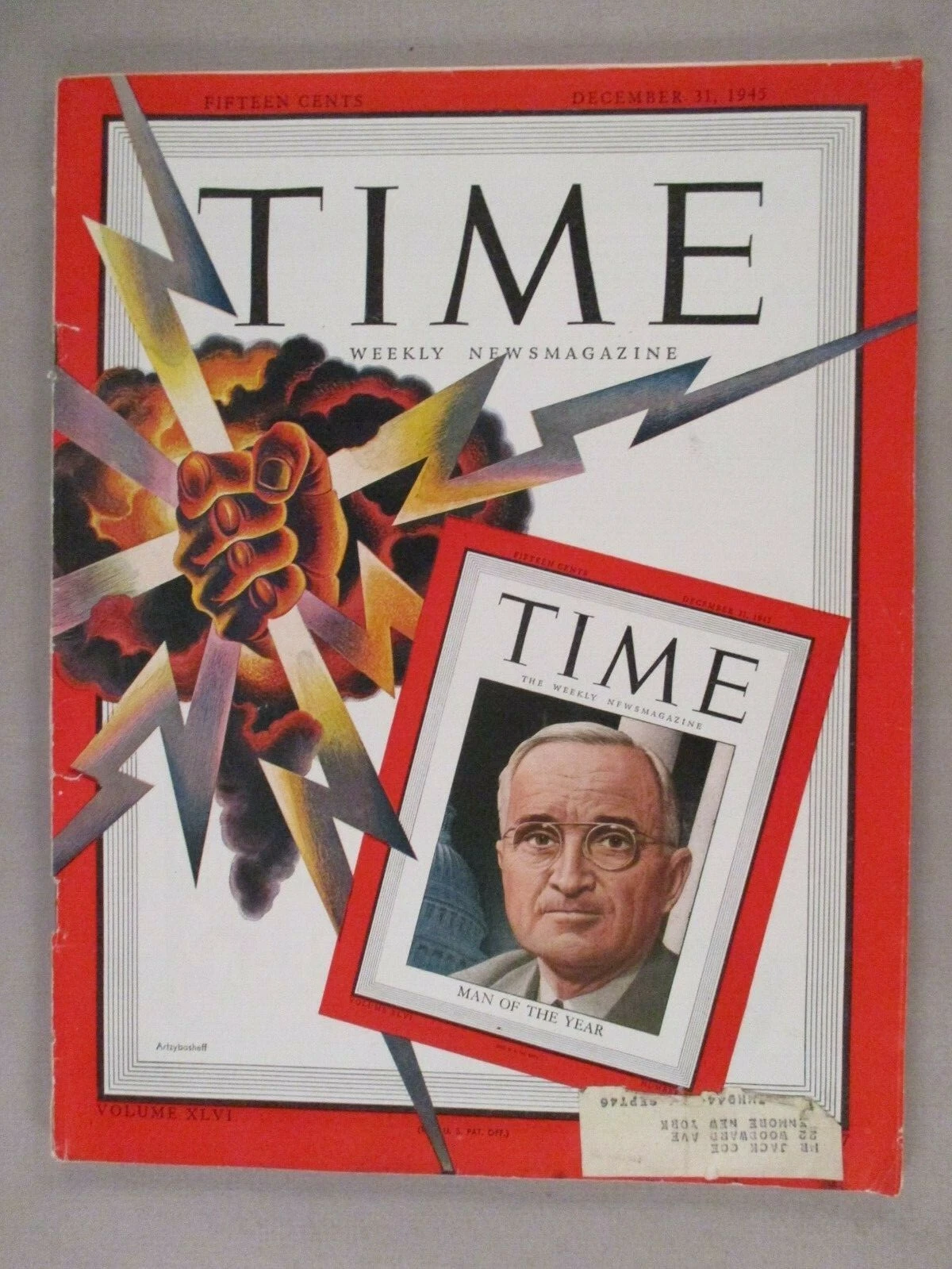
Truman as Time's Man of the Year, posted under fair use exception.
The significance of the atomic age, contrary to the way things are currently remembered, was appreciated immediately. Truman was Time magazine's Man of the Year, pictured in front of a fist grasping nuclear firebolts. Newspapers, even by late 1945, were pondering what atomic warfare would mean.
We've argued it here before, but the Second World War created the modern United States, and more than that, modern American culture, in both good, and bad, ways.
Tire rationing came to an end on this day in 1945.
The most oblivious, at first was the change to the economy, which was little understood. Pent up consumer demand dating back to the start of the Great Depression meant that the country did not slide back into the depression as nearly all Western economist had feared. Adding to this, however, was the fact that none of the European industrial powers, along with Japan, had not suffered some level of industrial destruction. The U.S.'s industrial base was not only left intact, it had expanded. Only Canada could claim to enjoy the same situation, although its economy was much smaller. American workers took advantage of the situation nearly immediately with a wave of strikes demanding higher wages, strikes that were in fact largely successful. The economic golden age that current Republican populists imagine to have existed in the past reached its most pronounced form in the 1950s which is still looked back upon fondly, if inaccurately, in the same way that singer Billy Joel imagined it to have been in his lamet Allentown
Well our fathers fought the Second World War
Spent their weekends on the Jersey Shore
Met our mothers in the USO
Asked them to dance
Danced with them slow
And we're living here in Allentown
The obliteration of European industry created the illusion of some sort of American economic uniqueness that remains to this day and which the country is presently attempting to sort out by restoring it, which will not and cannot work. Part of that also involves an imagined domestic perfection that doesn't' reflect what was going on in reality either.
Prior to the Second World War the domestic culture of the United States was different in nearly every fashion. Even the horrors of World War One had not changes that. Most Americans lived closer to the poverty line than they do today, even if most Americans lived in families. Most Americans did not attend college or university, and most men didn't graduate from high school. There was a minimum of surplus wealth on the part of the average, although that had started to change by imd 1920s, only to be retarded by the Great Depression. Most people did not move far from home. Most men and women married people who grew up near them and were part of the same class and religion, although a surprisingly large lifelong bachelor class existed, particularly in certain occupations.
The war changed nearly all of that, and even during the war itself.
The first peacetime Federal draft in the nation's history took thousands of young men away from their homes starting in 1940 and 41, and of course became the major wartime draft that continued on until after the war, and with some hiatus, basically until 1973. The country would not have tolerated a peacetime draft prior to 1940, and barely did in 1940 and 1941. The country's views on the military, which prior to the war was sort of a type of disdain but acceptance of it as necessary, as long as it was small, completely changed during the war so that by the war's end the concept of a large peacetime military was fully accepted, and even admired, although that would be disrupted again due to the Vietnam War for a time.
Prior to the war, soldiering was, for enlisted men and junior officers, a bachelor occupation with servicemen largely looked down upon as lazy. The enlisted ranks often contained large numbers of immigrants, although that is still true. After the war, the view of servicemen, many of whom for decades were conscripts on relatively short enlistments changed radically.
The expectation of marriage changed as well, even at a time that wartime marriages came into periods of great stress. Prior to the war a fair number of blue collar workers and nearly all non owner agricultural workers were lifelong bachelors.
Cowboys Out Our Way from December 31, 1945. The two working hands are discussing "Sugar", their former ranch cook, who just married a rich widow, and Stiffy, the oldest cowhand on the ranch.
This ended after the war for a variety of reasons, one simple one being that entire classes of men who had never really lived any other life now had seen at least much of the country, and some large sections of the globe. Men who had planned on a life of working on the farm or ranch and living in a bunkhouse no longer found that appealing and no longer believed they had to do that. For those who returned to their states of origin, and huge number of them did not, this often meant taking up a job in towns and cities, rather than in fields. Quite a few used the GI Bill to advance an education that benefited them at a time in which a university education guaranteed a white collar job. Regions that had large reservations found that many returning Native American veterans chose to live in towns and cities near the reservations they were from, rather than on them where living conditions remained comparatively primitive. Lots of men married who would not have otherwise. The average marriage age notably dropped for the first time in decades and remained depressed in the 1950s.
Lots of couples got divorced in fairly quick order as well.
This was because of a "marry in haste" situation that had broken out during the war. Couples who figured that the male's chances of surviving the great blood letting were fairly slim and were willing to accordingly gamble, where as previously they would not have been. Moreover, many of the couples that married were of different backgrounds and different regions of the country, and not the literal "girl next door" so often portrayed. A really good portrayal of the this sort of situation was given in the brilliant 1946 film The Best Years of Their Lives, which gave a dramatic, but fairly accurate, examination of the domestic situation of the post war years. Of note, 1946 also gave the country It's a Wonderful Life, which really portrayed the prewar, not the wartime or postwar, domestic ideal.
The amazing film The Best Years of Our Lives which captured the immediate impact of World War Two on Americans.
It's a Wonderful Life, also released in 1946, but which really portrayed the nature of American life from the 1910s until the late 1930s, although it was set in 1946. It's gone on to be a sentimental Christmas classic.
The Best Years of Their Lives also depicts fairly heavy drinking, and not in an accepting fashion, but in a relatively realistic one .That was also something that the war really brought in. Returning veterans were often very broken men, and alcohol abuse was an enduring feature of their lives, along with chronic cigarette smoking. This bled over into the culture in general and an increased acceptance of heavy alcohol use became common, and indeed is something often featured in post war films in a routine fashion. Men who had endured killing on a mass scale often never really adjusted back to a normal life, and resorted to the bottle in varying degrees.
At least by my observation, some of these men became downright mean. We hate to say that about "The Greatest Generation", but it's an enduring theme of the recollections of many of their children. Alcoholic fathers who were extremely demanding on their male children seems to have been routine. Again, by my observation, many of the same children, who went on to rebel during the 1960s, returned to their childhood roots and became mean demanding fathers to their own children, making World War Two the domestic abuse gift that keeps on giving.
While certainly most returning veterans did not become mean, or abusive, it has to be noted that the Second World War started the country off on a destruction of the natural relationship between men and women we're also still dealing with.
Not since the American Civil War had so many young men been taken away from their homes and never in the country's history had so many young men been kept in the company of young men overseas. War involves the ultimate vice, the killing of other human beings, and all other vices naturally come along with it, in varying degrees by personality, and by military culture.
All wars involve the abuse of women, the most spectacular example during the Second World War being the mass rapes, often accompanied by murder of the victims, by the Red Army late in the Second World War. There are some examples by Western armies as well, but they are much smaller in scale. Also notable, however, was the largescale outbreak of prostitution in Europe, some of which was conducted nearly publicly in places that would never have tolerated it before the war. Economic desperation caused much of it in some areas, which included underaged European women prostituting themselves in some instances and the military simply accepting it.2
Bill Mauldin in 1945. The diminutive Mauldin appeared a little younger than he actually was, being 24 years old at the time of this photograph. Indeed, Mauldin strongly resembled, oddly enough, Rockwell's Will Gillis depiction of an average GI. Mauldin's appearance contributed to a public view of the cartoonist that fit very much in with the public's image of "fresh faced American boys" in general, but he'd already lived a hard life by the time he entered the service. She son of New Mexican farmer/ranchers who were partially native American, Mauldin's early life had been somewhat chaotic and his teenage years were more so, being somewhat on his own by that time and living a somewhat odd life by the time he was in high school. While Mauldin is associated with the typical GI, his status as a member of the staff of two separate Army newspapers lead to an atypical existence including have a teenage Italian mistress when he was in Italy. In some ways Mauldin reflects the best and the worst of Army life in his cartoons and for that matter in actual service life.
Even where not completely sordid, plenty of misconduct occurred in all of the ranks. This is depicted in the recent series Master of the Air with at least one of the affairs depicted actually having occurred. In fictional form, it's portrayed in 1956's The Man In The Gray Flannel Suit.
The Man In the Gray Flannel Suit from 1956, but which starts off in World War Two and the moral failings in combat of the central character, including the violation of his marital vows.
This was bound to have some impact on the wider culture, and we've argued that it lead to the wider acceptance of the objectification of women. Indeed, thousands of men became acclimated to the centerfolds in Yank during the war, making the introduction of Playboy in 1953 not all that much of the big leap as its claimed to be.
Playboy often gets credit for firing the open shots of the disastrous Sexual Revolution, but it can be argued that Yank did. At any rate, by the wars end, millions of men had served in places were morality of all types was at a low ebb, and had ogled the girls in Yank, and perhaps painted topless or nude figures on government aircraft. That this would have some effect, particularly later when bogus sex studies were released as scientific texts, isn't too surprising. The major erosion of the natural order between men and women that came into full fruition after the late 1960s had some roots that went at least as far back as the 1910s, but World War Two gave it a major boost.
The war also gave a major boost to automobiles.
Prior to the war, and during it, the US relied on rail transportation. But new types of automobiles, notably 4x4s, were introduced during the war, and cars overall simply improved. By 1950 it was clear that road building and automobiles had become a major American obsession, spawned in part by the heavy road use, in spite of automobiles, that occurred during the war. 4x4s, which were strictly an industrial vehicle, were introduced into civilian use shortly after the war, with pickup truck variants ending the need for ranches to have cowboys in the high country during the winter, and allowing any part of the country to be accessed to some degree by sportsmen or agriculturalist year around.
1947 Sheridan newspaper advertisement for what was probably a surplus Dodge WC.
Reliance on equine transportation, in contrast, started to decline markedly.
December 31, 1945 brought the news that Hirohito had renounced claims to divinity, with the nature of the Japanese monarchical claim on that point never understood by Westerners in the first place. He did not ever claim to have been a god, and it was soon learned that the majority of the Japanese had never believed in the imperial family's claim to a unique divine status in the first place.
The war ended, seemingly for good, Japanese militarism. It also seems to have ended German militarism as well, something assisted by the fact that the Soviets ended up with Prussia, it's source.
The war, of course, also advanced the frontiers of Soviet domination beyond its 1940 status, something the Soviets had been working on since 1917. This would prove to be temporary, as would the Soviet Union itself, but that could not be foreseen in 1945. A world that had worried about whether fascism, communism, or democracy would prevail, now worried over whether communism or democracy would be the ultimate victors.
In China, where on this day an unsuccessful treaty between the Nationalist and the Communists would be signed, a contest more resembling the pre World War Two one was going on, revived from its 1927 start and temporary hiatus during the Second World War.
1945 was a fateful year. For Americans it started with American troops fighting the Germans in Bulge in Operation Wachts am Rhein and in Alsatia in Operation Nordwind. For the Soviets, January 1945 would be the bloodiest month of the war, as it would be for the Germans. For the Japanese, it marked pitched resistance to Allied advances everywhere, and a desperate effort to advance in China. It all came to an end in August, 1945, and by December 31, 1945, the world was trying to sort out where it was going. Much of it could be anticipated, but much could not be.
*I had typed out a very long and detailed look at the 1940s, and 1945, for the December 31, 1945 entry, before some computer glitch entirely wiped it out. It's completely gone.
I may try to reconstruct it a bit, but the fact that I started working on it some time ago is a deterrent to that. And even if I do, a reconstructed post is never as good as the original.
1. Like decades, centuries don't really track the calendar precisely either. The 20th Century arguably began around 1898 or so, and continued on, perhaps, to 1991, when the Soviet Union collapsed.
2. An interesting sympathetic depiction of a woman engaging in prostitution due to economic desperation in found in the 1946 Italian film Paisa'.
The Gros Ventre landslide near Jackson occurred following heavy rains and a 4.0 magnitude earthquake. Approximately 38,000,000 m3 (1.3×10⁹ cu ft) of sedimentary rock came down the Tetons, dammed a river, and created the Lower Slide Lake. The dam partially failed in 1927, wiping out Kelly.
Plutarco Elias Calles of the Partido Laborista Mexicano won Mexico's presidential election with 84.1% of the vote. Before the emergence of the PRI, which Calles founded, it was the labor party, a democratic socialist party, was the most powerful party in Mexico.
That Mexico, which had just endured a violent attempt at overthrowing the government, was able to successfully stage an election was a triumph of democracy, albeit a temporary one as the PRI would later lock the country up into being a one party state with the PRI as the official party.
Calles was a left wing figure who had come up as a general in the Mexican War. A controversial figure, he's admired by some for his work on social and institutional changes in Mexico, and an attempt, albeit only partially successful, to reform a military then dominated by revolutionary generals who were a threat to the government itself. His administration, however, attacked the Church which lead to the January 1, 1927 Catholic rebellion known as the Cristero War, arguably the last chapter of the Mexican Revolution, in which 200,000 Mexicans died and would ultimately bring about the reelection of Alvaro Obregón in 1928. He was exiled to the United States in 1936 but returned in 1941 when the PRI was firmly in power. By that time, closer to death, he had become a spiritualist.
The Johnstown Meteor fell to earth in Colorado and interrupted a nearby funeral. It's only one of eleven such events that have been witnessed.
Johnstown is famous today for the Buc-ee's located there.
The USS Argonaut was a V class submarine launched in 1927 which was in fact of a class that was the largest non-nuclear submarines ever built by the US, with the V-4 being the absolute largest. It was designed primarily for laying mines.
USS Argonaut.
The American First Party was formed in Detroit by Gerald L. K. Smith. It should be noted that this is just one of several parties that have used this name.
It was a hyper isolationist party that nominated Smith in 1944 for the Oval Office and then went down in spectacular defeat. It was thereafter merged into the Christian Nationalist Party. Indeed, Smith, a Protestant minister, had founded the Christian Nationalist Crusade the year prior. He had at one time been a major supporter of Huey Long, which brings to mind once again Shepherd's piece on fanatics. Among other things, Smith was quite antisemitic.
Smith died in 1976, but the Christian Nationalist Crusade went away in 1973. The Christian Nationalist Party was its political wing. It's also only one of several parties that have used that name.
Suspicion, the film, not the feeling, premiered on this day in 1941.
The Ark Royal, hit yesterday by a torpedo, sank.
Remarkably, only one life was lost due to the sinking.
The movie is also mentioned on Sarah Sundin's excellent blog, along with the item that the United States ordered the withdrawal of Marines from China to the Philippines along with the river gunboats of the U.S. Navy.
The Marine Corps had a presence in China that dated back to the 19th Century, as indeed did the U.S. Army (the 6th Cavalry had once patrolled in northern China). In context however, the Marines in China in 1941 were there, as were the Navy's gunboats, as part of a military mission in the country to protect American lives and property in the context of the Chinese Civil War. They'd been placed there with that mission in 1927.
Their withdrawal came at this point as it war with Japan was regarded as nearly inevitable and the Navy and Marine Corps mission in the country placed those assigned to it at the mercy of the Japanese, given their location. The Marine Corps returned to China following the war's end, but were withdrawn again in 1948 as the Nationalist began to slide towards defeat.
or actually Anak Krakatau, which means, in the Indonesian language, the child of Krakatoa. That latter volcano, of course, blew itself off the face of the earth in 1883, destroying half of the island that it had formed, and leaving a subsea caldera. That in turn depressed the temperature of the planet by .72F, darkened the skies and caused a year of spectacular sunsets and sunrises. It also resulted in the direct deaths 36,417 people.
Ash plume from Anak Krakatau in 2010.
Anak Krakatau came up out of its caldera in 1927 in the the destructive process of rebuilding the island, making the distinction between Anak Krakatau and Krakatoa merely one of human perception. The volcano's 2018 eruption produced a deadly tsunami that killed over 400 people. No deaths have been reported this year, but the ash has ascended to 50,000 feet.




.jpg)
.jpeg)


