Wednesday, February 24, 2016

"I'll go to Canada". No, Yankee, you will not.

One of the most common refrains I hear from Americans of all political stripes, concerning an election outcome they don't like, is "I'll go to Canada".

 Canadian Parliament Building.  The parliament hasn't voted to open the doors to unhappy Americans over losing an election.

Canada is a sovereign nation with its own immigration policies and they don't want you.  It's rude and presumptuous of you to assume you can just move in.

Why would they want you?

"Disgruntled about my country's politics" is not a category for immigration into any country, let alone to our neighbor the north which has a bit of a chip on its shoulder about the common American assumption that we somehow own Canada, or that Canada is "United States Lite" or something.

You aren't moving there.  They don't want you.  Unhappy with an election outcome just shows you are disgruntled, not that you'd make a good Canadian.  Besides, you just can't "move there". They have to accept you as a resident, and there are a lot of other, non disgruntled people, from all over the world trying to do the same thing.

Not only that, but frankly, most Americans unhappy with our election outcomes would be really unhappy with Canadian ones.  Think that Bernie Sanders is too darned far to the left?  Have you heard of Justin Trudeau?  Upset about Donald Trump and think the country's gone to far to the populist right?  Are you aware that Canada actually does impose speech restrictions on some controversial matters, having no Constitutional prohibitions to the contrary.  You, disgruntled American, aren't going to be happier there.  You'll just be annoying Canadians.

Mid Week at Work: Female Life Guards, Los Angeles Califorina


Venice Beach Life Guards.  No date, but probably around World War One.

Thursday, February 24, 1916. Does prohibition prohibit?

The Germans captured Beaumont-en-Verdunois.

Today In Wyoming's History: February 24: 1916   The Cheyenne Men's Club discussed whether Prohibition "does or does not prohibit".  I'm not sure how to take that, but apparently with the looming move towards Prohibition coming on, they took up the topic. Attribution:  Wyoming State Historic Preservation Office.

Last edition:

Tuesday, February 22, 1916. German advance at Verdun.

Tuesday, February 23, 2016

Ancestry.com: 9 Reasons Your Great-Great-Grandparents Were More Awesome Than You

An interesting item from Ancestry.com:

As 21st-century adults, it’s hard to fathom the kind of lives our great-great-grandparents led. While there were many difficulties they had to contend with, there were also many advantages to a pre-digital life in the 1870s and 1880s. . .
So how's it hold up?  Here, without the accompanying text, are the nine reasons?
1. They could probably ride and care for a horse.
.
2. They wrote and received letters regularly.

3. They could get by without electricity.

4. They could make their own household goods.

5. They knew how to behave in different social situations.

6. They could get a good job without a lot of education.

7. They could get cheap household help.

8. They got to witness the earliest years of some of the most fascinating things in modern life.

9. They didn’t have to explain their facial hair to anyone.
Is Ancestry.com right?  Well, not too surprisingly, given that I find a lot of this stuff interesting, I've already addressed a bunch of these right here.  And, given that, I'd have to say that Ancestry.com doesn't do too bad, but they aren't 100% on the mark either.  Let's look at each one a bit more carefully.
  
1. They could probably ride and care for a horse.

Well, maybe not so much.

I've addressed equine transportation quite a few times on this blog.  The definative one, if there is one, is likely here:
Horsepower

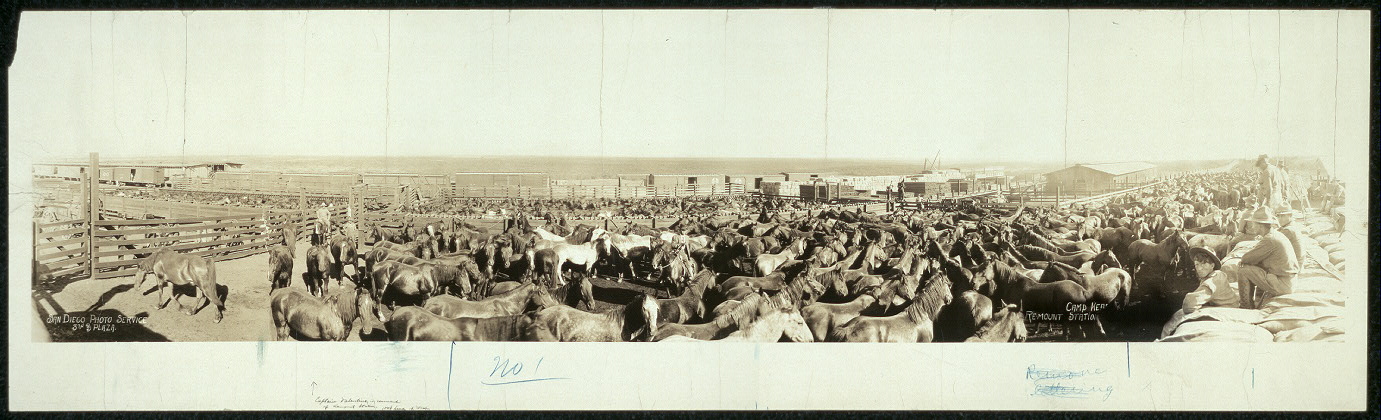
 Remounts. World War One.
I've been doing a series of posts here recently on transportation.  I started out with the default means of transportation, walking, and then recently I did one on bicycles, the device that first introduced practical daily mechanical transportation to most people, most places, in the western world, and which continues to be the default means of daily transportation for a lot of people around the globe.  Here I turn to nearly the oldest means of alternative ground transportation (accepting that floating transportation was the second means for humans to get around, following walking), that being animal transportation. And when we discuss animal transportation, we mean for the most part equine transportation, at least in the context discussed here.. 
Having said that, this one is pretty relevant too:

Walking
For the overwhelming majority of human history, if a person wanted to get somewhere, anywhere, they got there one of two ways.

They walked, or they ran.

That's it.

Businessmen, Washington D. C., 1940s. Walking.
Alternative modes of transportation didn't even exist for much of human history. The boat was almost certainly the very first one to occur to anyone.  Or rather, the canoe.  People traveled by canoe before they traveled by any other means other than walking. . .

As explored here, and elsewhere, most people actually didn't ride that much.  Horses are expensive and require daily upkeep of some sort.

Now, for rural people, of which there were a great deal more then, than as opposed to now, as a percentage of the population, knowledge of equine transportation was certainly the rule.

So here, Ancestry.com  hits and misses.
2. They wrote and received letters regularly.
Ancestry.com is right on the mark here, that's for sure.  I've touched on this quite a bit too, including one fairly recent entry.  So Ancestry.com gets high marks here, and indeed, this topic is well worth writing about here again, and I likely shall.
3. They could get by without electricity.
Very true.  And a topic I haven't directly covered.  I'll have to add this one to the hopper.
4. They could make their own household goods.
Also at least somewhat true, depending upon the era and what we're addressing.  Actually, for most of us, it'd be more true of our great grandparents, or perhaps our great great grandparents, but even our immediate parents were generally handier than most people are now.

Another thing I'll have to cover.

Here's the actual entry from Ancestry.com:
Great-great-grandma probably sewed all her own household linens, complete with fancy embroidery, tatting, or other decorative embellishments. She could probably knit, crochet, or hook rugs. While some of these skills are becoming popular again, the ready availability of manufactured textiles has made most of them hobbies rather than essential life skills.
Cudos to Ancestry.com again. Another topic right on point for this blog that I've failed to cover.
5. They knew how to behave in different social situations.
This is one that wouldn't have occurred to me, but I think there's some truth to it.  Another one that I need to cover here.
6. They could get a good job without a lot of education.

This is an interesting one.  Here's the actual entry:

The movement for compulsory secondary education didn’t begin in the U.S. until the 1890s, so many adults in the 1870s and ’80s had only an elementary education. Still, they were able to find good-paying jobs in manufacturing — steel, meatpacking, and other major industries. Of course, these jobs didn’t pay nearly as much as most skilled labor jobs, which required years of apprenticeship prior to employment. A college education was mostly for the elite. Student loan debt was unheard of.
Very true again.

This is one that I have covered here quite a bit, in numerous different ways.   An older short one (which is hardly the only time I've covered it) is here:
Education

 Engineering Building, University of Wyoming, 1950s.

First of all, let me start off by noting that I'm not posting this as a screed advocating dropping out of school, quite the opposite.

Anyhow, this is my second social history post of the day.  The first one, posted just below, concerns weddings, this one concerns education.

Some friends and I were observing how the value of degrees has changed over the past couple of decades. The change is really quite remarkable.
7. They could get cheap household help.
I've covered daily living and the burden or household chores a lot, and in depth, here. But hiring domestic help I haven't covered.

Of course, a lot of our ancestors were probably working as domestic help as well, which is, and was, a pretty hard job.

But, once again, something to cover.
8. They got to witness the earliest years of some of the most fascinating things in modern life.
I think I've covered this, but as a matter of prospective.  That is, we think we live in a time with a blistering pace of change, but compared to earlier eras, but not all that long ago, not so much.

That can be a burden as well as a benefit, quite frankly.  That is, we shouldn't always assume that people enjoy these changes.  Some do, some don't, but its mixed for most.  Often its put just the way it is here, but perhaps we should be a bit more introspective on this one.
9. They didn’t have to explain their facial hair to anyone.
True. And another one I've covered a couple of times.

Well, Ancestry.com.  Nice job all and all.  And also, thanks for giving me ideas for some topics I need to explore.

Monday, February 22, 2016

Alcohol and the law.


 Should a sign like this come with your card of admission to the bar?

According to an item I received as part of a list serve I'm on for Texas lawyers (no, I'm not in Texas, long story), a frightening number of lawyers are alcoholics.  The Texas Lawyer reports:
But now, for the first time in decades, a team of researchers has verified and quantified the problem in a newly published study that shows that 21 percent of attorneys qualify as problem drinkers, 28 percent struggle with depression and 19 percent have anxiety.
Wow, that's a really high percentage.  I wouldn't have guessed it was anywhere near that amount.  I frankly doubted that but when I went to post this item, I found this one from a couple of years ago:
Studies conducted in numerous jurisdictions have pegged the rate of alcoholism in the legal profession at between 15% and 24%. Roughly 1 in 5 lawyers is addicted to alcohol. Of course, the converse is true,namely that the majority have no problem in consuming alcohol.
Hmm, the converse there isn't very comforting. 

Indeed, given the way statistics work, if 15% to 24% of lawyers are alcoholics, there must be a certain percentage above that who have some sort of problem with alcohol, assuming that a person can have a problem with alcohol and not be an alcoholic.  That does bring up the oddity that what constitutes being an alcoholic is, oddly, not universally defined.  You would think it would be, but it isn't.  Daily drinking doesn't equate with being an alcoholic, contrary to what some teetotalers feel, although in recent years some former drinking cultures have sort of headed that way, oddly enough.  Generally a male can drink up to two "drinks" per day and be regarded as a moderate drinking, but above that puts you in some other category. The amount is less for women.  Having said that, if addiction is considered, that's a different equation I guess (I"m not an expert on this, rather obviously).

Indeed, it's been interesting to note that columnist Froma Harrop has been sort of at war with the trend in some quarters in pretty strongly advocating her view that a drink a day or two for men isn't something that people ought to be up in arms about. That takes some guts on her part, as generally even people who drink a couple of drinks per day are going to be reluctant, in this environment, to admit it.  Harrop went one step further the other day and wrote a column arguing that 18 year olds should be allowed to drink, on the logical basis that if you are old enough to serve in the military, and to vote, you should be old enough to drink.  That's not going to happen here in the US, however, if for no other reason that this is one of those areas where an old Puritan ethic survives, even tough the Puritans were not teetotalers.

So, getting back on point, if 15% to 24%, or in the other calculation 21%, of lawyers are alcoholics, it must also mean that at least a few more percent are somewhere on the scale of maybe having a problem or verging on one.  And there'd be a few who must have problems with other substances, although a lot of those would be individuals who also have a problem with alcohol.  Having said that, about a year or more ago I worked on a matter where one lawyer frankly told me about another former lawyer in his firm that that the guy had a problem with marijuana, which is fully illegal here.  Of course, there was a lot of bad blood going on there, so I don't have a clue if that was really true.  I know that our bar is pretty darned aggressive about addressing lawyer misconduct, so I wonder.

Indeed, the ABA, in one of the periodic emails it sends out, reports from some ABA convention that:
On Wednesday, Hazelden and the ABA Commission on Lawyer Assistance Programs released the study that showed 21 percent of licensed, employed attorneys qualify as problem drinkers, 28 percent struggle with some level of depression and 19 percent demonstrate symptoms of anxiety. It found that younger attorneys in the first 10 years of practice exhibit the highest incidence of these problems. The findings were posted online this week in the Journal of Addiction Medicine, with the print edition available in mid-February.
So it was at 21%, but went on to note:
When focusing on three of the 10 questions that measured only volume and frequency of drinking, the authors arrived at the conclusion that more than 1 in 3 practicing attorneys are problem drinkers even though the attorneys themselves might not characterize themselves as that.
So that would be 33%.  That's a stunning figure.

 Old Parr.  Apparently this Scotch whiskey was named after the oldest man in England, and is still distilled, although its no longer sold in the UK but only in export markets.  I don't know much about Parr, other than that he lived on a spartan diet, but which included a small drink of something each day, and lived to a reputed 152 years old, which is way old, if true.  Ironically, his death was precipitated by rich eating when he became famous in his advanced old age.

Anyhow, if this many lawyers have a problem, a person would still have to ask why this is the case.  One Blawg, Above the Law commented on it as follows:
Earlier this week, a tipster sent us a link to a Greedy Associates post entitled “Why Do Lawyers Drink So Much?” My initial thought was “Ugh.” Honestly, somebody writes that article every three months, and every six months we have to write another version of the same story.
The reasons given for lawyer alcoholism are always the same. “Lawyers are only alcoholic because they’re super TYPE A badasses.” “Lawyers hate their jobs and drink to forget.” “It’s not the law that makes people alcoholics, it’s alcoholics who choose the law!”
I was going to ignore this latest Drunks and the Law story, but then the scotch in my coffee kicked in and I thought, “Hey, isn’t it just that lawyers drink because they can?”
Think about it: being a lawyer is a great job to have if you want to drink as much as possible while also having a job…

Here’s my premise: being a “functional alcoholic” is the best kind of function and the best kind of alcoholic. Functional alcoholics get to do fun things like hang out with their friends, get hammered and hook-up with random people, then claim they “don’t remember” it in the morning. But they also get to hold onto their jobs, have relationships, and, of course, they don’t have to go to meetings.
Well, presumably this was written with tongue in cheek. Having said that, now I really wonder how many lawyers are functioning alcoholics?  I frankly am still stunned that the figure for the percentage who are alcoholics is up over 20%.    I don't see a lot of lawyers boozing it up, so if people are, they're doing it, I guess, in the privacy of their own homes or something.

Still, what's that say about the law and lawyers?  Whatever it is, it isn't good.

I recently sat in a computer CLE put on by the ABA regarding Introverts in the Law.  I'm fairly introverted myself, so I thought it might be interesting to hear what the had to say.  One thing I did think was really interesting is that, contrary to what people suppose, Introverts aren't necessarily shy nor non gregarious.  They can and do interact with people, it's just that they need down time and they sort of retreat into themselves at some point.  Often, the people speaking claimed, others are surprised to find out that somebody else is an introvert.  I'll be that's really true.  That's probably also why the families of introverted lawyers, supposedly up over 60% of the profession, are probably routinely frustrated with the spouses, who are busy and being engaged and engaging all day, only to come home and say "no. . . I don't want to go to a Super Bowl party. . . can't you watch it here while I work on the car?"

That's a sudden shift in this conversation, but I think the Above the Law item on "Type A" personalities is wrong, as I suspect a lot of lawyers aren't Type A, whatever Type A is, but something a lot more complex.  And I'm wondering if the severely introverted, and those folks do exist, are shutting their minds down that way.  Very bad, if true.

What that suggests is a couple of things, I suppose.  For one thing, if a person isn't they type of person who can be around others for at least 8 to 10 hours a day, and is so introverted that they hate to call that witness or opposing lawyer, maybe you ought to think twice about this as a career.  And it would seem very clear to me if you have a problem with alcohol before you are ready to take the bar, you better avoid this career as you may be setting yourself up.  And I guess I now know why so many state bars have a substance abuse program, which was a bit of a mystery to me before.

I still wonder, however.  21%?  That seems awfully high.

 Are a lot of lawyers hitting the bottle? Seems so.  Is ten years old a long time for Scotch?  I have no idea, as Scotch tastes like paint thinner and I can't imagine why anyone drinks it.

Sunday, February 21, 2016

Monday, February 21, 1916. The Battle of Verdun commences.

The Germans committed fifty divisions to an assault at Verdun, commencing the battle that would last over nine months.


The German Army deployed stormtroopers in the attack for the first time.

Richard Murphy, legendary American seaman and commercial fisherman, died at age 77.

The Italian hospital ship HS Marechiaro was sunk by the SM U-12 near Durrës, Albania.

Last edition

Friday, February 18, 1916. Villa departs from Plaza de Namiquipa.

Limiting Supreme Court terms

An interesting proposal is being floated to limit Supreme Court terms to 18  years, with those terms being staggered so that one comes up every two years.

As much as I feel that thirty year veteran Justice, the late Antonin Scalia, was a great justice, this is a good idea.  I wish it would get some traction, even though I know that it is unlikely to.

The fact of the matter is that any one U.S. Supreme Court justice has an inordinate amount of power and, by extension, it causes the dead hand of the President who nominated them to live on well after it should not.  Scalia was nominated by the late President Reagan.  Long serving and highly infirm Justice Douglas, served for forty years and had been appointed by Franklin Roosevelt, only to go out under Gerald Ford.  

I'd also modify the proposal, were it me, to require a retirement age of age 70.  I know that's an unpopular idea and it would mean that no justice over age 52 could be appointed, but so be it.  Douglas is a good example of what can happen when very old justices continue to serve, but he's not the only one.  The current system simply requires too much gambling.

Sunday Morning Scene: Churches of the West: St. Luke's Episcopal Church, Buffalo Wyoming

Churches of the West: St. Luke's Episcopal Church, Buffalo Wyoming:

This is St. Luke's Episcopal Church in Buffalo Wyoming. It was built in 1889. Oddly enough, it's one of two St. Luke's in Buffalo, the other being a Lutheran Church across town.

Friday, February 19, 2016

Friday Farming: Farmer John Boyd Jr. Wants African-Americans To Reconnect With Farming

 African American farmers in Texas, April 1939.  Note the horse hames.

This is a really interesting short interview that touches on one of the lost demographic stories of the US since the end of World War Two:

Up until mid 20th Century a huge percentage of African Americans worked on the land.  Quite a few worked on land they didn't own, and no doubt that's why they have declined in that role to the present day.  Heavily concentrated in the American South, during World War One and then again during World War Two African Americans from the South started migrating up into Eastern and Midwestern cities.  When Robert Johnson wrote about wanting to go to "my sweet home Chicago" in 1936, he was expressing an aspiration that more than a few Southern blacks had at the time.

The great migration really wrecked that in a way that it didn't for other demographics.  There are still black farmers, but not like their once was. Given that a lot of black farmers farmed on sharecropping operations that's not too surprising, but it is a huge change in the farming demographic that should be lamented.

The African American legacy on the land shouldn't be forgotten, nor should it be lost.  Would that it could be somewhat restored, although with land prices being what they are that would be quite a chore in this economy.


Lex Anteinternet: And the Economic news gets starker.

I haven't run one of these grim items on the local economy for a month now, with this being the last one:
Lex Anteinternet: And the Economic news gets starker.:
Lex Anteinternet: Lex Anteinternet: Lex Anteinternet: Lex Anteintern...: And now the price of oil is down to. . . $29.00 bbl.
Wyoming sweet crude is down to about $19.00 bbl.  Wyoming sour crude is
now down to about $9.00 bbl.  It was at $76.00 bbl in June 2014.

Fairly clearly, those are not economically sustainable prices.
There were several intervening bad stories in the meantime, but given at there's been so many, you reach a "what's the point" type of location.

This past week, however, prices went up, in spite of the news that Iran was about to place 4 bbl/day on line.  Some of the OPEC countries and Russia were beginning to get in line, and there was a day when there was a sharp escalation of the price.  Of course, sharp in this context doesn't put the price up around $50/bbl where it seems to need to be, but it was hovering around $40/bbl.

Yesterday, however, it was sinking again.

Today we read in the paper that Ultra has hired Kirkland & Ellis, the bankruptcy firm that shows up in all of these bankruptcies and which we recently read that Chesapeake was consulting with (although they say they aren't taking bankruptcy).  And Cloud Peak (coal, but still in good shape) and Marathon (which downsized earlier) posted losses for the last quarter.

When the price started to climb a bit I thought that perhaps it had sunk to the pint where the low prices were no longer sustainable.  I could have been premature on that.

Thursday, February 18, 2016

Tuesday, February 16, 2016

Wednesday, February 16, 1916. Russian Army blunders, Lomond established, Kermit Roosevelt Jr. born.

The Imperial Russian Army, which had been seeing success after success against the Ottomans, entered Erzurum, but botched it, allowing the retreating Ottoman Third Army to set up a new defense line less than 10 km away from the city. Losses were heavy on both sides.

Lomond, Alberta was established.

Kermit Roosevelt Jr. was born to was born to Kermit Roosevelt Sr., son of U.S. President Theodore Roosevelt, and Belle Wyatt Roosevelt (née Willard) in Buenos Aires.  He's later work for the OSS and CIA.

Kermit Jr, Theodore Roosevelt, and Richard Derby.

A member of the greatest dynastic American family, he died in 2000.  His father exhibited the occasionally tragic aspect of the family, dying by suicide in 1943 in Alaska.

Anyway you look at it, the Roosevelts stand apart as an American political family, although they have chosen to remain outside of politics since the 1940s.  Never tainted while in office, and highly self sacrificing, their family remains admirable to this very day.  The Adams family may rate a close second (or first?), followed by the Bush family, and perhaps the Kennedy family.  The Trump family stands a chance of being the polar opposite.

Dương Văn Minh, the last President of South Vietnam, was born in French Cochinchina.  A soldier by training and profession, he'd live until 2001.  He spent much of his post Vietnam War exile in France, but immigrated to Pasadena California to be near his daughter in his old age.  He was extremely quiet in exile, and did not produce a memoir.

A gas explosion destroyed Mexia Texas' opera house and damaged a half-block of buildings, killing nine and injuring eight.

Last edition:

Tuesday, February 15, 1916. Chivalry in Africa.

Monday, February 15, 2016

Tuesday, February 15, 1916. Chivalry in Africa.

Allied commander Brigadier General Frederick Hugh Cunliffe sent a message to German commander Captain Ernst von Rabe at the mountain fortress near Mora in Kamerun (now modern-day Cameroon), offering terms of surrender that included all African native soldiers to be allowed safe passage back to their home villages and all German troops interned in England. 

Rabe accepted the terms with an additional offer all the native soldiers be paid for their military service.

Ottoman forces around Erzurum were evacuated.

British forces were forced off of "the Bluff" in Belgium.  The Germans, however, sustained inordinate casualties in the effort.

Followers of putative Vietnamese Emperor Phan Xích Long attempted to break him out of his prison in Saigon. They failed.

Airborne reconnaissance located the new location of the Senussis.

Last edition:

Monday, February 14, 1916. Russians take Ft. Fafet, Australians mutiny, Petra Herrera murdered, Vietnamese rebel.

Lawyers and the Challenges of the Electronic Age

Recently I was reading a commentary by a young lawyer that was on working conditions. The commentary was not on technology, but it raised a really important point that is often missed, and indeed that relates directly to work environment.  As this blog tracks changes on an historical basis, and this is a pretty big one, it's well worth looking at.  That is, how has computerization and the Internet, both of which we've explored here at great length in the terms of the law, impacted work expectations vs. reality.  It's a bit disturbing in some ways.

 Lawyer, in this case an African American lawyer, the way it was.  Now this scene would be very rare, in a suit and tie, he's going through the books, the way that thousands of lawyers once did.  Now it'd be rare to find a lawyer dressed like this, and in a law library.

First of all, let's look back a bit.  Unfortunately, in doing this, I have to jump around a bit, so bear with me.

Law firms have been around as long as lawyers, that's no surprise. But the nature and position of lawyers within firms is quite a bit different now as compared to earlier eras.  If we go far enough back, let's say into the late 1700s, we'd find that most lawyers worked as general solos or in firms of just a few men.  There was no "Big Law", that category of firm so beloved by the ABA and whose fates sends the ABA into fits of angst.  A lot of other things were different too, and one of them was, by and large, that young would be lawyers basically apprenticed with firms "reading the law".  There were some professors who taught law but the big law schools, or for that matter, the small law schools, didn't exist.

This type of firm basically evolved along into the 20th Century, with there of course being modifications and changes depending upon where a person was, and the big firms, those darling beloveds of the ABA, did start to appear.  But much was different about the practice at the time.

Now, all lawyers kept libraries depending upon their ability to do so. And indeed, the law library remains the stock visual element in film in depicting lawyers, in their firms, at work.  And for a real reason.  The first thing any lawyer did in his own office was to resort to his own library.  If answers couldn't be found there, he might resort to the county law library or, if there was a Federal court, the Federal Court law library.  Beyond that, and perhaps surprising in context, the value of libraries was so appreciated by lawyers that it was very common for lawyers to use the libraries of other firms.  All this was true when I was first practicing.

 Typical court law library, this one in a Federal Courthouse in Seattle.

Now, leaping back to law firms for a second, up until after World War Two, while there were very large firms in big cities, by and large most law was quite local, and this remained the case well into the 1990s.  What wasn't the case, however, was the predominance of the "billable hour" and the business model of the modern firm.  

Billable hours have actually always existed to some degree. There's a reason that Lincoln said "a lawyers time is his stock and trade".  But following World War Two, and really more into the 1960s, there were other models as well.  Most of those simply died off, and in spite of the fact that some lawyers propose other models from time to time, the billable hour is firmly entrenched and it isn't going anywhere.  Lawyers, charge by the hour.
 
 Private lawyers' club library, New York.  This club apparently had quite the reputation at one time, but I'm not sure if it is still around.  If somebody knows of The Lawyers Club in NYC, let us know.

Now, getting back to the libraries, when we consider big projects or big litigation prior to the real dominance of the Internet, what that meant is that young lawyers assigned to research projects, or for that matter more established ones who were doing the same, spent hours and hours in law libraries reading, and then reducing their research to writing.  To give a typical example, a senior lawyer on a case would assign a project or a brief to a young lawyer, who would then spend several days, perhaps even a week of eight to ten hour days researching it, and then he'd reduced that to a written product by dictating (not typing or writing) his work, based upon the copies of cases he'd made and his hand written notes.

Common office scene up until the 1990s.  Secretary (in this case blind) typing while transcribing.  You can still find a few lawyers using Dictaphones, but for the most part this process is one of the past and a lawyer's first product is rendered in print from a computer.  Quite a few lawyers my age and younger, and I'm not young (age 52) generate nearly all of their finished written product themselves.  Voice has returned and is returning, however, in the form of dictating into the computer itself.

It took a long time.

Inside of firms, this was the norm for decades. Firms became highly acclimated to it, and so did the lawyers that grew up in that environment.

And what that meant is that a young lawyer assigned to very few cases actually, simply by default, engaged in a lot of work and thereby rendered quite a return. It wasn't some sort of conspiracy, it just was.  So, to put out one substantial summary brief a single lawyer might have 60 to 80 hours of time.

Now, that's all changed.

With the computer and Internet, the law library is a thing of the past to some degree.  Most more substantial firms still  have one, but quite a few solo practitioners do not.  And they don't need them.  If they have a Westlaw or Lexus account, they have the equivalent of a massive case law, law library, at their fingertips. They also have access, if they are willing to pay more, to the treatises that used to be one of the real pluses of a bigger law library.  But case law is a big deal.

Frankly, I think the product isn't as good as it was before the computer, but the speed at which it is produced is massively increased. Given our prior example, that 60 to 80 hour work product is now reduced to 20 or so hours.  That is, the average good young lawyer can probably do in 20 hours which once took 60, in terms of research and writing.
So one good lawyer is much more efficient than ever.

But, as the business model never contemplated this, and as most of the bigger firms are dominated by lawyers who came up in another era, and as overhead has not gone down, the work hour expectation has not been reduced.

This was the point of the complaining young lawyer.  Wherever he was, he was complaining that where he worked the older lawyers had expectations based on what things were like when their careers started, and things were now different. I'd never considered that, but that's really quite true.

Added to that, however, the younger lawyer probably hasn't considered that while libraries were always expensive, a time has gone on, overhead for firms has increased in every way. So, the business model is not only based on an earlier era, to some extent (and definitely not in all firms) but it may be necessary.

Indeed, the only area this isn't true is for solo practitioners, for whom costs should be way down. With a Westlaw account their libraries are as good as most big firms, and now that there's no real need for scriveners or secretaries, the one having yielding to another, and both to some degree to the computer, in a solo's office, they ought to be more competitive than ever.

All of which makes the ongoing super sized white shoe firms a real oddity.  They do keep on keeping on, but mostly it would seem due to reputation and history.  Mid sized regional firms ought to be a lot more competitive in terms of product than the big firms the ABA has on its perpetual worry list.  True, the internet lets these firms penetrate everywhere, which is something they do use to their advantage.  But the extent to which the advantage is perceived, as opposed to real, is another factor.

Anyhow, by way of that young Internet lawyer's example, he probably has to be working on a lot more things at one time to keep up his requirements than his fellows of 30 or 40 years ago.  And that may explain why so many of the "Millennial" generation lawyers don't stay in firms long. It wouldn't be the only reason, but part of one, I suspect.

On a totally different topic, another interesting is problem has become that young staff members becoming so totally acclimated to the electronic age that they operate in the assumption that the law, in terms of materials and evidence, is in that age.  It isn't.  I've really been noticing that recently.

Many documents are produced only in the electronic form now. A disk comes in the mail, or a thumb drive, or maybe somebody just dropboxes records to another lawyer. That's all well and good, but at the broken bottle end of the law, depositions and court, paper rules.  You can't turn to an witness and say "See!  See Mr. Witness, here in an electronic form within this piece of plastic is that letter that you wrote that says. . . .".

Nope, that's happening with paper.

But that is, interestingly enough not obvious to the totally electronically acclimated.  Recently I've noticed that I have to say "print out" rather than "give me" when getting ready for a deposition, or somebody will think that giving me a thumb drive is adequate.

Indeed, I'm not  the only one, I suspect, that's experienced this, as I've been in more than one deposition recently where a lawyer will say "look at this photo on my computer".  That's a totally worthless line of questioning in a deposition.

While on the topic of electronic acclimation, I've now noticed that the cell phone checking addiction that is common with teenagers has spread to lawyers. I've been in more than one deposition recently where lawyers are continually checking texts on their cell phone or looking at it.  I'm convinced that cell phones are a truly hideous invention and won't be good for us long term, and aren't good for us now.

Finally,  I note that a debate has broken out about a recent study which concluded that if legal services were fully automated the population of lawyers were correspondingly drop 13%.

Not so say some, including the New York Times.

Perhaps the missed story is that this has already happened, and impacted the lawyer population, and lawyers incomes, already.  I've addressed this above, basically, but automation is hitting big time and exactly at that time during which there is a surplus of lawyers.  If one lawyer can do the work in 1/5th of the time, this has to have an impact.  It hasn't reduced the population of lawyers yet, but like gasoline, lawyers are a surplus product that we continue to oddly generate irrespective of a lack of demand. We could do some things about that.  We could make the bar exam tougher, but instead we're making it travel, like the UBE, arguably making the situation worse.  Or we could reduce the number of students going through the system, indeed we could probably reduce that by half and not suffer.  Or we could make a legal education tougher.  There seems to be an idea it's really tough, but that's not really true.  Given recent opinions by the US. Supreme Court, making law school tougher and inserting some serious courses on the philosophy and history of law might be a good idea.

Sunday, February 14, 2016

Antonin Scalia passes on.


By the time this goes up here, this will hardly be in the category of really new "news", as it was already widely discussed and analyzed on the very day that it occurred.  The story, of course, is that Judge Antonin Scalia has died at age 79.

I've posted a lot about the Supreme Court and the fact that the system we have would create in the very near future an opening on the Court that would be of huge significance, so the analysis being done today is something I've already touched upon.  Suffice it to say, however, while no man controls the date of his passing, the passing of Justice Scalia couldn't come at a time that would have more impact.  Or, perhaps, make the impact of Presidential elections more obvious.  Some far left Liberals are frankly almost gloating about this death, which is unseemly to say the least, but his death, like his life, may have more of a Conservative impact than those gloaters may think.

First, the man. Scalia was, by all who would evaluate him objectively, a massive intellect.  In recent years Scalia stood out with his political opposite Ruth Bader Ginsberg in those regards.  Not every Justice can have that claimed and almost none can have it claimed to the extent it was true about Scalia.  It was impossible to ignore him as the force of his logic and opinion were simply too great to to do so..

Appointed by Ronald Reagan, Scalia was only older than the other surviving Reagen appointee, the disappointing Anthony Kennedy.  He was not the oldest Justice at the time of his death, that being Ruth Bader Ginsberg.  For some time I've been expecting either Ginsberg or Scalia to pass on, simply based on their appearance, which did not look good to me.  That may sound morbid, but it's realistic. Kennedy appears much healthier.  But, any way this is looked at, at the age that four, now three, of the Justices have been, death has been something that's been in the Court chambers every day.  During the next President's term, whomever that is, there will be at least one more Justice to replace in this manner, if not three.  This fact alone, evident seemingly to all, has made me wonder why Ruth Bader Ginsberg did not resign last year, thereby making it semi assured that President Obama would pick her successor rather than potentially a Republican President next term.

That gets ahead, I suppose, of the story a bit.

Scalia was born in 1936 in Trenton New Jersey.  His father was from Sicily and his mother was an American whose parents had immigrated from Italy. At the time of his birth his father, who would go on to be a professor of Romance languages, was a graduate student.  His mother was an elementary school student.  He attended a public grade school and a Jesuit high school before going on to Georgetown University and then Harvard Law School.  

As a lawyer, he only practiced for six years before moving on to a teaching position at the University of Virginia.  In 1971 he began a series of posts with the then Administration which he retained until appointed to the D.C. Circuit Court of Appeals in 1982.  He was appointed to the United States Supreme Court on September 17, 1986.  He was the longest sitting justice at the time of his death.

Scalia's career, quite frankly, defines much of what I have criticized about the United States Supreme Court.  He practiced in the real world very little, and was yet one of the many Ivy League graduates to be appointed to the bench. And, of course, he occupied the position for eons, leaving it only through death.  But I'll concede that Scalia's intellect argues against my position.  He was a giant.

One of the justices whose opinions were consistently well thought out and frankly brilliant, it won't be easily possible to replace him.  And his death occurs at a time when American politics have descended into an increasingly extreme stage, epitomized by a very odd Presidential race, while the Court has been consistently split between four conservatives and four liberals with Justice Kennedy in the middle.  His death means we now have a more or less liberal court with a swing vote that is problematic.  So, this court will swing between deadlocked and liberal at least until the next appointee makes it something else.  

The appointment of that Justice is of massive importance.  President Obama will nominate somebody, but of course he well knows that there is little chance that nominee shall be approved (but not no chance whatsoever).  Given that, it will be interesting to see who he chooses for a position that can probably not be obtained, at least right away.  And now, who will fill this vacated bench, will become an issue in this campaign.

Who fills the Supreme Court seats should in fact always be an issue, and perhaps in this fashion Justice Scalia serves us one more time. Grant that it should be somebody of such equal intellect.

Monday, February 14, 1916. Russians take Ft. Fafet, Australians mutiny, Petra Herrera murdered, Vietnamese rebel.

The Russians captured Ft. Tafet.

Australian troops mutinied against conditions at Casula Camp in New South Wales.

Mexican revolutionary Petra Herrera, who fought both as a soldier and worked as a spy, was shot dead by drunken revolutionaries in a bar.

She's started off as a Villista who disguised herself as a man, and then later became an acknowledged female combatant, and later a spy.

Vietnamese rebels rose up in Saigon.

Last edition:

Saturday, February 12, 1916. Russians advance against the Ottomans.

Sunday Morning Scene: Churches of the West: St. Luke's Lutheran Church, Buffalo Wyoming

Churches of the West: St. Luke's Lutheran Church, Buffalo Wyoming:

Classically styled Lutheran Church, St. Luke's, in Buffalo Wyoming. It's one of two "St. Luke's" in Buffalo, which is a fairly small town, the other being the Episcopal Church.