This is Memorial Day weekend, and that means that some movie channels will be running war pictures all weekend long. I've noticed that this film is getting a real running this year.
This movie is one of my all time favorite films, and it has been since I was a child. I recall that for many years the movie was played on a Denver television channel on New Years Day, without interruption, sponsored by Lloyd's Furs. What the movie has to do with New Years I have not a clue, and I doubt that it has anything to do with it at all, but the fact that this was a type of big deal says something about how well respected the film was, and is.
The Longest Day is the movie version of the book by Cornelius Ryan. The Irish born Ryan was a war correspondent during World War Two and turned towards writing a series of histories of the war thereafter. He wrote a total of three books on the war, all of which are truly excellent, and all of which are written in the same style which primarily focus on first person recollections by the participants.
The movie treatment of his 1959 book came out in 1962 and featured a huge star studded cast, which it would almost have to have, given that it is, after all, a series of recollections. Filmed in black and white so that it had the appearance of a newsreel to some degree, and using a small bit of original footage, the movie excellent portrays the events of the Allied invasion of Normandy in 1944 from both the Allied and the German prospective. It's a great film.
So nothing to complaint about, right?
Well, sadly no.
As great as this film is, it suffers in one significant manner, particularly post Saving Private Ryan. Material details are somewhat lacking, mostly in the category of uniforms.
That may seem like a minor matter, and it is, but this film really blows it in terms of American uniforms. It's way off. Part of this was likely because it was being filmed in black and white, and all military uniforms have a drab appearance. My guess is that another reason was that the sheer size of the caste deterred the filmmakers form having that many period uniforms recreated where they could avoid it. Indeed, that they knew in part that they were getting them wrong is oddly demonstrated by the uniforms of a few key characters where parts of the uniform details were obviously detailed to try to get a correct appearance.
Almost all the US soldiers in the film are wearing field uniforms that are correct for when the movie was made, in 1962. Not for when the film is set, 1944. In a few odd instances 1962 period jackets have been somewhat reworked to try to look like the paratrooper uniform of that period, but it's pretty obvious that's what's been done. More oddly still, however, US troops are shown wearing khaki shirts of various patterns under their field jackets, which is completely incorrect.
Not that this should be hugely problematic for most people watching the film. But for those detail oriented, it is a bit frustrating. It's still a great film, however.
Saturday, May 23, 2015


Sunday, May 23, 1915. Italy declares war on Austro Hungaria.
Italy declared war on Austro Hungaria. The Austrians opened the actual hostilities post declaration by bombarding the port of Ancona
Faisal bin Hussein received the Arab Secret Societies Damascus Protocol proposting an Arab state to come about by way of a rebellion against the Ottoman Empire which read:
The recognition by Great Britain of the independence of the Arab countries lying within the following frontiers:
North: The Line Mersin-Adana to parallel 37N and thence along the line Birejek-Urga-Mardin-Midiat-Jazirat (Ibn 'Unear)-Amadia to the Persian frontier;
East: The Persian frontier down to the Persian Gulf;
South: The Indian Ocean (with the exclusion of Aden, whose status was to be maintained).
West: The Red Sea and the Mediterranean Sea back to Mersin.
The abolition of all exceptional privileges granted to foreigners under the capitulations.
The conclusion of a defensive alliance between Great Britain and the future independent Arab State.
The grant of economic preference to Great Britain.
Last edition:
Saturday, May 22, 1915. Eruption of Lassen Peak.
Friday, May 22, 2015
Taking on ISIL

Bedouin in Palmyra, early 1940s
ISIL has taken Palmyra, a Syrian city with spectacular Roman ruins from the first century. The global fear is that what time and weather have not done, which is to erase Palmyra from the face of the earth, ISIL, under its extreme interpretation of the tenants of Islam. So extreme, in fact, that some time ago it issued a disapproval of important Islamic features in Mecca.
No ruin is worth human lives, but there is a bigger question at work here. And what that is, is this. Should we (the Western World) take on ISIL?
I think we have to.
The reason I think we have to, is that it is taking on us, and what we have to determine is how much ground we're prepared to lose before we can't tolerate losing any more.
I think there's been a very widespread assumption in the West that ISIL is so nutty that it will fail on its own accord. That might be true, long term, and it probably is true, but we have to ask, as part of that, how much damage are we willing to endure in the meantime. And as part of that we have to acknowledge that really nutty ideologies can be hugely attractive, even if nutty. Nazism was both evil and full blown whacky, and I think a lot in the developed world assumed that such an evil, nutty, ideology would fail in such a civilized nation as Germany. It probably would have, but left unchecked that probably would have taken decades. Communism provides another example. Soviet Communism never made any sense at all, but it did manage to make a 70 year run in the Russian Empire, killing millions in the process.
ISIL may look minor in comparison with either of those, but I'm not so sure it really is. It's proven that it actually can exhibit state craft, perhaps at least as effectively as the actual sovereigns in the region in some instances. It's gone from being a radical Islamic militia to an actual army that's not terribly badly equipped, in the regional context. That army seems to be able to hold its own and even defeat the Iraqi army, and to hold its own and occasionally defeat the Syrian army. It's administering a government in the areas that it's captured, and right now it probably controls more ground that the governments in Baghdad and Damascus do. We don't notice it much here, but it's ideology seems to having a real impact in the Islamic regions of the former USSR where there's an ongoing problem of young men being drawn into it and leaving to fight in Iraq and Syria. It's pretty clear that immigrant Islamic populations in Europe have some people who go back and forth into it, and its hardcore Islamic message has proven attractive enough to some in the Western world that there are converts who are drawn into it. In some ways, what we're seeing is sort of analogous to Communism in the 20s and 30s, when it was really attractive to certain groups and during which it seemed to be expanding.
I don't think we can ignore it in the West, therefore, as I think there is a real risk that it'll win in both Iraq and Syria. If it does, it's not going to be content with that and we'll have to deal with an incredibly violent, aggressive, rich, regime that would be hugely problematic to the entire region, and which would sponsor some violence well beyond its borders. The questions is, I guess, what to do.
And as part of that problem, we have to acknowledge that this is a religious war. We don't want it to be, but because our opponents conceive of it that way, it is.
I'm sure I don't have the solution, but what I think we probably have to concede is that this might be a long one. But we probably also have to strangle ISIL in the cradle of Iraq and Syria right now in the hopes that kills it off. The Iraqi army appears completely worthless, and the only fighting force worth its salt seems to be the Kurds. I don't think any Western nation, ourselves included, are willing to put boots on the ground. The only regional one that clearly is, is Iran, and that presents its own problems.
Pretty grim situation.
I think we have to.
The reason I think we have to, is that it is taking on us, and what we have to determine is how much ground we're prepared to lose before we can't tolerate losing any more.
I think there's been a very widespread assumption in the West that ISIL is so nutty that it will fail on its own accord. That might be true, long term, and it probably is true, but we have to ask, as part of that, how much damage are we willing to endure in the meantime. And as part of that we have to acknowledge that really nutty ideologies can be hugely attractive, even if nutty. Nazism was both evil and full blown whacky, and I think a lot in the developed world assumed that such an evil, nutty, ideology would fail in such a civilized nation as Germany. It probably would have, but left unchecked that probably would have taken decades. Communism provides another example. Soviet Communism never made any sense at all, but it did manage to make a 70 year run in the Russian Empire, killing millions in the process.
ISIL may look minor in comparison with either of those, but I'm not so sure it really is. It's proven that it actually can exhibit state craft, perhaps at least as effectively as the actual sovereigns in the region in some instances. It's gone from being a radical Islamic militia to an actual army that's not terribly badly equipped, in the regional context. That army seems to be able to hold its own and even defeat the Iraqi army, and to hold its own and occasionally defeat the Syrian army. It's administering a government in the areas that it's captured, and right now it probably controls more ground that the governments in Baghdad and Damascus do. We don't notice it much here, but it's ideology seems to having a real impact in the Islamic regions of the former USSR where there's an ongoing problem of young men being drawn into it and leaving to fight in Iraq and Syria. It's pretty clear that immigrant Islamic populations in Europe have some people who go back and forth into it, and its hardcore Islamic message has proven attractive enough to some in the Western world that there are converts who are drawn into it. In some ways, what we're seeing is sort of analogous to Communism in the 20s and 30s, when it was really attractive to certain groups and during which it seemed to be expanding.
I don't think we can ignore it in the West, therefore, as I think there is a real risk that it'll win in both Iraq and Syria. If it does, it's not going to be content with that and we'll have to deal with an incredibly violent, aggressive, rich, regime that would be hugely problematic to the entire region, and which would sponsor some violence well beyond its borders. The questions is, I guess, what to do.
And as part of that problem, we have to acknowledge that this is a religious war. We don't want it to be, but because our opponents conceive of it that way, it is.
I'm sure I don't have the solution, but what I think we probably have to concede is that this might be a long one. But we probably also have to strangle ISIL in the cradle of Iraq and Syria right now in the hopes that kills it off. The Iraqi army appears completely worthless, and the only fighting force worth its salt seems to be the Kurds. I don't think any Western nation, ourselves included, are willing to put boots on the ground. The only regional one that clearly is, is Iran, and that presents its own problems.
Pretty grim situation.
Saturday, May 22, 1915. Eruption of Lassen Peak.
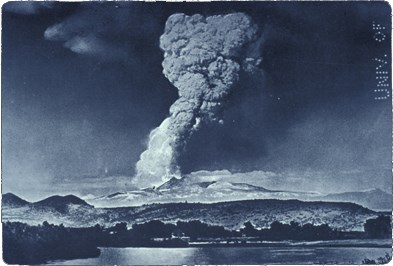
The Eruption of Lassen Peak
In a bizarre look at what was considered acceptable at the time, a cigarette advertisment, before cigarettes were really popular, in Colliers:

Mecca cigarettes?
Last edition:
Thursday, May 20, 1915. Russians in Van.
Labels: 1910s, 1915, Battle of Festubert, British Army, Defense of Van, Ottoman Empire, Turkey, World War One
Wednesday, May 20, 2015
Thursday, May 20, 1915. Russians in Van.
The Imperial Russian Army entered Van.
British efforts at Festubert were renewed with some success.
Last edition:
Wednesday, May 19, 1915. Attack at ANZAC Cove.
Labels: 1910s, 1915, ANZAC, Equine Transportation, Gallipoli, May 14 Revolt, Ottoman Army, Portugal, Turkey, World War One
Tuesday, May 19, 2015
Wednesday, May 19, 1915. Attack at ANZAC Cove.
The Ottoman army launched a third attack on Anzac Cove. The assault included 42,000 troops but it was repelled by the entrenched 17,000 ANZACs. Casualties were massively uneven with Ottoman forces sustaining 13,000 casualties including 3,000 killed, while ANZAC forces had 468 wounded and 160 killed.
Australian medic John Kirkpatrick, who had innovated the use of mules and donkeys to transport the wounded, was killed in the attack.
President of Portugal Manuel de Arriaga announced his decision to resign following the end of the May 14 Revolt.
Last edition:
Tuesday, May 18, 1915. The Amos Barber Effect.
Sunday, May 17, 2015
Tuesday, May 18, 1915. The Amos Barber Effect.
The 1st Canadian Division attacked the German line at Festubert with support from a British division but failed to progress against enemy artillery.

Division patch of the 1st Canadian Division.
British submarine HMS E11 infiltrated Turkish waters past the Dardanelles.
Today In Wyoming's History: May 19: 1915 Dr. Amos Barber, Wyoming's second governor after statehood, whose governorship was marred by the Johnson County War and his general ineffective reaction to it, died. Barber had a successful career as an Army surgeon before entering private practice, and he followed up on that with service again during the Spanish American War, but his having participated through acts of omission in the large cattleman's invasion of central Wyoming is principally what he is remembered for.
This appears on May 19 on the above referenced site, but likely because that's the date hit hit the press.
Barber was 54 years of age at the time. He stands as an example of a weak willed politician that caved to the seeming authority of the time, and came to be tainted by it. An example, as it were, for modern politicians.
Last edition:
Monday, May 17, 1915. Van abandoned.
Labels: 1910s, 1915, Armenia, Armenian Genocide, Defense of Van, Ottoman Army, Turkey, World War One

Monday at the Bar: Courthouses of the West: Converse County Courthouse, Douglas Wyoming

This is the Converse County Courthouse in Douglas Wyoming. This modern office style building houses all of the principal offices of Converse County, as well as one of the four 8th Judicial District courtrooms.
The Converse County War Memorial is located in the lobby of this courthouse.
My annual spring cold has arrived. . .
and I feel miserable.
Most people associate colds with winter. But I'll go years with no wintertime cold. Not so spring, I get a spring cold every darned year. Must be something about the unpredictable weather or something.
Most people associate colds with winter. But I'll go years with no wintertime cold. Not so spring, I get a spring cold every darned year. Must be something about the unpredictable weather or something.
From the phenominally bad idea department: M J Wright: Chickenosaurus lives
Chickenosaurus lives!
I'd note that there are a lot of bad ideas that seem to float around in the genetic modification department now days, everything from this step back towards dinosaurs to trying to revive mammoths. Studying this stuff is fine, but we seem to have utterly no restraint on implementing whatever bad ideas we come up with.
I'd note that there are a lot of bad ideas that seem to float around in the genetic modification department now days, everything from this step back towards dinosaurs to trying to revive mammoths. Studying this stuff is fine, but we seem to have utterly no restraint on implementing whatever bad ideas we come up with.
Monday, May 17, 1915. Van abandoned.
Saturday, May 16, 2015

Sunday, May 16, 1915. Armenian casualties.
The Central Powers established bridgeheads over the San.
Ottoman soldiers killed 6,000 Armenians by artillery fire while covering the evacuation of Turkish women and children from Van.
The Royal Naval Air Service intercepted two Zeppelins, badly damaging one.
Last edition:
Saturday, May 15, 1915. Night attack.
Friday, May 15, 2015
The paused that refreshed.

Fountain for horses, downtown Denver. These were placed by the National Humane Alliance, an organization that put the up for urban horses all over United States. They were concerned about the conditions that working horses worked in. The draft horses are, largely, gone, but the fountains remain.
Saturday, May 15, 1915. Night attack.
The British First Army launched a night attack a three mile section of the German line from Neuve-Chapelle, France, in the north to the village of Festubert .
The court of inquiry on the Singapore Mutiny sentenced 47 were sentenced to execution by firing squad. The remaining 600 Indian soldiers and officers that did not mutiny were ordered to serve in Africa.
It was of course Saturday.


Last edition:
Thursday, May 13, 1915. Sending a message.
Thursday, May 14, 2015
Wednesday, May 13, 2015
(Over)acclimating to technology
One of the things that gets cataloged here a lot are technological changes. How technology, specifically computer technology, has worked a change in my own daily life became abundantly clear to me this pat week. Frankly, I don't think all of the changes are universally good either, which may seem surprising for somebody who is running a blog.

Amishman, 1940s. The Amish are a well known North American religious group (Anabaptist) that have restricted their use of technology. Widely misunderstood, the religious concept at work has to do with the use of things that would reduce a human's humbleness and therefore their focus on devotion. As we become more and more technological, the more a person has to wonder if the Amish don't really have it right on at least recognizing that technology may offer, at some point, as many dangers as it does benefits.
For one thing, this is a new computer. This computer came about as I recently went from a Pentax K-x to a Pentax K-3. It's a great camera, but I'm frankly still learning how to use all of its features, and as it's a fairly complicated camera, I probably never will. Be that as it may, I like it. And part of the liking it is that not only can you take really good pictures with it, but you aren't leased to film, the way we were with earlier film cameras.
However, because of certain new features in it, it wouldn't work with my old computer, which was truly ancient. It was in the category of PC's that had an operating system that was supposed to be updated some time back, as it was no longer supported by Microsoft, but as it was working, and as computers are expensive, I didn't do it. Well, I finally had to as the software for the K-3 was not supported by the old operating system. So one technology lead to another.
That meant, for a variety of reasons, that I was without a home computer for about a week. That should have been no big deal, but it was oddly unsettling. This was, in no small part, because I've grown used to checking the computer early in the morning, when most of this stuff is written, and also checking it sometimes in the evening as well. In other words, I've become habituated to that, and anything you are habituated to you do in place of something else.
Indeed, anything that you are habituated to, you are dependent upon to some degree. I could easily live in a house with no television, and I only listen to the radio while in a car (although now I frequently listen to podcasts, which is another habituation) but the computer I really noticed not being here. Not good, in some ways.
Taking this further, last weekend I was in Denver. I'm not really keen on Denver, but I was there with my family and we went to REI, the big outdoor sports store. REI has a great store, and a great catalog. I first became acquainted with both through a college friend, who was a big outdoorsman (and still is). We went down to Denver, probably in 1983 or 84, and went to REI, which we did frequently thereafter.
At that time, REI was in one of the neighboring towns around Denver, not Denver proper, although where one begins and the other stops is questionable. Most people would have said we were in Denver. At any rate, it was in what had been built as a grocery store at the time, but it was amazing, or perceived that way in any event.
Now, REI is in Denver, in a trendy nice area near the aquarium, and it's new bigger store is in a building that had been built as a power plant a century ago. It's a nice store, but visiting it just doesn't have hte same excitement it once did. There may be a variety of reasons for that, including that I"m just older, but while there I texted (technology again) my old friend and noted that I was there, and that it just wasn't as exciting as it had been back when. He texted back that "the internet has ruined the experience".

Spacious interior of the current REI outlet in Denver.
I hadn't thought of that, but I really think he's right. It has. Not completely, but partially.
Now, when you want something, there's none of the sense of scarcity of the item or the wonderment in finding it. In a way, of course, that's good. But at the same time, there was something sweet about finding what you wanted, or even what you liked but didn't know you wanted, and which was difficult to get. The effort, or just the surprise, meant something. Now, that's all gone. In its place, we look up everything on the net and know its whereabouts right away. Again, that's not universally bad by any means, but it has given us a false sense of super abundance that makes us less appreciative of anything we have or seek to acquire. That would include, I feel, even the acquisition of knowledge, as now we just "Google it".
While in Denver, as I have several times recently, we made frequent use of the Google Maps navigation feature which allows for voice directions. This is a nifty feature, but I've found its had a direct impact on my sense of place and direction, both of which have always been very good.
I've always been able to navigate my way around any place, including any city, simply by looking at maps and mentally planning a route. Now, because of Google Maps, I frequently don't, just having my Iphone do the work. I've found that this has actually messed significantly with my sense of place and direction, as when I depart from it, I don't have a real good sense of where I am. Usually, if I go to a place once, I know how to get there, but now it would seem this is less certain. I don't like it.
Fortunately I can get back to normal simply by not using it, but it was disturbing to see how very quickly I'd become acclimated to it. This is particularly disturbing as I feel that this is one of the many technological things that has the impact of taking us a bit further from the natural world, really, which as I noted the other day has the impact of creating a world that's contrary to our natures.
All in all, while technology definitely has its benefits, I do question if we can reach the point where it's overall detrimental to us. Indeed, I think we may have already done that. We don't have a really good history of self restraint. Most of us will not take the view of the Amishmen, and it risks making us less in tune with where we are, or even who we are. Indeed, an entire younger generations doesn't notice where they are or who they are with at any one time, as their heads are buried in their phones. This trend is not only negative, but to paraphrase from Pogo, we have met the enemy, and its our technology. Not completely, yet, but partially.
Thursday, May 13, 1915. Sending a message.
President Wilson wrote a letter to Germany calling on it to abandon submarine warfare on commercial ships.

Canadians held the line at Frezenberg Ridge but sustained huge casualties doing so. Princess Patricia's Canadian Light Infantry went from 700 men to 150 men resulting in the unit's unofficial motto – "Holding up the whole damn line".
Last edition:
Wednesday, May 12, 1915. Mackensen ordered to advance.
Tuesday, May 12, 2015
Wednesday, May 12, 1915. Mackensen ordered to advance.
General August von Mackensen was ordered to advance to the San River and establish bridgeheads on the east bank. While that was going on, further to the south Ottoman forces were unable to slow a Russian advance on Van.
French forces at Artois took 3,000 German POWs.
South African forces took Windhoek, German South West Africa.
The U.S. Army formed its 2nd Aero Squadron.
The stuck ship of the Ross Sea party, the Aurora, was drifting northwood with the ice attempted to make a radio broadcast to the stranded members of the party at Cape Evans.
Last edition:
Tuesday, May 11, 1915. Taking the high ground.
Monday, May 11, 2015
Tuesday, May 11, 1915. Taking the high ground.
French forces took vital high ground locations from the Germans in the Second Battle of Artois.
The Russians regroup and dug at the San River.
Last edition:
Monday, May 10, 1915. "There is such a thing as a nation being so right that it does not need to convince others by force that it is right."
Sunday, May 10, 2015
Lex Anteinternet: Wyoming Adopts the Uniform Bar Exam, and why that'...
Back when I posted this item:
Now I've read that New York is adopting the UBE with the expressed purpose of allowing transferability of its licenses.
This may seem irrelevant to Wyoming, but far from it. I don't know how many New York lawyers there may be, but it wouldn't surprise me if the number exceeds the number of residents that reside in any one of Wyoming's larger cities.
On a plus side, however, this will impact the same out of state bars that are presently poaching in Wyoming. So, now we can expect to see Colorado and Montana firms that have been practicing across state lines complain about the same thing we're experiencing, and they certainly will experience it. And it won't be good for the practices in their states.
I'm not going to cry about that, but we can shed a tear for one group, the legal consumer. An irony of the practice is that practitioners in small states are often highly experienced in the courtroom, with far more trial practice than some trial lawyers in big states. Quite often, a local litigant is better off with a lawyer from their home state, which is becoming less common, and stands to become even less and less the case as we move on.
Nothing every prevented a Colorado lawyer from taking the Wyoming exam, or a New York lawyer taking the Colorado exam. If they took it, and passed, we knew they were qualified. With the UBE, we don't know that.
Lex Anteinternet: Wyoming Adopts the Uniform Bar Exam, and why that'...: Wyoming Supreme Court in Cheyenne. Students of legal minutia know that the phrase "to pass the bar", or "to be ca...I noted a widely held concern that the adoption of the UBE would be detrimental to the practice of law in Wyoming in a number of ways. So far, at least one of the concerns, the increased exportation of the legal practice in this state to big out of state cities, accompanied by a decrease in practitioners who actually know Wyoming's law, has been coming true. Now, I work with a lot of really good out of state counsel, and this isn't a universal slam. Certainly quite a few of those lawyers are really good lawyers, but there a lot of lawyers residing in Wyoming who are equally good. The concern, however, was well placed and long term, this is not a good trend for Wyoming at all, as all the fine really good local counsel risk being forgotten simply because they aren't in a large city, in spite of their trial records.
Now I've read that New York is adopting the UBE with the expressed purpose of allowing transferability of its licenses.
This may seem irrelevant to Wyoming, but far from it. I don't know how many New York lawyers there may be, but it wouldn't surprise me if the number exceeds the number of residents that reside in any one of Wyoming's larger cities.
On a plus side, however, this will impact the same out of state bars that are presently poaching in Wyoming. So, now we can expect to see Colorado and Montana firms that have been practicing across state lines complain about the same thing we're experiencing, and they certainly will experience it. And it won't be good for the practices in their states.
I'm not going to cry about that, but we can shed a tear for one group, the legal consumer. An irony of the practice is that practitioners in small states are often highly experienced in the courtroom, with far more trial practice than some trial lawyers in big states. Quite often, a local litigant is better off with a lawyer from their home state, which is becoming less common, and stands to become even less and less the case as we move on.
Nothing every prevented a Colorado lawyer from taking the Wyoming exam, or a New York lawyer taking the Colorado exam. If they took it, and passed, we knew they were qualified. With the UBE, we don't know that.
Monday at the Bar: Courthouses of the West: Weston County Courthouse, Newcastle Wyoming
Courthouses of the West: Weston County Courthouse, Newcastle Wyoming:


 This is the Weston County Courthouse in Newcastle, Weston County, Wyoming. If this well preserved courthouse is not the oldest operating courthouse in the state, it must be very close to the oldest one still in use. The courthouse houses a courtroom of the 6th Judicial District, which also has a courthouse in Gillette, Wyoming.
(Note, the text here is the original from the original Courthouses of the West entry. Since that time, I've learned that there is in fact an older courthouse still in use in the state, in Evanston Wyoming.).


 This is the Weston County Courthouse in Newcastle, Weston County, Wyoming. If this well preserved courthouse is not the oldest operating courthouse in the state, it must be very close to the oldest one still in use. The courthouse houses a courtroom of the 6th Judicial District, which also has a courthouse in Gillette, Wyoming.
(Note, the text here is the original from the original Courthouses of the West entry. Since that time, I've learned that there is in fact an older courthouse still in use in the state, in Evanston Wyoming.).
Monday, May 10, 1915. "There is such a thing as a nation being so right that it does not need to convince others by force that it is right."
Resisting demands the US immediately enter the Great War, due to the sinking of the Lusitania, President Wilson stated "There is such a thing as a nation being so right that it does not need to convince others by force that it is right."
Germany cabled its regret over civilian loss of life in the incident to the United States but in terms that placed the blame on the United Kingdom.
Wilson addressed naturalized citizens in a speech at Philadelphia's Convention Hall.
Mr. Mayor, Fellow-Citizens:
It warms my heart that you should give me such a reception; but it is not of myself that I wish to think to-night, but of those who have just become citizens of the United States.
This is the only country in the world which experiences this constant and repeated rebirth. Other countries depend upon the multiplication of their own native people. This country is constantly drinking strength out of new sources by the voluntary association with it of great bodies of strong men and forward-looking women out of other lands. And so by the gift of the free will of independent people it is being constantly renewed from generation to generation by the same process by which it was originally created. It is as if humanity had determined to see to it that this great Nation, founded for the benefit of humanity, should not lack for the allegiance of the people of the world.
You have just taken an oath of allegiance to the United States. Of allegiance to whom? Of allegiance to no one, unless it be God—certainly not of allegiance to those who temporarily represent this great Government. You have taken an oath of allegiance to a great ideal, to a great body of principles, to a great hope of the human race. You have said, "We are going to America not only to earn a living, not only to seek the things which it was more difficult to obtain where we were born, but to help forward the great enterprises of the human spirit—to let men know that everywhere in the world there are men who will cross strange oceans and go where a speech is spoken which is alien to them if they can but satisfy their quest for what their spirits crave; knowing that whatever the speech there is but one longing and utterance of the human heart, and that is for liberty and justice." And while you bring all countries with you, you come with a purpose of leaving all other countries behind you—bringing what is best of their spirit, but not looking over your shoulders and seeking to perpetuate what you intended to leave behind in them. I certainly would not be one even to suggest that a man cease to love the home of his birth and the nation of his origin—these things are very sacred and ought not to be put out of our hearts—but it is one thing to love the place where you were born and it is another thing to dedicate yourself to the place to which you go. You cannot dedicate yourself to America unless you become in every respect and with every purpose of your will thorough Americans. You cannot become thorough Americans if you think of yourselves in groups. America does not consist of groups. A man who thinks of himself as belonging to a particular national group in America has not yet become an American, and the man who goes among you to trade upon your nationality is no worthy son to live under the Stars and Stripes.
My urgent advice to you would be, not only always to think first of America, but always, also, to think first of humanity. You do not love humanity if you seek to divide humanity into jealous camps. Humanity can be welded together only by love, by sympathy, by justice, not by jealousy and hatred. I am sorry for the man who seeks to make personal capital out of the passions of his fellow-men. He has lost the touch and ideal of America, for America was created to unite mankind by those passions which lift and not by the passions which separate and debase. We came to America, either ourselves or in the persons of our ancestors, to better the ideals of men, to make them see finer things than they had seen before, to get rid of the things that divide and to make sure of the things that unite. It was but an historical accident no doubt that this great country was called the "United States"; yet I am very thankful that it has that word "United" in its title, and the man who seeks to divide man from man, group from group, interest from interest in this great Union is striking at its very heart.
It is a very interesting circumstance to me, in thinking of those of you who have just sworn allegiance to this great Government, that you were drawn across the ocean by some beckoning finger of hope, by some belief, by some vision of a new kind of justice, by some expectation of a better kind of life. No doubt you have been disappointed in some of us. Some of us are very disappointing. No doubt you have found that justice in the United States goes only with a pure heart and a right purpose as it does everywhere else in the world. No doubt what you found here did not seem touched for you, after all, with the complete beauty of the ideal which you had conceived beforehand. But remember this: If we had grown at all poor in the ideal, you brought some of it with you. A man does not go out to seek the thing that is not in him. A man does not hope for the thing that he does not believe in, and if some of us have forgotten what America believed in, you, at any rate, imported in your own hearts a renewal of the belief. That is the reason that I, for one, make you welcome. If I have in any degree forgotten what America was intended for, I will thank God if you will remind me. I was born in America. You dreamed dreams of what America was to be, and I hope you brought the dreams with you. No man that does not see visions will ever realize any high hope or undertake any high enterprise. Just because you brought dreams with you, America is more likely to realize dreams such as you brought. You are enriching us if you came expecting us to be better than we are.
See, my friends, what that means. It means that Americans must have a consciousness different from the consciousness of every other nation in the world. I am not saying this with even the slightest thought of criticism of other nations. You know how it is with a family. A family gets centered on itself if it is not careful and is less interested in the neighbors than it is in its own members. So a nation that is not constantly renewed out of new sources is apt to have the narrowness and prejudice of a family; whereas, America must have this consciousness, that on all sides it touches elbows and touches hearts with all the nations of mankind. The example of America must be a special example. The example of America must be the example not merely of peace because it will not fight, but of peace because peace is the healing and elevating influence of the world and strife is not. There is such a thing as a man being too proud to fight. There is such a thing as a nation being so right that it does not need to convince others by force that it is right.
You have come into this great Nation voluntarily seeking something that we have to give, and all that we have to give is this: We cannot exempt you from work. No man is exempt from work anywhere in the world. We cannot exempt you from the strife and the heartbreaking burden of the struggle of the day—that is common to mankind everywhere; we cannot exempt you from the loads that you must carry. We can only make them light by the spirit in which they are carried. That is the spirit of hope, it is the spirit of liberty, it is the spirit of justice.
When I was asked, therefore, by the Mayor and the committee that accompanied him to come up from Washington to meet this great company of newly admitted citizens, I could not decline the invitation. I ought not to be away from Washington, and yet I feel that it has renewed my spirit as an American to be here. In Washington men tell you so many things every day that are not so, and I like to come and stand in the presence of a great body of my fellow-citizens, whether they have been fellow-citizens a long time or a short time, and drink, as it were, out of the common fountains with them and go back feeling what you have so generously given me—the sense of your support and of the living vitality in your hearts of the great ideals which have made America the hope of the world.
At Artois, the French launched a feint attack as a decoy while cavalry was moved to assist the Tenth Army. Germany launched a counter attack and recaptured some trenches and tunnels.
.jpg)
May 8, 1915.
Last edition:
Sunday, May 9, 1915. Combined offensive.
Subscribe to:
Comments (Atom)