Sunday, April 17, 2011

Monday, April 17, 1911. Keel for the USS Texas laid.

Emiliano Zapata's forces occupied Izúcar de Matamoros.  They would be driven out the following day.

The keel for the USS Texas was laid at Newport News Shipbuilding and Drydock Company.

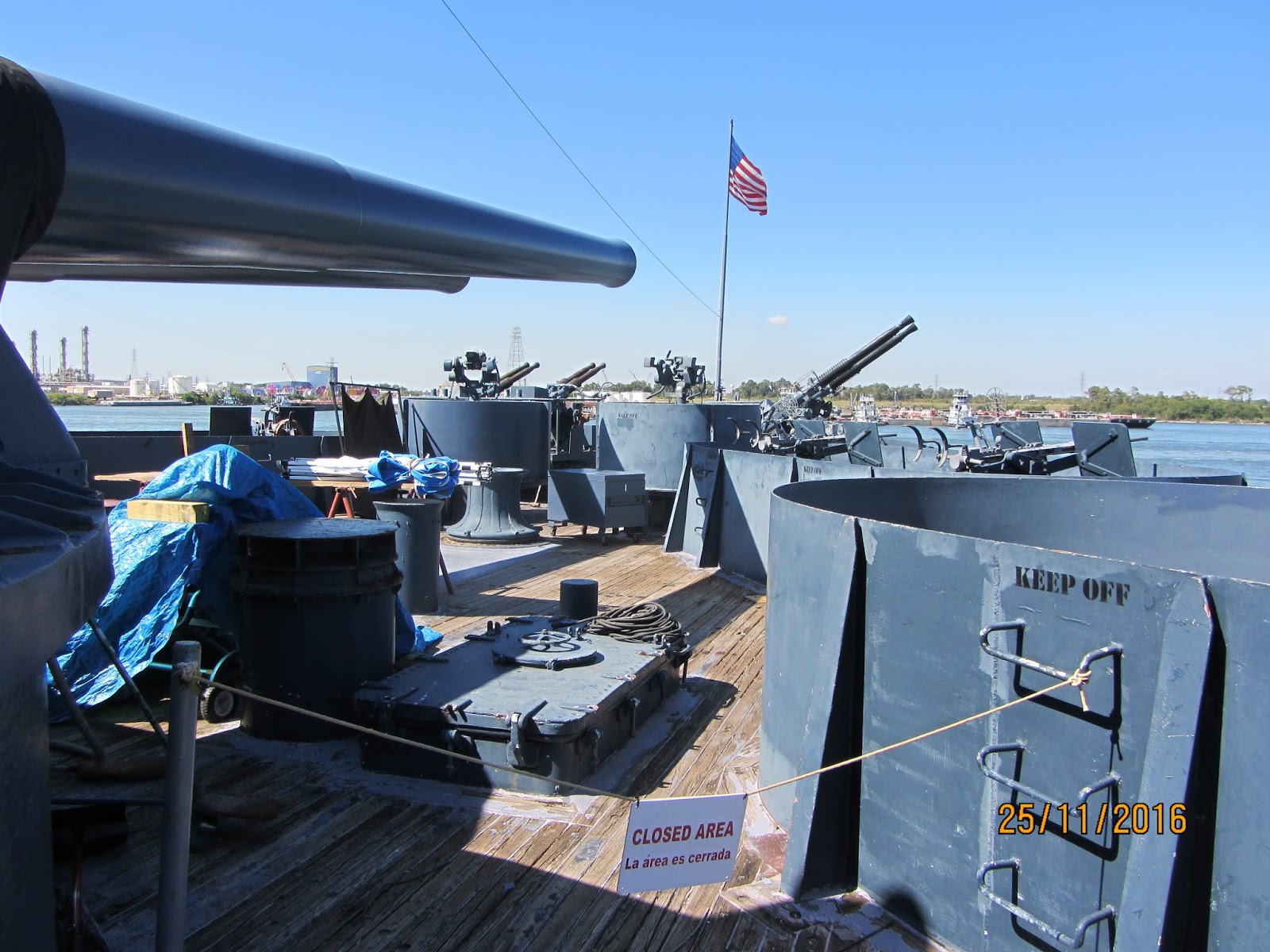
USS Texas. The only surviving dreadnought in the world. San Jacinto Battleground State Historic Site, Texas.


These are photographs of the USS Texas. The date stamp, fwiw, is in error. These were taken in  October, 2016.

The  Texas is the last Dreadnought on earth.  One pre dreadnought battleship exists, a Japanese example, and several post dreadnought battleships. But these ships, which formed the backbone of every major fleet in the world in the early 20th Century, are down to this example.  She was launched in 1912 and commissioned on 1914. A major ship in her day, while she served all the way through World War Two, and provided support to amphibious landings in Europe and the Pacific, she was already somewhat antiquated at the time of her commissioning.  Super dreadnoughts, like the Arizona, were already being launched prior to her commissioning.  Still, she was a ship of many firsts, including being the first US ship to mount anti aircraft guns.


 San Jacinto Monument as viewed from the USS Texas.


Last Edition:

Saturday, April 15, 1911. The Factory Girl's Danger.

Thursday, April 14, 2011

Friday, April 14, 1911. Taft's warning to Mexican combatants.

President Taft warned all sides in the Mexican Revolution to avoid fighting near the U.S. border and to avoid causing American casualties.

Anarchist Mexican commander Simón Berthold Chacón died of wounds sustained in recent fighting in Baja, where Socialist and Anarchist made up a strong contingent of the rebels.

Theodore Romzha, the Ukrainian Greek Catholic Church bishop who refused to merge his church with the Russian Orthodox Church was born in Nagybocskó, Austria-Hungary, which is now Velykyi Bychkiv, Ukraine.  He was murdered in 1944.


The original Polo Grounds was destroyed by fire in New Jersey.

Last edition:

Thursday, April 13, 1911. Rebel victory at Agua Prieta.

Wednesday, April 13, 2011

Tuesday, April 12, 2011

Wednesday, April 12, 1911. First date of authorization for the Mexican Service Medal. Navy Aviator No. 1. Shortest baseball game.

Today is the starting date for authorization of the Mexican Service Medal.

United States Navy, Lt. Theodore G. "Spuds" Ellyson, became "Naval Aviator No. 1.


He died in 1918 in an airplane accident.

The shortest major league baseball game on record occurred in the season opener between the Philadelphia Phillies and the New York Giants.   The 2-0 game in favor of the Phillies lasted 50 minutes.

Last edition:

Sunday, April 9, 1911. Second Battle of Bauche and the Socialist invasion of Baja California.

Saturday, April 9, 2011

Sunday, April 9, 1911. Second Battle of Bauche and the Socialist invasion of Baja California.

The Second Battle of Bauche took place as part of the larger Battle of Ciudad Juarez.

News was spreading on the American soldier of fortune attack at Mexicali.


The participation by Americans here was distinctly different than that which was seen at Juarez earlier that week as the American solders were members of the IWW.  Their commander, Stanley Williams or Willian Stanley, the name varies in different accounts was a wobbly.  At any rate Williams, who was killed in the battle at Leroy Little's Ranch, was reportedly a deserter from the US Army, in which he'd been a Quartermaster with the rank of Sergeant.

These troops had crossed from California and were mostly radical Socialist, showing the different character of the revolution in some part of Mexico.  Largely forgotten now, American Socialist took a strong early interest in the revolution including such notables as Emma Goldberg.

Last edition:

Friday, April 4, 1911. The First Battle of Ciudad Juárez commences.

Thursday, April 7, 2011

Friday, April 4, 1911. The First Battle of Ciudad Juárez commences.

The First Battle of Ciudad Juárez commenced at the border city with 1,500 men under the command of Maduro, 500 under Villa and another 500 under Orozco, with American mercenaries under Captain E.L Holmdahl and Captain Karl Linderfeldt, launching their assault on Temosachi and Bauche.

The surrounded the city, which retained only one route to the outside.

Long time readers here may recognize Linderfeldt for his role at Ludlow, Colorado, which of course lay in the future at this point in time.

Linderfelt had served in the Philippine Insurrection and in China with the U.S. Army and Colorado National Guard.  He's also served in the Mexican Army in 1911 and his name was in the Colorado newspapers frequently due to that at the time, usually under his nickname "Monte".  Prior to the 1913 mine labor troubles in Colorado, he's been working as a mine guard.  He was activated again during the Puntive expedition and then again for World War One, during which he rose to the rank of Colonel in the Colorado National Guard in spite of Ludlow.  His name was frequently in the news in the teens, with the papers being very hostile to him at first, but later more sympathetic as the Punitive Expedition and World War One rolled on.  The troops he was in command of did deploy to France, but not until October 1918, making it unlikely that hey saw much, if any, wartime combat.  In 1919 he purchased a farm in Custer County, Colorado.  In 1922, however, he was being foreclosed upon. He died at age 80 in 1957, at which time he was living in Los Angeles.    

Homdahl had fought in the Spanish American War and the Philippine Insurrection, joining the Army at age 15, under Lee Christmas in Central America, and then as a mercenary in the Mexican Revolution.  He's serve in the U.S. Army during World War One.  He's one of the people accused of stealing Pancho Villa's head.

Homdahl as a Mexican Revolutionary.

Unlike Linderfeldt, Homdahl served the revolutionary side for most of the Revolution, before becoming disenchanted with Pancho Villa.  He had some fairly substantial commands under Madero.  In 1915 he was convicted in the U.S., along with some other Mexican Revolutionaries, of violating the neutrality laws.  He turned against Villa shortly thereafter and sought to join the U.S. Army as an officer, which was denied to him because of his conviction.

During the Punitive Expedition he seems to have served as a scout for the U.S. Army, although the details are murky as the records were destroyed after the event.  He began an extensive campaign to be pardoned which paid off in July 1917, although it also exhausted his financial resources.  He thereafter rejoined the Army, but with difficulty due to prior wounds at first disqualifying him.

After the war he was a prospector and spent time searching for the "buried gold" of Pancho Villa. As noted, he's suspected of having stolen Pancho Villa's head, but he's not the only suspect.  He died in April, 1963.

Linderfeldt certainly lived a life of adventure, but not a wholly admirable life.  Linderfeldt certainly didn't live a wholly admirable life.

The Department of Justice obtained its first conviction of a member of the Black Hand, that being of Gianni Alongi for his role in sending death threats to butcher shop owner Garmila Marsala.

A fire at the  Price-Pancoast Colliery at Throop, Pennsylvania, near Scranton, Pennsylvania, killed 73 coal miners, many of them boys.

Last edition:

Wednesday, April 5, 1911. Remembering the victims of the Triangle Shirtwaist Factory fire.

Tuesday, April 5, 2011

Wednesday, April 5, 1911. Remembering the victims of the Triangle Shirtwaist Factory fire.

A massive labor demonstration combined with a memorial service for victims of the Triangle Shirtwaist Factory fire.

Over 350,000 people participated in a march which was viewed by an additional 400,000.

Last edition:

Tuesday, April 4, 1911. 62nd Congress convenes.

Monday, April 4, 2011

Remembering what places were like

An interesting edition of the Casper Star Tribune's history column appeared this week, under the title "Routines Disrupted". The following caught my attention, showing what the town was like early in the 20th Century. It's easy to imagine everything being slower paced and more relaxed, and easy to forget the atmosphere that actually prevailed at the time:
Because the city authorities stopped them from selling liquor and insisted that there must be no more piano thumping in their houses, the landladies of the bawdy houses of Casper held an indignation meeting one day last week and decided to suspend business entirely, and accordingly all the inmates of the three places on David street were discharged on the first of the month and Saturday morning fifteen of them left town on the east-bound train, it is hoped to return no more.

“These people got the notion in their head that they could do just as they pleased so long as they remained in the restricted district, and high carnival was held nearly every night for awhile, and it was seldom that a big fight was not pulled off by some of them two or three times a week. They caused the authorities so much trouble that it kept one man on watch nearly every night to quell the disturbance. But after tolerating it until it could be tolerated no longer, the order was given out to cut out the booze and the music, and this made the madams mad and they have closed up their houses, and threaten to ‘kill the town.’ ...

“[I]f the places are ever opened up again, which they undoubtedly will be before the end of this week if they are permitted to do so, the people should, and no doubt will, insist that the places be conducted along lines that will not disturb the decent people of the town.”

Tuesday, April 4, 1911. 62nd Congress convenes.

The 62nd United States Congress convened with a Democratic majority.

The Japan-United States Treaty of Commerce and Navigation ratifications were exchanged at the Imperial Palace in Tokyo, as the Emperor Meiji, Prime Minister Katsura, and Foreign Minister Komura welcomed Ambassador O'Brien.

Former bandit and later revolutionary Antonio Carrasco died of wounds sustained in the fight over Juarez.


Last edition:

Monday, April 3, 1911. Racism in San Antonio.

Sunday, April 3, 2011

Monday, April 3, 1911. Racism in San Antonio.

President Taft ordered the reassignment of the all-African-American U.S. 9th Cavalry out of San Antonio, Texas as the unit's northern-born soldiers had defied the city's segregation laws.  Indeed, two white streetcar conductors had been beaten up after insisting that the soldiers move to the "colored" section of the cars.

They'd only recently been deployed there due to the outbreak of the Mexican Revolution.

Draft registration became mandatory in New Zealand for all males aged 14 to 20.

Last edition:

Saturday, April 1, 1911. An ironic proposal by Díaz

Thursday, March 31, 2011

Friday, March 31, 1911. Viva Zapata!

Emiliano Zapata led a group of armed men in commandeering a police station in Villa de Ayala.  They then enlisted 100 townsmen in their revolutionary army.

The Mayor of Jerusalem, Raghib al-Nashashibi, and 150 prominent Arabs in Palestine sent a cable to the Turkish parliament, urging the Ottoman nation to stop further sales of land in Palestine to Jewish immigrants.

A prominent Palestinian figure, he would figure in successive regimes, and his second wife would be Jewish, and from France.

Perhaps love conquered all.

He died at age 71 in 1951.

A common sight in cities at one time:


Cleveland Mounted Police.  Note the cut of the great coats.

Last edition:

Wednesday, March 29, 1911. The adoption of the M1911.

Surprise Biscuit (1911) on Sandwiches of History


Tuesday, March 29, 2011

Wednesday, March 29, 1911. The adoption of the M1911.

In 2024 we noted this:


The Colt M1911 is a John Browning designed semi-automatic pistol that can legitimately be regarded s the greatest handgun ever made, although there are, or perhaps more accurately were, a few other contenders.  Other than the mostly John Browning Designed Hi Power, none of the other contenders remain in service somewhere however and the M1911 has by far the longest period of service.

Adopted by the U.S. on March 29, 1911, in 1923 the handgun received some minor modifications, the most significant of which is a curved spring housing which changed the profile of the grip.  The trigger was also shortened.  In 1924 the modified design started to ship, this month, from Colt.  The M1911A1 designation came in 1926.  

When we posted this, we actually thought we might have noted the adoption of the M1911 when the centennial of the pistols adoption came up, in 2011, but we didn't.  We covered a fair amount of ground regarding it in the thread above, but not really it's whole history.

Of course, that would require a book.

Given the ostensible purpose of this blog, however, we really ought to cover this.

Lex Anteinternet?


The Consolidated Royalty Building, where I work, back when it was new.

What the heck is this blog about?

The intent of this blog is to try to explore and learn a few things about the practice of law prior to the current era. That is, prior to the internet, prior to easy roads, and the like. How did it work, how regional was it, how did lawyers perceive their roles, and how were they perceived?

Part of the reason for this, quite frankly, has something to do with minor research for a very slow moving book I've been pondering. And part of it is just because I'm curious. Hopefully it'll generate enough minor interest so that anyone who stops by might find something of interest, once it begins to develop a bit.

The 1911 is part of the history we're covering, and moreover, it was a brand new pistol in that period.

Vast amounts have been written about the M1911 over its century plus history.  Most of that starts right around 1900, when the very first tests of semi automatic pistols took place.  But in order to really grasp the M1911 you need to start earlier. . . in 1873.

1873 was the year that the Army officially adopted its first cartridge using revolver, the legendary Colt Single Action Army Revolver.  The M1873 replaced a series of cap and ball revolvers that had been the standard sidearms dating back to 1846.  We won't get into those, but Colt managed to pioneer really effective revolvers with this series which were widely used by civilians as well, and very well liked.  When cartridges started to come in, particularly during the Civil War, it was obvious that soon revolvers would be adapted to take them, and very soon after the war Colt introduced what would become and remain the premier single action revolver, chambered in .44-40. The cartridge closely approximated the black powder load taken by the earlier cap and ball revolvers.  The M1873 did have competitors, even in military service, with the primary one being the Smith & Wesson No. 3, which had the advantage of being a break open design allowing for more rapid reloading, but nothing really challenged the Cold Peacemaker for dominance in the U.S. Army, or for that matter, the civilian market.

What was a challenge, however, was that it became pretty clear in the last quarter of the 19th Century that double actions had arrived.  Indeed, double action cap and ball revolvers had been produced and used during the Civil War, albeit not in large numbers.  The fact that the Army didn't go straight to a double action revealed its real conservatism after the Civil War, which also showed itself in the long arms that it adopted.

By the 1890s black powder was being replaced by smokeless powder, which also yielded higher pressures and therefore higher velocities.  As this occurred, a movement towards smaller projectiles occurred, with the thought that the same or better lethality could be achieved with a lighter cartridge.  In rifles, this proved to be quite true.  Pistols, however, are another matter.


This led to the military adopting the Colt M1892 "New Army" in that year, which was a very well designed double action revolver.  The basic design would be used by Colt for decades.  Slight improvements to the design would occur over time, leading to the Models 1892, 1894, 1896, 1901, and 1903 for the Army, the Model 1895 for the Navy and the Model 1905 for the Marine Corps, although they were all very similar.  Manufacture of the basic design for civilian shooters as well as policemen, in various cartridges, would continue until at least the 1950s, although the original New Army pattern went out of production in 1908..

What the problem would prove to be was the cartridge.

The M1892 took the .38 Long Colt cartridge.

The new handgun was first used in the Spanish American War where there were no complaints regarding it.  Soon thereafter, however, it was sent with U.S. troops to the Philippines where it proved to be pretty much completely inadequate.  In the hardscrabble guerilla wars that followed U.S. troops landing there, the pistol simply lacked stopping power.

This lead to a series of emergency responses by the Army, part of which was to reissue M1873s, often with barrels refitted to the 5.5" length.  The M1873s immediately proved successful, and as a result the Army adopted the Colt New Service civilian double action revolver, a massive .45 Long Colt, as the M1909.  Like the New Army, the New Service was a very well designed modern double action revolver, and it was produced for military and civilian use over its long life, with production ceasing in 1946.

As good as the New Service revolver was, it was a stop gap when adopted.  The Army was already looking for a semi automatic pistol.  Trials had started in 1900 with John Browning's Model 1900, Mauser's C96, and Mannlicher's weird M1894 having been purchased for evaluation. The Browning design was by far the best, and in 1906 it came back in a new version, the Model 1905, to compete against submissions by Bergmann, Deutsche Waffen und Munitionsfabriken (DWM), Savage Arms, Knoble, Webley, and White-Merrill. Some of  the new pistols, such as DWM's Luger and Savage's John Pederson designed automatic were very good indeed.  The Colt 1905, hwoever, wa the best.  Browning improved the M1905 and came out with the M1910, and the M1910 and the Savage went on to the final test.

The M1911, the final Colt design, was adopted on this day in 1911.  The Navy, and hence the Marine Corps, would not adopt the pistol until 1913.

A fire broke out at the library of the New York State Capitol in Albany at 2:00 am, hours after legislators had adjourned for the night destroying more than 600,000 books, and manuscripts, many of them irreplaceable.  A night watchman was killed in the fire.


Last edition:

Tuesday, March 28, 1911. The Lost Patrol