Showing posts with label Lincoln Highway. Show all posts

Monday, July 8, 2019

Tuesday, July 8, 1919. The 1919 Motor Transport Corps Convoy goes from Frederick to Chambersburg, Pennsylvania. 62 Miles

In spite of the difficulties it imposed, the 1919 convoy picked up speed on day two, while also fixing bridges and fording streams.

So what was the big deal about this 1919 convoy anyhow.  Just a road trip, right?

Well, no, it was a lot more than that.

Let's start with the state of, oddly enough, driving in the United States in general and the U.S. Army in particular.

Now, to be fair, training people to drive wasn't the point of the convoy. But as background to the convoy, at this point in our history, most people didn't drive.

Cars had been around for awhile, but the movie view of the past in which Model Ts suddenly appeared and all other form of transportation disappeared is completely inaccurate.  Cars came on rapidly after the Model T. . . in towns. . . but they didn't suddenly become the universal norm overnight.  That took some time.

Indeed, for those of us living today, cell phones might be a good analogy.  The first cellular mobile phone was introduced by Motorola in 1973, but that mean that everyone was using them by 1974. Far from it.  It wasn't until the 1990s that they seemingly were everywhere.  I didn't have a hand held cell phone until work made it a necessity for me, and that was sometime in the 2000s, well after my wife had adopted a good, for the time, hand held cell phone.  I didn't switch to a modern type Iphone until my work again made it necessity.  I don't know how long ago that was, but I remember it replaced my Ipod, of which I've ever had one.  I must be on the third, unfortunately, Iphone now.

Cars worked the same way.  Younger people, I suspect, adopted them more readily than the older.  I know that in rural areas of the East and Midwest they were not popular at all at first, and even a bit feared.  But the Model T served in the role of Iphone and once it came in it made a big change.  It was durable and relatively affordable, in an era in which average automobiles were actually hugely expensive.

But the Model T was only introduced in 1908, just a little over a decade prior to the date we're speaking of.  That means that the vast majority of Americans were only just now really getting an exposure to driving.  Most didn't know how to drive.

Driving, in fact, was a skill that was valued commercially.  People who did know how to drive, which also meant they knew something about being a mechanic as well, were in commercial demand. It was the golden age of chauffeurs.  And in military terms, that made it a valued special skill.  

Which takes us back to the military.

It's well known that wars spur technology.  World War One certainly spured truck production, but as far as technology goes, the technology remained more or less oddly the same.

Now, of course, the war was only four years long. But by the same token World War Two wasn't appreciably longer, and it had a huge impact on truck technology.  Indeed, World War Two, not World War One, doomed the horse as a the prime mover of all armies.

And the horse was that prime mover during the Great War. The truck played a valuable role, but one secondary to the horse.

None the less, the military could see and appreciate that day was changing and indeed was coming to an end. For that matter, that had been obvious to the farsighted since prior to the war.  That the day hadn't arrived was obvious, but that it was arriving was also obvious.

So the convoy existed in that world.  Trucks and cars were on the cusp of being seriously reliable for long distances, and becoming common.  Most Americans still didn't drive, but they would be soon.

The Army could see that, and it was getting ahead of the curve.

________________________________________________________________________________

Related Threads:

The Punitive Expedition and technology. A 20th Century Expedition.


Monday, July 7, 1919. The 1919 Motor Transport Corps Convoy departed Washington D. C.. .


Saturday, July 6, 2019

Monday, July 7, 1919. The 1919 Motor Transport Corps Convoy departed Washington D. C.. .

with an intended destination of San Francisco, California.

World War One vintage Motor Transport Corps recruiting poster.

This would be a long trip by contemporary standards, but in 1919 it was daunting in the extreme.  Only adventurers with cash tried to drive across the United States as a rule.  While it had been done quite a few times by 1919, it was not a short trip by any means.  People who wanted to cross the country did it the logical and safe way. . . by train.

The purpose of this trip was several fold.  A primary one was to test the inventory of trucks that the Army now owned, thanks to the Great War, in order to determine which ones were the best and weed out those that couldn't endure.  Additionally, however, problems with the railroads during World War One, by which we mean labor problems, inspired the service to see if trucks were a viable means of transporting men and equipment for mobilization in time of war.

The scale of the test was massive.  Over 250 men were detailed to the experimental operation which included repair vehicles and bridging equipment.  Vehicles were highly varied and ranged from artillery tractors to to motorcycles.  It's significance was appreciated at the time, and the Signal Corps was detailed to film the convoy in route, which was proceeded by a Publicity Officer and a Recruiting Officer who arrived in towns along the route several days ahead of the convoy.  The route was that of the already established, but far from modern, Lincoln Highway.

Lincoln Highway route as of 1916, which was the same as it would be in 1919.

Command of the overall operation was in the hands of Lt. Col. Charles W. McClure with the actual "train" commander being Cpt. Bernard H. McMahon.  Officers who were familiar with motor transport, including Bvt. Lt. Col. Dwight D. Eisenhower, were detailed to the operation.

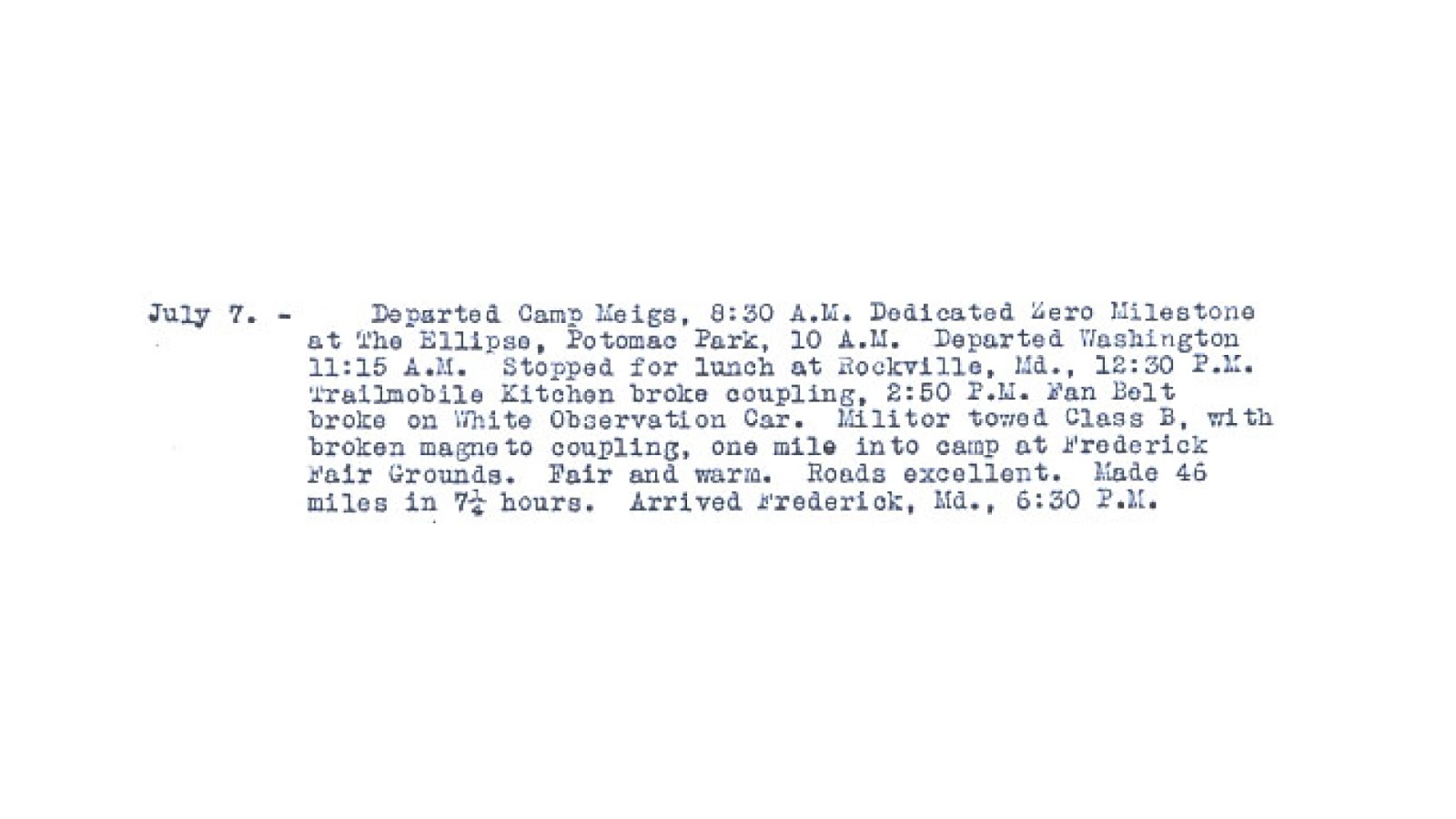
So how did day one go?  Well, the official log of the trip gives us a picture, albeit a brief one, of the same.

Forty six miles. . . in 7.5 hours.  And that on excellent roads.

Friday, April 5, 2019

April 5, 1919: Showers, Parades, Shows, Sabers, Ships and Slogans.


On this day in April, 1919 the Saturday Evening Post featured one of J. C. Leyendecker's illustrations, this one of a young woman expecting, but not receiving, April showers.


In the port town of St. Nazaire France, American sailors were on parade.


The Army was conducting shows of its own on this day.  In Toul, France, the U.S. Second Army was having a horse show on this Saturday.


War prizes were being photographed in northern Russia, where this U.S. Army Captain was displaying a Russian saber taken from a Red Army commander.  These men had lately been in action against the Reds.


And the Troopship America docked with solders returning home from France.


Casper was pondering a slogan, which is a headline that's oddly contemporary as Casper just adopted one a couple of years ago, that being "WyoCity".  What became of the 1919 effort I don't know, but perhaps we'll learn of it in upcoming editions of the Casper Daily Tribune.

And in southern Wyoming efforts were underway to create a Pershing Highway, in honor of John J. Pershing. The proposed route was on the Lincoln Highway, so what was really contemplated was renaming  a stretch of that highway.

Monday, November 7, 2016

The Laramie Daily Boomerang for November 7, 1916. Wars and highways.


The Laramie Daily Boomerang, which is still published today, didn't bother much with elections in its November 7, 1916 edition.  It focused on the news of other things, including the crisis in Mexico, prohibition in Virginia, Polish independence and the Lincoln Highway eliminating polls.

The Boomerang, perhaps, may have felt that the voters had made up their minds and focused on other things.

Wednesday, August 24, 2016

Was this sign placement necessary?


No, I don't think it was.

This is a stop sign outside of Hanna, placed right on the blacktop at the intersection with the Lincoln Highway.  If you turn right, you go the right, if you turn left or go straight, you go its left.

Of course, if you are turning off of the Lincoln Highway to drive towards Elk Mountain, you go past the same thing on the other side of the road.  Thing is, with its back towards you, it really isn't that visible.  Or it wasn't to me.

No, I didn't hit it, but I'm having a bad run of automobile luck recently, and it was a surprise.

Friday, May 2, 2014

Saturday, May 2, 1914. National Suffrage Day

There were suffrage parades and marches across the United States.  The day, in fact, had been declared National Suffrage Day by those advocating for a nationwide franchise for women.

In a lot of ways, this was a carryover of labor protests that had occured the day prior, on May Day.

In Wyoming, where Wyoming had the vote, the news was on the war in the state to the South, where Federal troops were deploying.


In later pages, readers learned that (union) railroad workers were refusing to haul troops to the conflict zone, although I've seen photos of the railroads doing just that, which raises some questions regarding this assertion.

The telegraph company was celebrating the construction of the Lincoln Highway, which really wouldn't be much of a thing for years.


Last prior edition:


Friday, November 15, 2013

The Golden Era of Classic Hotels: Parco

The Parco Hotel.

If you try to book a room in the Parco Hotel today, you won't be able to.  Indeed, you won't even be able to find Parco. But the classic building is still there, in another use, and the town is still there, under another name. 

Parco was a company town started by the Producers & Refiners Corporation to house their operations and workers in Carbon County Wyoming.  It was built in 1925.  It says something, perhaps, about the nature of transportation at the time that the company undertook this, as the existing town of Rawlins was very well established by that time and quite nearby.  I estimate Rawlins to be a mere seven miles distant, and the Wyoming Highway Department places it at three miles.  Not much.  But ParCo chose to build its refinery distant from the Union Pacific railroad town and county seat for some reason.

 Spanish architecture buildings in Sinclair.

That wasn't the only (perhaps) unusual thing ParCo did. It also hired an architect to design the company town with a distinct architectural style and to include a very distinct hotel.  The town was not only on the Union Pacific, a necessity for a Carbon County refinery, but it was also on the Lincoln Highway.  ParCo was apparently run by a type of visionary, who saw that at least travelers heading west from Laramie and who passed by Medicine Bow might be looking for attractive lodging for the night.

So the company built the Parco Hotel.  Covering an entire city block, the Spanish architecture hotel featured 60 rooms and had two bell towers.  It was quite the hotel.  ParCo, however, didn't survive the  Great Depression and sold out to Sinclair in 1934.  In the 1940s, the town, still owned by the main employer, with that employer being Sinclair, changed its name to Sinclair.  In the 1960s Sinclair sold the town's buildings to its residents.

Another view of the Parco Hotel.

When the Parco Hotel ceased to be a hotel, I have no idea, but it was long ago.  In some ways, it's almost a shock to think of there being a near luxury hotel in its current location, with the larger town of Sinclair so close, and the main employer in Parco being the refinery, which continues on in operation to this day.


Towns separated by only a few miles are unusual in Wyoming's interior. There are some other examples, but not many.  That Parco came about with Rawlins so close is a bit of a surprise, and a luxury hotel in Parco is an even greater surprise. But perhaps that says something about transpiration at the time.  Even at three miles, in 1925, could have been rough traveling in in the winter, and perhaps for refinery operations you need the workers right there.  If the refiner wasn't going to build in Rawlins, it perhaps had to have a company town where it built.  And town it built had nice buildings. That they thought of a hotel where they did, perhaps reflected the nature of travel on the early Lincoln Highway.  The trip by interstate highway from Laramie to Sinclair is 93 miles today. If a person is driving from Cheyenne its 142 miles. But on the Lincoln Highway those miles were longer, and harder.  I'd guess that the distance on the Lincoln Highway was more like 110 to 120 miles from Laramie, with an added 50 if you came from Cheyenne.  By the time you traveled that distance, in 1925, you were likely ready for a stop. Rawlins was only another few miles, but that few miles probably seemed like an unwelcome few miles in 1925.  Rawlins was, no doubt, catching all of the train travelers.  But Parco probably caught quite a few of the motorists.