Wednesday, November 24, 2021

Wednesday November 24, 1971. The Flight of D. B. Cooper

On this day in 1971 a man wearing as suit and tie, typical travel attire for the era, checked into a short flight from Seattle to Tacoma, Washington, something only requiring thirty minutes of flying time.  Once the plane was airborne, he slipped a note to a stewardess seated nearby, who at first ignored it, thinking he was trying to pick her up. He then told her to read the note, which claimed he had a bomb in a briefcase.

At the time no search of carry ons was conducted, and the stewardess asked to see the bomb, which the man proceeded to show her. And then a several hours long ordeal unfolded in which the man, who had checked into the airplane as Dan Cooper, ordered that he receive $200,000, two reserve parachutes and two main parachutes, and that the plane take a route in which Mexico was the declared ultimate destination.  The money and the parachutes were provided in Tacoma, where Cooper also released most of the passengers and all of the stewardesses save for one.  Showing very advance knowledge of the aircraft, a Boeing 727, he instructed the pilots to fly it at 10,000 feet, keep the wheels down, and to set the flaps at a certain angle, all of which made sure that it was flying very slowly.

Once airborne, he parachuted into the night near Mount St. Helens during a severe thunderstorm, leaving via the 727's unique integral downloading back staircase.  The man, misnamed by the press as "D. B. Cooper", was not apprehended and most of the money has never been found.

This has, of course, been one of the most enduring air mysteries and crime mysteries of all time.  The serial numbers of the bills involved were microfilmed, but only a small number of them have ever been located, and those by campers on the Columbia River in 1980.  The bundles they found were, moreover, badly deteriorated but their bundling was not, with a small number of bills missing in a manner which raised questions as to how that could have occurred.  Given that the money did not resurface, the official speculation is that Cooper died parachuting into the forest, in a thunderstorm, at night.

There's plenty of reason to suspect that is the case.  He obviously was extremely familiar with the aircraft, its systems, and knew something about parachuting.  Nonetheless, he wasn't dressed for a hike through the wilderness and, dropping at night, he could not possibly have had anything but a remote idea as to where he'd be coming down. While some discount the chances of his death, night drops are always risky, let alone one in which a military parachute was used (which it was) and in which he was badly dressed for the endeavor.  The fact that the money never resurfaced strongly suggests he was killed in the attempt.

In spite of the massive effort to capture him, he was not located alive and no body was ever found. . .to date and, more oddly, nobody was ever reported as missing.  The knowledge that he displayed was quite distinct and therefore the number of suspects would seem rather limited, but nonetheless there's never been any solid leads.

The mystery remains an enduring one not only because Cooper wasn't captured, but also because there are so many clues regarding him, and yet he remains elusive.  Suffice it to day, if the event occurred today, which it would not as airline security has changed so much, Cooper would have been captured or found dead.

Cooper in fact left many clues as to his background, and therefore his identity. There was, of course, first of all his appearance.  He had "olive" skin and therefore a "Latin" appearance, something that gave him somewhat of a minority appearance for a Caucasian.  He was smoking heavily, although that could have been to steady his nerves, and therefore was a smoker at any rate, although at that point a little over 40% of all Americans smoked weekly, with that likely meaning that well over 50% of men did.

More tellingly, however, Cooper demonstrated a knowledge of parachutes, and expressed a request for military parachutes rather than sporting ones.  A comment from the air noted that he recognized the Air Force base at Tacoma.  And he had an extremely advanced knowledge of the features of the 727, knowing how slow it could go, knowing how to precisely set the flaps to slow it further, and knowing that it uniquely had a real loading under fuselage staircase that could be opened in flight.

Indeed, the 727 had seen military use in Vietnam due to its rear loading staircase for that very reason, with the Central Intelligence Agency using them for air drops of material.

These combined facts strongly suggest that Cooper had a military background of some sort, but they also, when combined with other factors, discount his having been a paratrooper, as is sometimes suggested.  

Cooper did not ask for the static line T-10 model of parachute in use then and now, but rather one that could be deployed manually, as would have been necessary for the drop.  That was a necessarily choice, but otherwise Cooper seemed to display an ignorance as to actual dropping.  He wanted the plane low, 10,000 feet, which makes sense, but military parachutes have a very violent deployment which meant that getting his stolen loot to the ground would have been difficult.  Beyond that, keeping his shoes on would have been difficult as well.

Landing safely would have been extremely difficult.  Deploying into the night, and in a severe thunderstorm, the odds would have been against him making it to the ground and landing uninjured.  Even if he did come down in the storm without injury, military parachutes of the era required, for good reason, the wearing of protective footgear, which his dress shoes were not in any fashion.  Moreover, his leaving in the night meant that he was risking coming down in trees experienced parachutists desperately seek to avoid as they are so strongly associated with death and injury to them.  

Finally, his clothing wasn't close to being suitable for a hike out of the forest.

Indeed, the entire concept of parachuting out of the plane, at night, seems to have been intentional, but it also seems to have been reckless in the extreme for a plot which was otherwise very well planned out.  Cooper's plan either seemed to discount the dangers and difficulties with making his departure from the plane to the ground safe, and his escape complete, or he just didn't care, trusting to luck at that point. And that also gives us an interesting hint as to his potential identity.

Combining all fo these up to this point, what this suggests is that Cooper had military experience involving parachutes and airplanes, but not that of being a paratrooper.  Being a pilot or a cargomaster seems the most likely candidates.

Analysis of  his tie, however, conducted years later suggests that he worked in heavy industry, and in some managerial capacity.  The aircraft manufacturing industry itself would seem to be a good candidate, as his clip on tie contained metals and substances that were used in that industry at the time, and which were unlikely to be picked up accidentally.

Combining all of these, it seems likely that Cooper was or had recently been an employee of an aircraft manufacturing company, perhaps Boeing the maker of the plane, and in that capacity he had become very familiar with the 727.  He likely had some prior military experience, or at least was aware of the military use of the plane.  He knew too much about the 727 for that knowledge to be casual, and if he had picked up any studied knowledge for the attempt, it would have been as to the use of the parachutes, and not the aircraft.  That knowledge would have been easier to obtain, and perhaps could have been obtained on the job.

Indeed, the oddity of it can't help but cause a person to have at least some question as to a possible connection with service in the CIA, and that has been suggested.

Of course, suggesting a CIA connection to things is commonly done with certain big events, with some reaching the absurd level. The claims, for instance, that the CIA was involved in the 9/11 attacks provides such an absurd example.  But here, there's at least some credibility to those claims.

The OSS of the 1940s and the CIA of the 50s and 60s was truly populated, in part, with characters who were "spooks".  And examples of servicemen and espionage characters going rouge are not too difficult to find.  Not really analogous, the example of Jonathan Pollard certainly comes to mind.  But beyond that, Lee Harvey Oswald was a Marine Corps veteran, turned defector, turned lone assassin.  Timothy McVey was a serviceman who turned against his own society. The recent January 6 Insurrection featured a serving Army intelligence officer.

While, once again, none of those ins analogous, it's not beyond the pale to think that a former member of the CIA went to work for Boeing and then used his knowledge to develop this scheme. Such a former member would have most likely been a pilot or crewmember of the 727 effort over Vietnam, with both positions being ones that would have been much less spy like than simply a rarefied form of government service.

Such a connection has been suggested as the reason the crime has never been solved, and while that sounds like a wacky conspiracy theory, it's at least partially credible as well. The CIA of the 60s and 70s did all sorts of things that it kept secret that are of an iffy nature, and the Government intelligence branches weren't above doing that, even coming up with bogus UFO reports to gaslight an individual.  If there was a CIA connection in 1970s, it's not at all impossible to imagine the CIA realizing a former member was involved and acting to cover the entire matter up.

That doesn't prove that by any means, however.

Other possibilities simply include a Boeing employee, or that of a contractor, who knew enough about the 727 and went to learn enough about parachuting to pull that part of it off.  It's also possible that it was done by a pilot form another airline who possibly had prior military experience or who simply studied up on parachutes before attempting the plot.  Indeed, this is quite plausible.  It's even possible that Cooper was a member of the one Air National Guard unit using a militarized version of the airplane at the time.

While we don't know, my guess is that he was a former or current Boeing employee who had some prior service connection, but not as a paratrooper.

If that's the case, then the question would be why he wasn't discovered.

It's simply possible that, in spite of the extremely long odds, he pulled it off.  It's hard to imagine a person walking to a forest road dressed in a suit and hitching a ride to town, but then it's also possible that the suit covered up a second set of clothes.  Maybe under that we was wearing a pair of Levis and a flannel shirt, although dress shirts are thin.  Still, it seems unlikely, but it's not impossible.  Perhaps he landed safely, hiked to a road, with or without most of the money, and made good his escape, returning to work after the holiday.  As careful as he was, chances are that he wouldn't have spent any of the money right away, or knew how to fence it without getting caught, which would not have been difficult at the time.

More likely, in my mind, he has already quit his job with Boeing, perhaps a year or more ago, and didn't have work to return to, which would explain a lot.

The careful part of the plan was getting the money and getting out of the airplane. Beyond that, very clearly, much was left to chance.  Perhaps to Cooper his chances in life had run out and therefore what happened beyond that point didn't really matter.  If he made good his escape, he had the money, if he didn't, he wasn't going to have to worry about it.

Any number of things come to mind.  Reported to be ni his mid 40s, he was smoking like a train which always raises the possibility that he had lung cancer or some other serious health issue.  If so, Cooper may have needed the money for something, and if the end came in the jump, that something wouldn't have mattered.

And then there's the myriad of things that seem looming at the time and prove not to be. Debts, legal and illegal, failed relationships, or whatever.

So why didn't they figure it out?

Assuming, of course, no CIA cover up, which we will assume, although as we noted, as wild as that sounds, it's not completely beyond the pale.

Assuming that, the ability to simply disappear in 1971 was much better than it is now.  Now, it's nearly impossible, but at the time, that wasn't the case.  DNA testing didn't exist at the time. Finger printing did of course, but not everyone had finger print data and even where it did exist, it often didn't lead to leads for a variety of reasons, including bad prints and bad police data.  Photo databases were in hard copy and microfilm form.  Most people operated mostly on a cash and check basis at the time with credit cards being rare and even somewhat disdained.  Millions of men  had been in the Army, fo course, but that meant millions of paper records that had to be accessed by hand.  Employment records operated the same way.  Social Security cards were easy to get, and like now, they didn't feature photographs. Driver licenses did, but pulling those records would also have required near knowledge that the one being sought was of the guilty person.

So searching for people was much more difficult.

And indeed, this explains the reason that a person's becoming a lifelong fugitive from that era is not all that uncommon. Just recently, for example,  to identify of a 1969 bank robber was revealed.  Theodore Conrad was a 20-year-old bank teller that year, just two years prior to the year we're considering, when he robbed his own employer of $215,000 in cash.  It turns out that he was Thomas Randele, having relocated from Ohio to Massachusetts, where he had subsequently lived a quiet life.  Interestingly, his posthumous identify was revealed due to ongoing FBI work on the robbery, which has supposedly ceased on the 1971 skyjacking. . .

Another example would be Abbie Hoffman, who is remembered for being a radical anti-war protestor but who was arrested for conspiracy to distribute cocaine, a charge he was was a set-up, in 1973.  He fled in 1974 and turned himself in, in 1980, at which time it was fairly clear nobody was really looking for him anymore.

Randele was young and employed when he scooped up a bunch of cash on his way off the door and became a lifelong fugitive.  Cooper appears to have been a middle-aged, highly intelligent, and experienced man when he went out the back of the 727.  If he was at that time an unemployed, for whatever reason, loner, living in an apartment or even a rented house, he could well have just disappeared forever, even if killed.  He may well have had no work to report back to, or maybe it was minor work, in which case he would have just been replaced as an employee for failing to show back up.  Or if he was medically retired, and living modestly but alone, even if he never showed back up it might well not have meant much.  

Of course, if he did show back up, people likely would never have taken notice.

So could he be found now?


That's an interesting question.

Randele was.  The FBI claims it closed Cooper's file, but Randele's was even older and unlike other recent cold cases, it didn't involve DNA.  Cooper left a ton of really interesting leads that still exist.  There's all that there originally was and now, more.  Moreover, the computerization of records has reached a state where it's reaching back into the past.

Given all of this, in my view, there's enough to take a second look, and some people have. For example, there's the work of Citizen Sleuths, which goes much further than what I've noted here:

With all of this in mind, there's one other thing to keep in mind.

The most likely outcome of this mystery isn't a happy one, even assuming that a happy conclusion can be made from what was, after all, a terrible terroristic crime.  Cooper, whatever his real name was, likely went crashing into a forest canopy unprepared and at fairly high speed, given the military parachutes in use, and was likely hung up in the trees or killed right on the spot.  If not, his chances ankle injury were outstanding.  

No body has ever been found, but this very year a body of a hunter was discovered in Wyoming that had been out an equivalent period of time.  People go missing into the forest even now and are never found.  Cooper's body likely was hanging in the trees for years and has since decayed and fallen to the ground, to be distributed by wild animals.  His loot was probably distributed by the impact, assuming that it didn't get blown off his body when the parachute opened.  Only bits and pieces of the chute likely exist today, and nobody looks up in trees for those, and they likely couldn't be seen anyhow.

Also on this day. . . 


Ian Smith at the Convervative Monday Club in 1990, complete with Rhodesian flags.

Rhodesian Prime Minister Ian Smith and British Foreign Secretary Alec Douglas-Home signed an agreement lifting British economic sanctions in exchange for Rhodesia outlawing racial segregation, with the eventual goal of the country gong to majority black rule. 

The agreement was shortlived and really didn't go anywhere.  It is an interesting reflection, however, on politics of the time.

Rhodesia had declared independence unilaterally in 1965 over the objections of the United Kingdom.  It was one of those area of the British Empire/British Commonwealth which had a reputation of being more English than the English, but only if a person considered the English minority population of the country.

The move came about due to Harold MacMillan's policies, as Prime Minister, of divesting the UK of its colonies, something that had become inevitable but which the UK had struggled with since the Second World War. That the British Empire could not survive in that form had been obvious since before the Boer War, and the British had developed the commonwealth concept as a means of trying to evolve outright rule of its colonies into an association of English influenced nations.  The concept is hard to express now, but basically it was based on there being a certain Britishness, and once a colony became mature, it joined in the commonwealth as part and parcel of the British nation, looking to the King or Queen as the sovereign, and not really fully independent, at least as to foreign affairs.  Canada was the first former colony to achieve this status, obtaining it in 1867.  This was followed by Australia, New Zealand, Newfoundland, South Africa and the Irish Free State.  In 1926 the dominions were given authority over their foreign affairs.

By the time the Irish Free State was given dominion status, which followed its treaty with the United Kingdom gaining its independence, the entire concept was in trouble.  Ireland didn't want dominion status in the first place.  It wanted outright independence and simply terminated its dominion status in 1937 unilaterally.  South Africa proved to be a problematic dominion at best as the Afrikaans population of the country resented the English both in the UK and in South Africa.  Meanwhile, in places like Rhodesia, being English continued to be a huge matter of self identity.

World War Two made the entire colonial/dominion enterprise untenable even while it was the last great gasp of empire.  The United States obviously closely supported the United Kingdom even while making it known that it did not support the ongoing maintenance of empire.  Ireland sat the war out as an official belligerent. South Africa entered the war, but barely supported it.  Following the war, the United Kingdom struggled for a time to maintain the system, but following the Suez crisis of 1956 it became clear to the UK that the day of empire and even commonwealth was simply over.  In 1960 the winds of change speech was delivered in South Africa, and the UK essentially announced that it was going to recognize independence movements in its colonies and divest itself of them.

This created a firestorm of concern in the British colony of Southern Rhodesia, which had been self-governing since 1923.  Recognizing that white minority rule was untenable even before the Suez Crisis, the British had attempted to create a larger political entity in 1956 by creating the Federation of Rhodesia and Nyasaland,  It proved unstable right from the onset, with Rhodesia having outsized influence upon it.  It broke up in 1963 and its other regions headed rapidly towards independence.  Concerned that the British would force Rhodesia into a racial equality, the white controlled government declared independence in 1965.  No nation every recognized it.  For that matter, the British South African Police, which formed the policing body of the nation, nearly refused to recognize the move, while the army in the region did, leading to a rather odd tense situation.  Ultimately the BSAP came around, reluctantly.

This resulted in a hostile relationship between Rhodesia and the United Kingdom with Labour Party Prime Minister Harold Wilson very much opposed to the unilateral move.  In 1970, however, Edward Heath became the Conservative Prime Minister and the position for Rhodesia improved.  The agreement noted above was negotiated with the thesis that it would move the country towards eventual full democracy.

The agreement was really moribund from the onset, being of the nature of too little too late.  By 1971 colonial constituents everywhere were no longer willing to wait for Europeans to eventually recognize them as political equals.  Such proposals elsewhere featuring slow evolution of this type, such as in Algeria, had likewise met with failure.  Added to it, as the Cold War was now raging, it became fairly easy for independence movements to secure funding and arms against colonial governments or, in this case, one that looked back toward the United Kingdom in an old-fashioned, and very English, way.  The proposal met with no acceptance by black nationalist movements and rapidly failed.  For that matter, Heath would be back out of office by 1974 and Wilson back in.

The ultimate results were not surprising, but perhaps what would be to a current audience is the degree to which Rhodesia, even though it did not gain political recognition anywhere, nonetheless retained some sympathy.  It obviously had it with conservatives in the United Kingdom, which were willing to acquiesce to the concept of eventual political rights to Africans, but not immediate ones.  It had a fair amount of support in South Africa, for obvious reasons, as it was also attempting to maintain a whites only rule.  Even in the US, however, a fair number of people supported it.  The nation was a pariah of a type, but only of a type.

All of that has since obviously changed and it's nearly impossible to imagine any of this occurring now.  South Africa only had 250,000 white residents and a black population of 5,000,000.

U.S. Air Force F15s flying over Okinawa.  Thirty-two American military bases remain on Okinawa.

Japan's diet recogized on this date the Okinawa Reversion Act which sought to vest control of the island back in Japan.  Somewhat controversial in the US, the treaty with the US returned Japanese control to the island that had been the scene of bloody fighting in World War Two.

Thursday, November 24, 1921. Thanksgiving Day.


Today was Thanksgiving Day across the nation, the day falling on the same point in the calendar in 1921 which it now does.  As readers here know, during the Great Depression the day was moved, much to the consternation of some.

The news on the day included news of war and peace, with fears that negotiations to end the Anglo-Irish War, and grant Ireland independence, were about to collapse.

The day saw an inspection of Troop 2 of the Boy Scouts in Casper, with that troop having just received honors as noted.  This is of interest in that the newspaper didn't really bother to take much note that the troop was associated with St. Mark's Episcopal Church.  The association of the Boy Scouts with churches was so strong, it being part of the Muscular Christianity movement, that this was simply assumed.

I'm surprised, frankly, that this troop wasn't Troop 1, given that the Episcopal Church was very much a major American protestant denomination in an era in which protestant denominations were culturally dominant.


Interesting that gasoline prices were an issue.  As of January 2020, the price would be roughly equivalent to the current one, but with the current inflationary cycle the country is now in, that would be difficult to really determine now.

Disaster struck in Gillette:

Today In Wyoming's History: November 24: 1921

1921  A serious fire in Gillette, WY destroyed several of the towns landmark buildings.


Tuesday, November 23, 2021

Thanksgiving 2021. Advocating for peace, or Don't Be a Menace to South Central While Drinking Your Juice in the Hood*

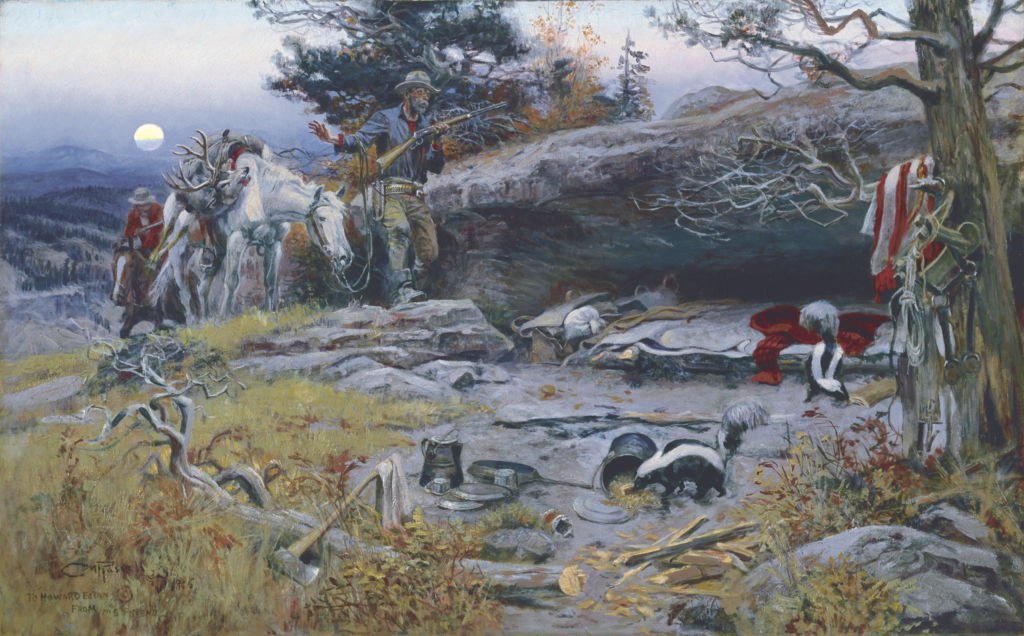
Linked to Sid Richardson Museum, as this is a 1916 dated painting, it should be public domain.  Russell:  "Man's Weapons Are Useless When Nature Goes Armed".

Tomorrow is what some people call "Thanksgiving Eve".

Not most people, but some people, and today and tomorrow are days in which a large number of Americans are on the road, going home to be with family and friends.

So, some reasonable requests, in anticipation of those gatherings.

From now, through next Monday, please:

If you are a candidate for major office, don't say anything. .  And I mean anything.  Don't voice your opinion on anything for the next few days. The nation deserves it.

This is particularly the case if you have some snotty opinion you wish to voice about something, or somebody, which only panders to your base.

If you aren't a politician. but are one of those folks who insist on voicing your political opinions in a large group, as if everyone else, or at least everyone else in your family, holds the same opinion, just keep it to yourself.

After all, if  you are really convinced that everyone believes the same thing as you do about Trump, January 6, infrastructure bills, and the like, you really don't need to say anything at all, now, do you?   At best, you're only going to learn that somebody has an equally strong, opposite, opinion, and you're off and running on an argument.

Okay, I feel differently about non-political issues, just don't mix them with politics.  I'm fine with people expressing their opinions on why people should get vaccinated, which means that you have to put up with people who are going to hold the opposite opinion.  And other health and scientific opinions as well, as long as they don't get political or wacky conspiratorial.  I.e, if you are tempted to say, "you know, influenza is simply a Portuguese plot introduce by Vasco Da Gama. . ." have a glass of port, or coffee, or something else instead.

If you live in Wyoming, or know a Wyomingite, please don't bring up the series Yellowstone.  M'eh.  It's really about the same as asking people in the physics department about The Big Bang Theory or people from New York if The French Connection depicts their daily lives.

Don't be a rube.

Also, don't drop in some surprising personal belief that is in tune with the times, to show everyone how in tune with the times you are.  As in, "you know, new evidence suggest that Christopher Columbus was a shipjacking dog kicker fleeing for his life. . . "

If you have some objection to Thanksgiving in general, and I know some of  you do, just keep it to yourself.

If there are of college age or just out of college people are there, don't ask. . . "so, when are  you two going to tie the knot?" or "how's school/job/the Navy?".

For that matter, if there are the older beleaguered there, on their one-day off from work, don't ask "so, how's work?", or "I don't mean to bother you, but you're a bicameral legislative mechanic and I am working on a bicameral legislative operative device and I was wondering. . ."

Regarding the Navy, and every military service, if you are one of the people who do it, resist posting on Facebook/Twitter/Instagram/TikTok some item of veteran hagiography.  Not every holiday needs to be Veterans Day.  You know what I mean, skip the "While you are safe and warm enjoying your @ER$@# turkey, I hope  you remember that somewhere some kid is behind a M4 carbine eating MRE's keeping your lazy civilian butt safe" or "Only the few will remember what it was like to be stationed at the ammo dump in Guam for Thanksgiving in 1967 worrying that the Red Chinese were going to swim the Pacific Ocean and. . . "

If people drove out to visit you in some distant location, and that location is cool, has neat things to do, or is just scenic, don't insist people stay in and eschew it, as in "oh, thanks for coming to our private chalet in the Swiss Alps, and yes that's our private ski run. . . now, let's pull the blinds down and talk about Donald Trump/football/gall bladders".

And by the way, if you are an employer, don't dump on the employees as they leave the door, as in "have a good @#$@#$ holiday. . . I'll be here working to feed your lazy butts. . .and by the way, whatever you are doing, you are doing it wrong, you lazy @#$@#$".

Finally, if you are one of those people with dietary concerns, self-imposed or otherwise, just spare the rest of us.

I.e, don't go to a Thanksgiving dinner and ask if the turkey is a free-range, free trade, free Tibet turkey.  Just save it.  And nobody wants to hear about your vegan/Keto/Waffle House/ or whatever diet.

Let's have a Happy Thanksgiving long weekend.

Footnotes:

*From:

A 2020 Holiday Reflection. Part 3 of 3. The Resolute Edition

Sunday, November 4, 1941. Expanding operations.

Catalina's from Patrol Squadron 14 in November 1941.

U.S. Navy Patrol Squadron 14 arrived in Oahu.

The United States Army occupied Dutch Guiana (Surinam), which is now Suriname.

Today the country is a South American republic we frankly hardly ever think of, which all in all may generally be a good thing.  At this point in history, however, it was a Dutch colony, which it had been since the 1600s.  During the war, the Dutch government reconsidered its status, and it obtained a type of dominion status in 1954, and full independence in 1975.

The US had been concerned about its bauxite deposits prior to this date, not wanting them to fall to the Axis, although exporting bauxite from northern South America to Germany would have been impossible. The occupation did secure them for the Allies, however.

This time is noted here:

Today in World War II History—November 23, 1941

Also noted there, trucks were now crossing Lake Lagoda, having followed a  horse-drawn mission of the day prior.

The British were thrown back at Sidi Rezegh in the desert.

A bomb went off outside the U.S. Consulate in occupied Saigon, although there were no injuries. Shades of things to come.

A large fire damaged parts of Seward Alaska.

Wednesday, November 23, 1921. Geology in Sheridan County, Welfare in the United States, Murder in Ukraine

Charles Russell illustrated letter of today's date.

On this date, we're reminded that Wyoming is tectonically active:
Today In Wyoming's History: November 23, 1921:

1921  An earthquake shook Sheridan County.  Attribution: Wyoming State Historical Society.
Earthquakes in Wyoming are not at all uncommon.

The Sheppard-Towner Act, which we dealt with earlier, that provided funding for maternity and child care, as signed into law by Republican President, Warren G. Harding.

Harding knew a little about childcare. At this point his illegitimate daughter, Elizabeth Ann Britton was a little over two years old.  She was not acknowledged, and the public had no idea.

In Bazar, Ukraine, the Red Army executed 359 Ukrainian soldiers who had surrendered to them.


Monday, November 22, 2021

Saturday, November 22, 1941. Advances and Reversals.

On this day in 1941 the Germans captured Klin on their advance towards Moscow.

The Atlantis.

On the same day, the German surface raider Atlantis was sunk off of Ascension Island by the HMS Devonshire, ending her surface raiding career.  The commander of the U126 which had been with her was left on board the Atlantis when the Devonshire appeared.

With the Atlantis sinking the Devonshire left the area and the U126 resurfaced and picked up 300 German survivors and one American prisoner.  She then towed the survivors in rafts towards Brazil until they were taken on board the refueling ship Python, which in turn was surprised by a British vessel on December 1 and scuttled.  It too left the area, and the survivors were then picked up by a collection of German and Italian submarines.

This interesting event gives us a window into the state of naval combat at the time. The Atlantis, a converted merchant ship, had been an effective surface raider, which is something that was on its way out.  And the Royal Navy didn't linger on station after the sinking, no doubt for good reasons, but with the results that survivors of sinkings were twice left to the Axis to pick up themselves.  Finally, the Italian navy participated in that recovery, even though their role in the Battle of the Atlantic is nearly forgotten.

Also, on this day German Luftwaffe squadron leader Werner Mölders was killed when a HE 111 he was a passenger in crashed while landing in a thunderstorm.  The plane was carrying him and other Luftwaffe figures to the commemorations for Ernst Udet.  Mölders was the first pilot in history to claim 100 aerial kills, a tally that dated back to his service in the Spanish Civil War.

Mölders was an enigmatic character who in some ways bests presents the myth of Luftwaffe pilots as somehow being above the taint of Nazism, although his service in the Spanish Civil War should cause and has a person to question that.  His father was killed in World War One when he was just a boy, and he thereafter was very much influenced by a family friend who was a Catholic Priest and was in contact to some degree with Westphalian Bishop Graf Von Galen during the war.  He was devoutly religious in spite of his German military service being 100% within the context of the Nazi regime.  When he was shot down over France early in the war he asked to meet the pilot who had brought him down, only to learn that the pilot had been killed.  He was at first somewhat mistreated as a Prisoner Of War, until a French airman intervened on his behalf, and then he later intervened with Goering to keep one of his former captors from being executed.

At the time of his death he'd only been married for a few months, with the Catholic ceremony having been preformed by his Priest friend and having been disapproved of by the Nazi regime.  Indeed, the Priest was under suspicion from the authorities.  His wife was pregnant at the time of his death.

West Germany honored him after the war with the naming of a ship and other military fixtures for him, although they were later reversed when the honors rescinded due to his service in the Spanish Civil War. At least one street remains named for him.  His grave was destroyed by East German authorities with the destruction of a graveyard, but it was restored in 1991.

At the time of his death he had been appointed Inspector of Fighters, a ground role, in part because the Nazi regime felt that it didn't wish to risk his combat death due to publicity reasons.  It's interesting to speculate what rule he may have played, if any, in the July 1944 plot had he still been living, given his strong Catholic nature, something he shared with several of the plotters of that attempted coup.

The 2nd New Zealand Division captured the Italian Fort Capuzzo in the Commonwealth drive to relieve Tobruk.

Discussions with the Japanese legation continued.

The Japanese Ambassador and Mr. Kurusu called at the Secretary's apartment by appointment made at the request of the Ambassador. The Secretary said that he had called in the representatives of certain other governments concerned in the Pacific area and that there had been a discussion of the question of whether things (meaning Japanese peaceful pledges, et cetera) could be developed in such a way that there could be a relaxation to some extent of freezing.

The Secretary said that these representatives were interested in the sug gestion and there was a general feeling that the matter could all be settled if the Japanese could give us some satisfactory evidences that their intentions were peaceful.

The Secretary said that in discussing the situation with the representatives of these other countries he found that there had arisen in their minds the wine kind of misgivings that had troubled him in the course of the conversations with the Japanese Ambassador. He referred to the position in which the Japanese Government had left the Ambassador and the Secretary as they were talking of peace when it made its move last July into Indochina. He referred also to the mounting oil purchases by Japan last Spring when the conversations were in progress, to the fact that he had endured public criticism for permitting those shipments because he did not wish to prejudice a successful outcome to the conversations and to the fact that that oil was not used for normal civilian consumption.

The Secretary went on to say that the Japanese press which is adopting a threatening tone gives him no encouragement and that no Japanese statesmen are talking about a peaceful course, whereas in the American press advocacy of a peaceful course can always get a hearing. He asked why was there not some Japanese statesman backing the two Ambassadors by preaching peace. The Secretary pointed out that if the United States and other countries should see Japan coming along a peaceful course there would be no question about Japan's obtaining all the materials she desired; that the Japanese Government knows that.

The Secretary said that while no decisions were reached today in regard to the Japanese proposals he felt that we would consider helping Japan out on oil for civilian requirements only as soon as the Japanese Government could assert control of the situation in Japan as it relates to the policy of force and conquest. He said that if the Ambassador could give him any further assurances in regard to Japan's peaceful intentions it would help the Secretary in talking with senators and other persons in this country.

Mr. Kurusu said it was unfortunate that there had been a special session of the Diet at this time, as the efforts of the Government to obtain public support had brought out in sharp relief the abnormal state of the present temper of the Japanese people who had been affected by four years of war and by our freezing measures.

The Secretary asked to what extent in the Ambassador's opinion did the firebrand attitude prevail in the Japanese army. Mr. Kurusu said that it took a great deal of persuasion to induce the army to abandon a position once taken, but that both he and the Ambassador had been pleasantly surprised when the Japanese army acceded to their suggestion in regard to offering to withdraw the Japanese troops from southern Indochina. He said he thought this was an encouraging sign, but that nevertheless the situation was approaching an explosive point.

The Secretary asked whether it was not possible for a Japanese statesman now to come out and say that Japan wanted peace; that while there was much confusion in the world because of the war situation Japan would like to have a peace which she did not have to fight for to obtain and maintain; that the United States says it stands for such ideas; and that Japan might well ask the United States for a show?down on this question.

The Ambassador said he did not have the slightest doubt that Japan desired peace. He then cited the popular agitation in Japan following the conclusion, of the peace settlement with Russia in 1905, as pointing to a difficulty in the way of publicly backing a conciliatory course.

The Secretary asked whether there was any way to get Japanese statesmen to approach the question before us with real appreciation of the situation with which we are dealing including the question of finding a way to encourage the governments of other powers concerned in the Pacific area to reach some trade arrangement with Japan. He pointed out that Japan's Indochina move, if repeated, would further give a spurt to arming and thus undo all the work that he and the Ambassador had done. He suggested that if the United States and the other countries should supply Japan with goods in moderate amounts at the beginning those countries would be inclined to satisfy Japan more fully later on if and as Japan found ways in actual practice of demonstrating its peaceful intentions. He said that one move on Japan's part might kill dead our peace effort, whereas it would be easy to persuade the other countries to relax their export restrictions if Japan would be satisfied with gradual relaxation.

Mr. Kurusu said, that at best it would take some time to get trade moving. The Secretary replied that he understood this but that it would be difficult to get other countries to understand until Japan could convince those countries that it was committed to peaceful ways. Mr. Kurusu said that some immediate relief was necessary and that if the patient needed a thousand dollars to effect a cure an offer of three hundred dollars would not accomplish the purpose. The Secretary commented that if the Japanese Government was as weak as to need all that had been asked for, nothing was likely to save it.

Mr. Kurusu said that Japan's offer to withdraw its forces from southern Indochina would set a reverse movement in motion.

The Secretary said that the Japanese were not helping as they should help in the present situation in which they had got themselves but were expecting us to do the whole thing.

Mr. Kurusu asked what was the idea of the American Government.

The Secretary replied that although the Japanese proposal was addressed to the American Government he had thought it advisable to see whether the other countries would contribute and he found that they would like to move gradually. The effect of an arrangement between these countries and Japan would be electrifying by showing that Japan had committed herself to go along a peaceful course.

Mr. Kurusu asked what Japan could do. The Secretary replied that if, for example, he should say that he agreed to enter into a peaceful settlement provided that there should be occasional exceptions and qualifications he could not expect to find peaceful-minded nations interested.

The Secretary then asked whether his understanding was correct that the Japanese proposal was intended as a temporary step to help organize public opinion in Japan and that it was intended to continue the conversations looking to the conclusion of a comprehensive agreement. Mr. Kurusu said yes.

Mr. Kurusu asked whether the Secretary had any further suggestions. The Secretary replied that he did not have in mind any suggestions and that he did not know what amounts of exports the various countries would be, disposed to release to Japan. He said that Japan made the situation very difficult, for if Japan left her forces in Indochina, whether in the north, east, south or west, she would be able to move them over night, and that therefore this would not relieve the apprehensions of neighboring countries. The British, for example, would not be able to move one warship away from Singapore. .

The Ambassador argued that it would take many days to move troops from northern Indochina to southern Indochina, and he stated that the Japanese desired the troops in northern Indochina in order to bring about a settlement with China. He said that after the settlement of the China affair Japan promised to bring the troops out of Indochina altogether.

The Secretary emphasized again that he could not consider this, that also uneasiness would prevail as long as the troops remained in Indochina, and commented that Japan wanted the United States to do all the pushing toward bringing about a peaceful settlement; that they should get out of Indochina.
Mr. Kurusu observed that the Japanese Foreign Minister had told Ambassador Grew that we seemed to expect that all the concessions should be made by the Japanese side.

The Secretary rejoined that Mr. Kurusu had overlooked the fact that in July the Japanese had gone into Indochina. He added that the United States had remained from the first in the middle of the road, that it was the Japanese who had strayed away from the course of law and order, and that they should not have to be paid to come back to a lawful course.

Mr. Kurusu said that this country's denunciation of the commercial treaty had caused Japan to be placed in a tight corner.

The Secretary observed that Japan had cornered herself; that we had been preaching for the last nine years that militarism was sapping everybody and that if the world were to be plunged into another war there would not be much left of the people anywhere. He said that in 194 he had told Ambassador Saito that Japan was planning an overlordship in East Asia. The Secretary added that he had tried to persuade Hitler that participation by him in a peaceful course would assure him of what he needed. The Secretary said it was a pity that Japan could not do just a few small peaceful things to help tide over the situation.

Mr. Kurusu asked what the Secretary meant. The Secretary replied that the major portion of our fleet was being kept in the Pacific and yet Japan asked us not to help China. He sand we must continue to aid China. He said it was little enough that we were actually doing to help China. The Ambassador commented that our moral influence was enabling Chiang to hold out.

The Secretary said that a peaceful movement could be started in thirty or forty days by moving gradually, and yet Japan pushed everything it wanted all at once into its proposal. The Ambassador explained that Japan needed a quick settlement and that its psychological value would be great.

The Secretary said that he was discouraged, that he felt that he had rendered a real contribution when he had called in the representatives of the other countries, but that he could only go a certain distance. He said he thought nevertheless that if this matter should move in the right way peace would become infectious. He pointed also to the danger arising from blocking progress by injecting the China matter in the proposal, as the carrying out of such a point in, the Japanese proposal would effectually prevent the United States from ever successfully extending its good offices in a peace settlement between Japan and China. He said this could not be considered now.

There then ensued some further but inconclusive discussion of the troop situation in Indochina, the Secretary still standing for withdrawal, after which the Ambassador reverted to the desire of the Japanese Government to reach a quick settlement and asked whether we could not say what points in the Japanese proposal we would accept and what points we desired to have modified.

The Secretary emphasized that there was no way in which he could carry the whale burden and suggested that it would be helpful if the Japanese Government could spend a little time preaching peace. He said that if the Japanese could not wait until Monday before having his answer there was nothing he could do about it as he was obliged to confer again with the representatives of the other governments concerned after they had had an opportunity to consult with their governments. He repeated that we were doing our best, but emphasized that unless the Japanese were able to do a little there was no use in talking.

The Ambassador disclaimed any desire to press the Secretary too hard for an answer, agreed that the Secretary had always been most considerate in meeting with the Ambassador whenever an appointment had been requested, and said that the Japanese would be quite ready to wait until Monday.

The Secretary said he had in mind taking up with the Ambassador sometime a general and comprehensive program which we had been engaged in developing and which involved collaboration of other countries.

The Ambassador said that the Japanese had in mind negotiating a bilateral agreement with us to which other powers could subsequently give their adherence.

The U.S. Navy launched the USS Aaron Ward, a Gleaves class destroyer.  Her service would be brief, as she was sunk by the Japanese in 1943 off of Guadalcanal.


Tuesday, November 22, 1921. Far Eastern Diplomacy*

President Harding's 1921 Thanksgiving turkey.


Flag of the Emirate of Afghanistan, which existed from 1919 until 1926, when it was succeeded by the Kingdom of Afghanistan.

The Emirate of Afghanistan and the United Kingdom modified the 1919 Treat of Rawalpindi such that Afghanistan could import munitions through India, the border was readjusted in Afghanistan's favor at the Kyber Pass, and Afghanistan assured that no Soviet consulates would be established in the country.

Elsewhere in Far Eastern diplomacy, Japan recognized Manchuria as part of China, which it had previously resisted.

Errata:

Most of this post ran on November 21 under that date, in error.

Sunday, November 21, 2021

Friday, November 21, 1941. Storms named Maria, Thanksgiving Parades, the 70th Infantry Division launches an attack at Tobruk, Relief across Lake Logoda, Dutch War Warning.

George Stewart's novel Storm, which dealt with a subtropical storm hitting California, and ultimately even New York, hit the stands. In the novel, the National Weather Service names the storm Maria, which in turn caused the NWS to actually start naming storms, and which inspired the song They Call The Wind Maria in the 1951 play Paint Your Wagon.

I'd often wondered how that suggestion came about.  The lyrics of the song, which is set in the mid 19th Century, famously claimed names for all sorts of natural events.

A Way Out Here They've Got A Name For Wind And Rain And Fire
The Rain Is Jack The Fire Is Joe And They Call The Wind Maria
Maria Flows The Stars Around Since The Clouds're Flying
Maria Makes The Mountains Sound Like Cold Wind Out There Dying
Maria Maria They Call The Wind Maria 
Before I Knew Maria's Name Heard Her Wails And Whining
I Had A Girl And She Had Me And The Sun Was Always Shining
And Then One Day I Left My Girl Left Her Far Behind Me
Maria Blowed Her Love To Me I Need Her Here Beside Me
Maria Maria They Call The Wind Maria 
Out Here They've Got A Name For Rain And Wind And Fire Only
But When You're Lost And All Alone There Ain't No Name For Lonely
Now I'm A Lost And Lonely Man Without The Stars To Guide Me
Maria Blowed Her Love To Me I Need Her Here Beside Me
Maria Maria They Call The Wind Maria

Interestingly, the book was influential, but not so much that it was ever made into a movie.  It was made into a televised Disney production.

Shoppers on that day were enjoying day two of the Thanksgiving Holiday, if they lived in state observing it this week and not next.  The New York Macy Thanksgiving Parade was held on this day in 1941.

The British 70th Infantry division attacked from besieged Tobruk.  The Italians held them back, but Afrika Korps defenses everywhere were rapidly being stretched to the breaking point.

Men of the 70th Infantry Division at Tobruk.

A Soviet horse-drawn supply column crossed the frozen Lake Lagoda outside of Leningrad/St. Petersburg for the first time, meaning that the besieged town is now no longer really encircled, but sill in desperate straits. The first convoy carried food stuffs.

The USSR also, on this day, instituted a tax on childless bachelors, singles, and small families. The tax would remain in place until 1992. The tax was instituted under the Soviet belief that childless people possessed more discretionary income and therefore needed to do more from that to help defend the state.

An elaborate military ceremony was held for the departed Ernst Udet, whose passing the German press attributed to an "accident".  Goering and Hitler were in attendance.

The United States Navy issued the following warning

Have been informed by Dutch Legation that they have received a dispatch as follows: 
 “According to information received by the Governor General of The Netherlands East Indies a Japanese expeditionary force has arrived in the vicinity of Palau. Should this force, strong enough to form a threat for The Netherlands Indies or Portuguese Timor, move beyond a line between the following points Davao (Philippine Islands) Waigeo (Island, Netherlands East Indies) Equator the Governor General will regard this as an act of aggression and will under those circumstances consider the hostilities opened and act accordingly." 
Inform Army authorities of foregoing. Request any information you may have concerning development of this Japanese threat against the Dutch East Indies and your evaluation of foregoing information.

For movie goers, two new films hit the screen, one being Shadow of the Thin Man, the fourth installment in that series, and the highly romanticized account of the death of George Custer and his men, They Died With Their Boots On.

Both are noted here:

Today in World War II History—November 21, 1941

Also noted is George Stewart's novel Storm.

Saturday, November 20, 2021

The Best Posts of the Week of November 14, 2021

The best posts of the week of November 14, 2021.

The weary Agrarian looks at modern "Homesteading"


Cliffnotes of the Zeitgeist Part XXIII. Trial, what trial? Looking for a fight. Free Peng Shuai. Leisure, rights and politics.

Eh?

There's a widespread assumption that lawyers follow criminal trials because they're lawyers.

That's incorrect.

For the second time in recent months, I've been asked by somebody what I thought of 1) the accusations against Kyle Rittenhouse and the 2) trial of Kyle Rittenhouse.

This presume that I'm following anything in regard to Kyle Rittenhouse. 

I know a little more about his situation than I did a couple of days ago, but only as I started to pay a little more attention after it was brought to my attention for the third time.  

The first time I was in a trial myself and was called by a client.  "What do you think about the accusations against Rittenhouse?".

I had no idea what this referred to, even though I was dimly aware that some teenager carrying a M4 style carbine had killed somebody in a disturbance somewhere.  More recently, the same person asked what I thought of about was coming out at the trial.

"I've been so busy, I haven't been following it".

That was true, but only partially so.  I wasn't following it, and I am very busy, but I don't usually follow criminal trials anyhow.

Finally, I was in a deposition when the verdict came in. The deponent actually had his phone set to rig a bell when the news came in, he was following it so closely.  He actually asked if we could take a break to read about it.

No break.

In the next break, none of the lawyers discussed it. One spoke about his upcoming holiday where he was going to a Ferrari race car driving school. That did sound pretty interesting.

This brings up a couple of things.

Living by the sword

Marines in Hue.  If you want to live like this constantly, there are places that you can do it for real, rather than pretending that it's about to happen here.

I knew a former University of Wyoming football player who didn't follow football at all.  He was always caught flat-footed when somebody asked his opinion on football matters.  He'd played football and presumably liked it, but he just didn't follow it after his college athletic career concluded   

I get that.

If you work every day in the law, you have a lawyers prospective, but given that, you likely know that there's a lot nobody knows about anything being tried and, moreover, the Press isn't very good at reporting trials anyhow.  

And frankly, most criminal trials are exclusively local news stories, not worth reporting on as big national news. This one is a slight exception, but it's getting a lot more press than it deserves and people are drawling conclusions which likely aren't merited.

One big conclusion is that lawyers are a lot less interested in the "big news" trials than other people seem to be.

There's probably a reason for that.

So what I now know is this.

Ritterhouse was 17 years old and went to a protest carrying a M4 type carbine.  The protest was racially charged and arose from an earlier Kenosha police shooting of an African American man.  Ritterhouse, while only 17, had an association with the current right-wing populist militia type groups.  He spent part of the night marching around, much like the armed men in downtown Casper during a similar event last summer.

While there, he encountered a Joseph Rosenbaum. Rosenbaum had been belligerent all night and at some point chased Ritterhouse.  Somebody fired a shot in the air, and Rosenbaum lunged at Ritterhouse and tried to disarm him. Ritterhouse shot  and killed him. He then fled on foot and was pursued and physically attacked.  The last assailant pointed a pistol at him but was only wounded when Ritterhouse fired first.

With that set of facts, there is no crime to commit Ritterhouse of.  He acted in self-defense.

Which doesn't really excuse him, or indeed some of the crowd.

Some things to consider.

Ritterhouse is part of the delusional set that exists in our country that feels that they need to walk around like they live in Hue in 1968. They don't, and it's dumb.  It should stop.  Now he seems genuinely remorseful, but he'll live with killing two other humans for the rest of his life, and it'll be ages before he escapes what occurred.  Frankly, he probably ought to change his name and disappear for a long while.  Lt. Calley overcame his crimes, so Ritterhouse will this too, but it'll be a long time.

He shouldn't have been there.

Next, while this event was supposedly over the killing of a black man by the police, all those involved in these shootings were white.  White right-wing militia kid Ritterhouse and three white protestors. 

 Joseph Rosenbaum was being belligerent and was just out of the hospital after trying to commit suicide.  He was a convicted child molester.

He should have been in the hospital.

His family showed up to protest the results, complete with a sister with a nose ring.  I'm not going much further on this, but Ritterhouse was not only a mess, but at least a partially icky violent mess.  That he got shot isn't all that surprising.

The second shooting victim, Anthony Huber, had served two prison stints, one for domestic abuse and one for trying to choke his brother.  

The third guy, the one who was wounded, pointed his handgun at Ritterhouse "accidentally", but also had a criminal history.  He had a concealed firearms permit which, oddly enough, expired that day.

You can draw lessons from this, and the survivors should.  Almost none of them will be the ones that are bandied about by anyone.

And once again, African Americans, who do have a story to tell here, have had their thunder stolen by a bunch of youthful whites ended up playing out on the stage when this really ought to have been focused on something else.

Let the stupid comments begin

Notwithstanding the fact that most people don't understand how the legal system actually works, there will be floods of really bad punditry and for that matter just regular public comment as a result of the verdict. Some will demand that Ritterhouse be hauled in front of a Federal Court as they perceive that justice wasn't done, others will want to give him the Congressional Medal of Honor for being in the wrong place, at the wrong time, and with insufficient maturity not to appreciate that he wasn't Sgt. York.

Already I've seen a comment on a list serve that's usually dedicated to lost cats and such things.

Uff.

Free Peng Shuai


I skipped all the concern over Brittany Spears when it was rolling around.

I hope that Peng Shuai gets at least as much attention.

I don't follow women's professional tennis, which is no surprise as the only professional sport I really follow is baseball, and this year I couldn't even get into it.  At any rate, I take it that she is a well known, and Chinese, tennis star.

She recently accused Vice Premier Zhang Gaoli of forcing sex upon her.

It's actually more complicated, and frankly icky, than that.  It started off, apparently, as an off and on extramarital affair and concluded with an assault, she alleges, with guard posted outside of her door.

And she's now disappeared.

The Chinese are really resisting opening up on this, which demonstrates what a thugocracy it is. Sooner or later it'll fall, but right now it has a chokehold on the Chinese people and is looking to expand its brutal grip over Taiwan.

We only put up with this due to money.

The Chinese Communists are bad for everything.  They're bad for the Chinese, and they're bad for the environment.  It ought to stop.

The US is demanding to know what's up with her whereabouts.  The Chinese, who are used to simply offing the difficult, seem surprised and more than caught a little off guard.

The proletariat

The Peng episode brings up something that will play itself out in the coming years, and probably more rapidly than we might suspect.

Most of the Chinese are still very poor, but as they build a middle class, that middle class is not going to cooperate with being out of power.  There is already a Me Too Movement in China, and it's pretty clear the authoritarian government doesn't know what to do about it.  

This is no surprise as it doesn't know what to do with the democracy movement either.

The infusion of money into people's hands eventually transforms them into a class that wants some sort of power.  It doesn't always work perfectly at first, as Russia provides ample evidence of.  And on the flipside, rich capitalist countries can undermine themselves by failing to heed Jefferson's warnings about wide scale funding of the public feeding trough, which I suspect may relate to more in this post than people are willing to admit.

Chanteuse

Apparently Taylor Swift and Adele have new releases out.

M'eh.

Thursday November 20, 1941. Thanksgiving Day.

 This was Thanksgiving Day in 1941. . . unless it wasn't.

The situation was pretty confused, it's easier to read about it here:

Thanksgiving in World War II

American Thanksgiving is a fairly late Thanksgiving to start with. As has been noted here on earlier posts, this holiday is much less unique to the US than Americans think it is.  Most nations do it earlier, however.

It has moved around in the US case.  The Library of Congress's "Wise Guy" posts, summarize it as follows:

Is it time to buy the turkey? In 1939, it would have been difficult to plan your Thanksgiving dinner for 12.

Today, Thanksgiving is celebrated on the fourth Thursday of November. But that was not always the case. When Abraham Lincoln was president in 1863, he proclaimed the last Thursday of November to be our national Thanksgiving Day. In 1865, Thanksgiving was celebrated the first Thursday of November, because of a proclamation by President Andrew Johnson, and, in 1869, President Ulysses S. Grant chose the third Thursday for Thanksgiving Day. In all other years, until 1939, Thanksgiving was celebrated as Lincoln had designated, the last Thursday in November.

Then, in 1939, responding to pressure from the National Retail Dry Goods Association to extend the Christmas shopping season, President Franklin D. Roosevelt moved the holiday back a week, to the next-to-last Thursday of the month. The association had made a similar request in 1933, but at that time, Roosevelt thought the change might cause too much confusion. As it turns out, waiting to make the change in 1939 didn't avoid any confusion.

At the time, the president's 1939 proclamation only directly applied to the District of Columbia and federal employees. While governors usually followed the president's lead with state proclamations for the same day, on this year, 23 of the 48 states observed Thanksgiving Day on November 23, 23 states celebrated on November 30, and Texas and Colorado declared both Thursdays to be holidays. Football coaches scrambled to reschedule games set for November 30, families didn't know when to have their holiday meals, calendars were inaccurate in half of the country, and people weren't sure when to start their Christmas shopping.

After two years of confusion and complaint, President Roosevelt signed legislation establishing Thanksgiving Day as the fourth Thursday in November. Roosevelt, recognizing the problems caused by his 1939 decree, had announced a plan to return to the traditional Thanksgiving date in 1942. But Congress introduced the legislation to ensure that future presidential proclamations could not affect the scheduling of the holiday. Their plan to designate the fourth Thursday of the month allowed Thanksgiving Day to fall on the last Thursday in five out of seven years.

This was the last  year of the confusion, and the split dates.  Sarah Sundin, on her blog, noted:

This was a hugely unpopular decision. While 32 states adopted the earlier date, 16 refused to. In 1939, 1940, and 1941, two dates were celebrated, depending on the state. The later original date was nicknamed “Republican Thanksgiving” and the new early date “Democrat Thanksgiving” or “Franksgiving.”

By mid-1941, Roosevelt admitted the earlier date had no effect on retail sales figures. On October 6, 1941, the House of Representatives voted to move Thanksgiving back to the last Thursday of November. The Senate amended the bill on December 9, 1941 (despite the previous day’s declaration of war on Japan) to make the holiday fall on the fourth Thursday, an accommodation for five-Thursday Novembers. The president signed the legislation on December 26, 1941.

So what about Wyoming in 1941?  Did we do Democratic Thanksgiving or Republican Thanksgiving this year?

Today.

Indeed, it's a little surprising, at least in a modern context, but Wyoming recognized today as the Thanksgiving Holiday for 1941. While Wyoming had a Republican legislature, and a Republican Governor, Nels H. Smith, serving his single term, it followed the Federal lead.

Lots of Americans were having their second military Thanksgiving.

Troops training in the field gathered around cook who is cooking turkey's with a M1937 field range.

Holidays in large wartime militaries, and while the US was not fully at war yet, this really was a wartime military, are a different deal by definition. The service does observe holidays and makes a pretty good effort at making them festive, but with lots of people away from home without wanting to be, they're going to be a bit odd.  Some troops, additionally, are going to be on duty, training, or deployed in far off locations.

As noted above, we've included a wartime photo of a cook in what is undoubtedly a staged photo cooking two turkeys in a M1937 field range, a gasoline powered stove.

They continued to be used through the Vietnam War.

Holiday or not, talks resumed in final earnest between the United States and Japan, with Japanese representatives presenting this proposal to the United States

1. Both the Governments of Japan and the United States undertake not to make any armed advancement into any of the regions in the South?eastern Asia and the Southern Pacific area excepting the part of French Indo-China where the Japanese troops are stationed at present.

2. The Japanese Government undertakes to withdraw its troops now stationed in French Indo-China upon either the restoration of peace between Japan and China or the establishment of an equitable peace in the Pacific area.

In the meantime the Government of Japan declares that it is prepared to remove its troops now stationed in the southern part of French Indo-China to the northern part of the said territory upon the conclusion of the present arrangement which shall later be embodied in the final agreement.

3. The Government of Japan and the United States shall co-operate with a view to securing the acquisition of those goods and commodities which the two countries need in Netherlands East Indies.

4. The Governments of Japan and the United States mutually undertake to restore their commercial relations to those prevailing prior to the freezing of the assets.

The Government of the United States shall supply Japan a required quantity of oil.

5. The Government of the United States undertakes to refrain from such measures and actions as will be prejudicial to the endeavors for the restoration of general peace between Japan and China.

The Germans captured Rostov on the Don in Russia and slowed the British advance in North Africa.

Averting Disaster


Back in July we ran this:
Lex Anteinternet: Facing economic reality. The disaterous neglect o...:  Big news at the University of Wyoming: UW Proposes Transformation in Light of Budget Reductions, Changing Needs So the university is going ...

Well, through careful reorganization and internal budget cuts, the big layoffs are being avoided.  No departments are being eliminated either.

This is certainly good news, but it is surprising in context.

Holscher's Hub: Near the Nowood

Holscher's Hub: Near the Nowood: