Friday, November 3, 2017

Creeps


Delia Kane, age 14.  The Exchange Luncheon, Boston.  January 31, 1917.  Recent stories have been focused on recent creeps, but you have to wonder how bad the treatment somebody like this girl, employed at age 14 in 1917, was in her era.  I hope not bad, but I'm not optimistic.

When the news hit about Harvey Weinstein, my first reaction was, "who is Harvey Weinstein?"^

I wouldn't have posted here about Weinstein at all until all the "me too" stuff started to come out, and then, as a draft, I started a thread called "Harvey Weinstein's everywhere?  And if so, why?".  I didn't get far on that, however.  Indeed, I got no further than the title itself.

From time to time thereafter I pondered a thread on it, but I never typed anything out.  In part I didn't because, as "me too" type stories started coming out, it was pretty clear that this entire story is societal in nature, not a Hollywood story (at least not exclusively so).  It was tempting to caste it as an example of moral decay, but I think this behavior has gone on, in perhaps somewhat different forms, for eons, so that wouldn't be accurate.  So I let it sit.

And then Dana Milbank wrote his column on it, and its really worth reading.

Milbank's article is entitled "How Could I Have Been So Stupid?" and relates that he was a staffer at The New Republic.  I was unaware of that even though I was once a loyal TNR reader (I dropped my subscription this year).*  In the article Milbank notes:
I was amazed by the #MeToo outpouring by women who have been sexually harassed or assaulted. So many women I know have been victims, and yet, I marveled, I had spent my career in charmed workplaces where such things didn’t happen.
But this week I learned that, earlier in my career, I worked in a place that was the very definition of a hostile work environment — a place that is now one of the most visible examples of the Harvey Weinstein fallout. Worse, one of my dearest friends was a victim — indeed, the one who first went public.
That place was TNR, as he relates, and the abuser was Leon Wieseltier.  Wieseltier isn't accused of being as big of spook as Harvey Weinstein, but he is accused of some inappropriate conduct.  Former TNR staffer Michele Cottle, Milbank's friend noted in his article, has written an article about it in The Atlantic.  She's stated:
It was never an “open secret” among me and my then-colleagues that Leon Wieseltier, the longtime literary czar of the New Republic, behaved inappropriately with women in the workplace. It was simply out in the open. This week, Wieseltier’s previously forthcoming culture magazine was suspended, and Wieseltier publicly apologized for past misconduct. Multiple women have complained of sexual harassment they say occurred during much of his three-decade reign at the New Republic.
Pretty harsh statements by Cottle.  How does that square with Milbank's article, in which he claims he wasn't aware of anything?. Well, it likely does and that's likely part of the nature of this problem.  Milbank states now that he was blind to it and didn't know it was going on, but that he should have suspected something due to Wieseltier's lewdness and bullying nature.  He's probably right, but then I suspect that most men in the modern workplace would have the same failing.  Maybe that's not the case now.  But maybe it is.  As Milbank notes:
I and many other male alumni of TNR, feminists all, are shaken by what we’ve learned this week. We weren’t a conspiracy of silence, but we were in a cone of ignorance. My friend Franklin Foer, a former editor, recalls being uncomfortable with Wieseltier’s lewd comments when he first arrived at the magazine. But “they just seemed accepted. I said nothing — and certainly didn’t think hard enough about how those remarks would be suggestive of private behavior or created a hostile environment.”
This begs the question, I suppose, of how long this has gone on.  And I suspect for a really, really long time.  Is it better or worse than it used to be? Well, that'd be hard to gauge.  I suspect the answer to that is yes on both accounts.

 Actress Loretta Young.  Young was one of the inspirations for the character in Hail Caesar! who adopts her own baby to cover a pregnancy.  In Young's case, however, the story wasn't so charming, according to some.  According to Young, she's been raped (some stories state it as "date rape") by Clark Gable resulting in the pregnancy, but the story wasn't revealed until after the death of both of them and therefore it truly isn't clear that it happened.  Young and her family came up with the story of her adopting a child to cover the situation and out of fear that the studio would try to force her to have an abortion which the devoutly Catholic Young would not contemplate, although here too there's some suggestion that the studio, much like in Hail Caesar!, conspired to keep the story secret essentially in the same method depicted in the film.  She kept the secret, although it was widely speculated on for years, as she didn't want to damage her career or that of Gable.

To set the stage for that it might be instructive, as odd as it may seem, to take a look at older films, particularly those from the late 1950s or the 1960s.  The Apartment or How To Succeed In Business Without Really Trying provide good examples. Both deal with a similar scenario, to a degree, young women in white collar offices who are treated as toys.^^  The real story behind the pregnant actress in Hail Caesar! provides a grimmer example (the actress the story was based on, Loretta Young, may have been raped, or date raped, or at least forced upon, maybe, by Clark Gable and the story was made up to cover the resulting pregnancy).  And anyone who knows a woman who worked in that era can find stories of men who acted like leches in the office.  It was simply tolerated as part of the background.  Indeed, if tales of the abuse household servants routinely took in some households are taken into account, this history goes back way before women really started to enter the modern workplace.

Indeed, if we go way way back, the Old Testament gives us the example of the unjust elders, who sought to force Susanna into a sexual relationship after they'd been ogling her for a while at the pool near her garden, only to have their treachery revealed in a trial that cost them their lives.**  We can presume that Wieseltier, whose parents were fairly Orthodox Jews (and survivors of the Holocaust), and who attended Jewish schools (and sent his kids to them) knows that, as he has related as to how he quit wearing the yarmulke, (kippah) as, even though he still is a practicing Jew, "My faith was not sufficiently strong to withstand my desire to taste wine and kiss women.”*** 

We likewise can suppose that Bill O'Reilly is well aware of this passage as he's a Catholic and it shows up fairly frequently in the liturgy.  O'Reilly likewise must be aware of the admonition that even looking at a women with lust is the commission of adultery.****  At least in Wieseltier's case he's on record with a statement preferring women and wine over adherence to sexual morality.  No such defense can be made for O'Reilly who never hinted on a personal code of aberrant departure..

Anyhow, just as Milbank now relates, there were signs that Wieseltier was a cad way back.  People just chose to ignore it.  Indeed, while getting ahead of ourselves here, apparently stories of his behavior have been long known, if ignored, and indeed Vanity Fair ran an article about him years ago detailing his drug use and, in their words "unproductive" life. .  chances are that similar revelations (long caddish behavior) could have been said about every single one of these guys, starting with Bill Cosby and running forward to the reveal of the day.

So, anyway, has nothing changed at all? Well. . . .I'm not so sure.  But I'm not sure it has either.

Back early in the Trump administration there was a day in which women demonstrated, and indeed that was sparked by accusations of caddish behavior by Trump.  One of my cousins did and in doing it, posted her recollections of her early days in working in Denver.  It was pretty clear that really the sort of brutish conduct that's now being complained about was part of her early professional career down there, something I had no idea of, and that caused her and her daughter to turn out for the demonstrations.  I can't blame her, and I was pretty shocked.  I would never have guessed it.

I particularly would not have guessed it in this day and age, in which women working has become so common.  But it seems to continue to happen fairly regularly.

As noted above, this sort of thing seems to have gone on forever, and in some fashion it certainly always has.  Nonetheless it's hard not to wonder if the Playboyization of the culture has a role in this today.  Maybe not, but maybe it does.  While the recently departed UberCreep Hugh Hefner liked to portray his trashy rag as progressive, in reality it was massively regressive.  What had been an industry dedicated, in large degree (although World War Two had partially changed that) to portraying prostitutes as toys changed to portraying every girl next door as a buxom dimwitted eager toy.  That view of women has really stuck in society in spite of all the advances in the work place that have been made.  You cannot really portray women as toys for men and expect powerful men not to treat them that way, to at least some degree.  Indeed, it's been interesting to note that the behavior we're now noting has no political or ideological limit, it's been perpetrated by both male figures of the left and the right.
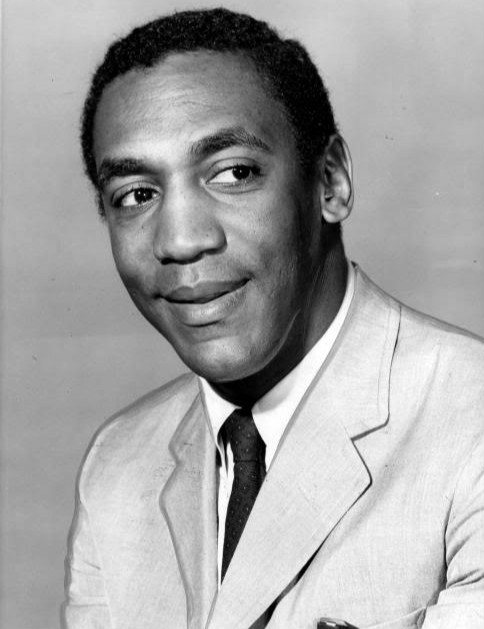
 Comedian Bill Cosby in 1966.  Cosby is genuinely hugely funny, and had a long career that resulted in him ending up being called, for a period of time, "America's Dad", only to have the crushing revelations of bizarre sexual behavior break out and lead to legal action of various type.  Anyway you look at it, he seems to have engaged in some really creepy behavior over a long period of time.

Indeed, I find it interesting here that the first figure to be revealed in what is now a long chain of revelations was Bill Cosby. The story is now out sufficiently long on him that, in the American short attention span news cycle, the stories of him drugging and violating women are now so old that they don't seem to be included in the current stores of newly revealed creeps.  But he was the first one.  And as the first one, I don't find it insignificant that he was a favorite in some ways of Hugh Hefner, attending parties regularly at the Secular Temple of Women Abuse that Heftner style a "mansion".

So maybe that what's changed is that we don't really know where the line is actually drawn in that its so far crossed that even treating women as toys doesn't work as an excuse..  Maybe the concept that this isn't wrong had changed to where the line isn't so clear.

I suspect that's the case, and that's why I also think a lot of the current analysis is off the mark.  I keep reading its about power.  I don't think so.  I think it's just about sex.

People are odd in who they want to interpret things and prone to over interpreting them to suit their current world view.  I think that's what's occurring here.  Acting badly about sex is something that some men in positions of power have done for eons, but not necessarily because it's about power, so much as their power gave them the ability to act badly in this context.  Men without money and power have also acted badly in these regards as well.  Men with power and money are simply better able to get away with it.  So their exercising their vice in this fashion isn't to demonstrate their power, it's what their power lets them get away with.  The same men would probably leer at women on the factory floor, if that was their station, if they could get away with it.

Indeed, the last reveal to hit the news on this seems to demonstrate this all the more. We've gone through Bill Cosby, Bill O'Reilly, Harvey Weinstein, Mark Halpern, Michael Oreskes and Leon Wieseltier, amongst others, only to arrive upon Kevin Spacey, whom another man claims Spacey made a sexual advance upon when that man was fourteen.*****  Spacey, he claims, was drunk at the time and doesn't recall it, but he apologized and then came out as a homosexual.  That seems to be a pretty clear explanation, not an excuse but an explanation, but now the homosexual community is in an uproar claiming that Spacey slandered them by suggesting that homosexuals are ipso facto pedophiles.  In actuality, however, that's not pedophile behavior but is classed by some other name I don't recall, and I'm not going to look up, which defines people who are attracted basically to post pubescent teenagers.  I.e., really young men and women.  That's significant in that that behavior is illegal and most people do not and will not engage or tolerate it but it's in the area of interaction which is not outside of the historic norm.  It's predatory, but its a species of sexual predation and not a power play, and is justifiably something we're really shocked about. We read of the same conduct being perpetrated by some people in charge of young people, most often teachers it seems, fairly regularly.  There was a shocking example of some teacher somewhere (I don't tend to follow these stories) who perpetrated such an act upon three students in a single day just recently, which is a lot more egregious, in relative terms, than Spacey's apparently one time drunk episode.  That doesn't excuse either, but what it suggests is that all of this stuff is about sex, not power.  Teachers, for example, are really powerful people in real terms in our society.  Nor are the other people generally accused of these sorts of acts.  Maybe Cosby, O'Reilly, Weinstein, Halpern and Wiseltier are, but that power allows them the opportunity, it's not the motive.

   
Obituary for Mildred Harris, movie actress, who born in Cheyenne.  She was a significant actress in the silent film era, having gone from being a child actor to a major adult actress, but had difficulty making the transition to talking pictures.  Harris married Charlie Chaplin in 1918, at which time she was 17 years old and the couple thought, incorrectly, that  she was pregnant.  In a way, although certainly not purely, this story recalls the Spacey story except that it didn't destroy Charlie Chaplin. Granted, she was older that Spacey's accuser, but not much at the time she and Chaplin met as she was 16 years old at that time.  He would have been about 29.  The marriage did not last long.

So what' the point?

Well, this behavior has always existed.  And its always been tolerated in the upper reaches of society.  Indeed, in the "me too" revelations, I'm not sure why no one is recalling the earlier reveals about John F. Kennedy, who was a terrible lech.  And that brings us to another difference, I suspect.

Earlier this conduct was disapproved of widely, but it was fairly well hidden and some in power were flat out protected.  Kennedy got away with stuff that's shocking really and at least, if one of his mistresses is to be believed, their first encounter could classify as rape under the loose definition given to that today (but it wouldn't have so qualified at the time).  Bill Clinton didn't get away with lecherous conduct in the Oval Office, even if he did (and I don't know if he did or didn't) with earlier such encounters, although he went on to be generally forgiven for it by the public after it was revealed.  None of these guys is going to get away with it.

 Bill Clinton.  His consensual affair while in the Oval Office nearly cost him the job. But his reputation managed to rebound, which is not quite as amazing as the situation pertaining to. . .

John F. Kennedy, whose personal morality in regards to women is truly appalling, but which hasn't seemed to diminish the "Camelot" reputation of his Presidency.

And the fact that they're not going to get away with it, probably even Spacey isn't going to get away with his, is a good thing.  Maybe things have really changed.

Maybe not, however.  Cokie Roberts, in being interviewed about this over the weekend, didn't think so at all.  But I think she's likely wrong.  I think there's been a true shift here.

But if there has been one, has there been a realization that the conduct complained of is wrong in a broader sense?  I don't think so, and that's where I think we've lost ground.

At the end of the day, if there's a line that's been crossed, people have to know what the line is so that we can philosophically grasp what the nature of that line is, and where it comes from.  And we're not doing that very well here when we claim its about power, but at the same time, fairly clearly, we cry out that it violates the Old Law.

And indeed, that's what we are really doing, which is good in a way, but which would be better if we grasped that we are crying out in that fashion.  In this current age when the very concept of male and female is confused, what we are seeing is woman after woman complaining that one man or another violated them in some fashion.  In a society in which every woman started to be implicitly violated every month with the latest issue of Playboy, and which the entertainment industry violates them with nearly ever new release, and which even magazines devoted to sports famously violate them annually, that's really something.  It's cri de coeur that goes all the way back.

And because it does, maybe we need to think of the nature of that.  Maybe not only these creeps are wrong, but maybe a society that tolerates this conduct and recognizes no standards at all in regards to sex, men and women,  needs to consider what it has become.  Toleration of this sort isn't just in the board room or the Hollywood office ought not to tolerate it on the cover of Sports Illustrated or in the student hallways.

In other words, it's great that this behavior is being exposed now. But in a society in which hookup relationships, in which the demand is that women put out, and in which women who don't meet some Playboy centerfold model standard of beauty must undergo plastic surgery, and in which everything from advertising to Sports Illustrated is graced with photographs of nearly naked women, how serious are we, really?

And if we are serious, what standard are we actually recalling, and where does it come from?


Finally, something that shouldn't be missed from Milbank's observations is that apparently at least Wieseltier was a bully.  The relationship between disrespectful and mean behavior, and even arrogant behavior, and truly awful behavior is a lot shorter than we might suppose.  I think one sort of leads right to another.  If you feel you have the right to bully your co-workers, at some point you think you have the right to screw them too, or if not that, take other liberties with them.  Bullying is wrong not so much because its mean, which it is, but also because the bully is taking a position of authority he's not entitled to and it needs to be checked.  Workplace bullies might be checking themselves just at that, but often, I suspect, they don't.

__________________________________________________________________________________

^When I posted this topic, one of the things I tried to find was a public domain photograph of Harvey Weinstein.  I couldn't find one, and the ones that are available on Wikipedia are of doubtful free license nature.   Anyhow, I note this as there's something I would have noted in a caption but now will just footnote here.

In every single photograph of Weinstein he appears unshaven with face of stubble. I'm sick of that look, but it shows to a degree how powerful he really is. Overweight and unshaven, he looks freakin' pathetic.  Somehow our standards have fallen so far that a look that at one time would have drawn comments and would have deterred most women from getting anywhere near you are now, well, apparently thought of as cool.  Maybe Weinstein's fall will end the Yassir Arafat beard stage the nation is going through.

*Part of the reason that I dropped my subscription is that under the long ownership of Martin Peretz the magazine began to decline.  Now, that's quite a statement as I started reading TNR in 1986 or so, at which time he'd owned it for over a decade.  But at that time it was excellent.  By 2011 it was much less so.  This also was the period in which Leon Wieseltier had increasing influence.  The magazine became less original and interesting.  It was of course subsequently sold, quit becoming a monthly, and just slid into irrelevance.  I let my subscription lapse this year.

^^Indeed, one of the "cute" songs from How To Succeed is "A Secretary Is Not a Toy", making light of the entire topic.  Recently this play was performed locally by one of the schools and I was stunned as I would have thought this musical so out of date that nobody could possibly relate to it now. Apparently I was wrong, as they presented it.


**Susanna.

In Babylon there lived a man named Joakim, who married a very beautiful and God-fearing woman, Susanna, the daughter of Hilkiah; her parents were righteous and had trained their daughter according to the law of Moses. Joakim was very rich and he had a garden near his house. The Jews had recourse to him often because he was the most respected of them all. 

That year, two elders of the people were appointed judges, of whom the Lord said, “Lawlessness has come out of Babylon, that is, from the elders who were to govern the people as judges.” These men, to whom all brought their cases, frequented the house of Joakim. When the people left at noon, Susanna used to enter her husband’s garden for a walk. When the elders saw her enter every day for her walk, they began to lust for her. They perverted their thinking; they would not allow their eyes to look to heaven, and did not keep in mind just judgments. Though both were enamored of her, they did not tell each other their trouble, for they were ashamed to reveal their lustful desire to have her. Day by day they watched eagerly for her. One day they said to each other, “Let us be off for home, it is time for the noon meal.” So they went their separate ways. But both turned back and arrived at the same spot. When they asked each other the reason, they admitted their lust, and then they agreed to look for an occasion when they could find her alone.

One day, while they were waiting for the right moment, she entered as usual, with two maids only, wanting to bathe in the garden, for the weather was warm. Nobody else was there except the two elders, who had hidden themselves and were watching her. “Bring me oil and soap,” she said to the maids, “and shut the garden gates while I bathe.” They did as she said; they shut the garden gates and left by the side gate to fetch what she had ordered, unaware that the elders were hidden inside.
As soon as the maids had left, the two old men got up and ran to her. “Look,” they said, “the garden doors are shut, no one can see us, and we want you. So give in to our desire, and lie with us. If you refuse, we will testify against you that a young man was here with you and that is why you sent your maids away.”

“I am completely trapped,” Susanna groaned. “If I yield, it will be my death; if I refuse, I cannot escape your power. Yet it is better for me not to do it and to fall into your power than to sin before the Lord.” Then Susanna screamed, and the two old men also shouted at her, as one of them ran to open the garden gates. When the people in the house heard the cries from the garden, they rushed in by the side gate to see what had happened to her. At the accusations of the old men, the servants felt very much ashamed, for never had any such thing been said about Susanna.

When the people came to her husband Joakim the next day, the two wicked old men also came, full of lawless intent to put Susanna to death. Before the people they ordered: “Send for Susanna, the daughter of Hilkiah, the wife of Joakim.” When she was sent for, she came with her parents, children and all her relatives. Susanna, very delicate and beautiful, was veiled; but those transgressors of the law ordered that she be exposed so as to sate themselves with her beauty. All her companions and the onlookers were weeping.

In the midst of the people the two old men rose up and laid their hands on her head. As she wept she looked up to heaven, for she trusted in the Lord wholeheartedly. The old men said, “As we were walking in the garden alone, this woman entered with two servant girls, shut the garden gates and sent the servant girls away. A young man, who was hidden there, came and lay with her. When we, in a corner of the garden, saw this lawlessness, we ran toward them. We saw them lying together, but the man we could not hold, because he was stronger than we; he opened the gates and ran off. Then we seized this one and asked who the young man was, but she refused to tell us. We testify to this.” The assembly believed them, since they were elders and judges of the people, and they condemned her to death.

But Susanna cried aloud: “Eternal God, you know what is hidden and are aware of all things before they come to be: you know that they have testified falsely against me. Here I am about to die, though I have done none of the things for which these men have condemned me.”

The Lord heard her prayer. As she was being led to execution, God stirred up the holy spirit of a young boy named Daniel, and he cried aloud: “I am innocent of this woman’s blood.” All the people turned and asked him, “What are you saying?” He stood in their midst and said, “Are you such fools, you Israelites, to condemn a daughter of Israel without investigation and without clear evidence? Return to court, for they have testified falsely against her.”

Then all the people returned in haste. To Daniel the elders said, “Come, sit with us and inform us, since God has given you the prestige of old age.” But he replied, “Separate these two far from one another, and I will examine them.”

After they were separated from each other, he called one of them and said: “How you have grown evil with age! Now have your past sins come to term: passing unjust sentences, condemning the innocent, and freeing the guilty, although the Lord says, ‘The innocent and the just you shall not put to death.’ Now, then, if you were a witness, tell me under what tree you saw them together.” “Under a mastic tree,” he answered. “Your fine lie has cost you your head,” said Daniel; “for the angel of God has already received the sentence from God and shall split you in two.” Putting him to one side, he ordered the other one to be brought. “Offspring of Canaan, not of Judah,” Daniel said to him, “beauty has seduced you, lust has perverted your heart. This is how you acted with the daughters of Israel, and in their fear they yielded to you; but a daughter of Judah did not tolerate your lawlessness. Now, then, tell me under what tree you surprised them together.” “Under an oak,” he said. “Your fine lie has cost you also your head,” said Daniel; “for the angel of God waits with a sword to cut you in two so as to destroy you both.”

The whole assembly cried aloud, blessing God who saves those who hope in him. They rose up against the two old men, for by their own words Daniel had convicted them of bearing false witness.b They condemned them to the fate they had planned for their neighbor: in accordance with the law of Moses they put them to death. Thus was innocent blood spared that day.

Hilkiah and his wife praised God for their daughter Susanna, with Joakim her husband and all her relatives, because she was found innocent of any shameful deed. And from that day onward Daniel was greatly esteemed by the people.

***Which is partially an odd comment, and he must know that, as there's no prohibition at all in the Jewish faith prohibiting the tasting of wine.  By that he presumably meant leading a wild life, which he did for quite some time (with rumors of pretty extensive drug use being part of that).  Of course, Judaism, while it recognizes divorce, does not allow libertine behavior towards women.  At least he was honest, which most of these other characters were not, about not adhering to his Faith even if not actually abandoning it.

****You have heard that it was said to those of old, "You shall not commit adultery." But I say to you that whoever looks at a woman to lust for her has already committed adultery with her in his heart.

*****Spacey's situation bring sup the fact that it might be, sadly, only Americans who really care about this stuff.  Spacey's career may well be completely wrecked at this point.  Roman Polanski, on the other  hand, has managed to survive drugging and raping a 13 year old girl decades ago, which seems rather odd to say the least.  But Polanski is a Pole who fled back to Europe where it seems authorities have taken a rather relaxed view about what is undoubtedly a truly horrific action on his part. 

U.S. Troops landing in France, November 3, 1917.

"4098. A.E.F., France. Debarkation of Rainbow Division, St. Nazaire. Col. William Kelly, Lieut. Col. Harold Hetrick, Chaplain Bell, Captain Elihu C. Church, regimental adjutant. One Hundred and Seventeenth Engineers, November 3, 1917."

Friday Farming: The Oil Boom’s Roots in East Texas Cotton Farming

The Oil Boom’s Roots in East Texas Cotton Farming

Oil’s rise was as dependent on the old as much as the new. The industry also benefited from changes in agriculture. . .

Thursday, November 2, 2017

Freshman Caps? The Wyoming Student, November 2, 1917.


Freshman caps?

I'd  never heard of such a tradition, and it certainly didn't exist while I was at UW, that's for sure.

It seems they were passed out around Halloween and you were compelled to wear them, if you were a UW freshman, until the Thanksgiving break.

Based on the description, I guessed they were beanies.  And in looking up the term, I found that, yes, in fact, they were. Apparently this was a widespread college tradition at the time.  For example, the college paper for Ohio State reported in a 2014 article:
Freshmen Buckeyes were required to put on another hat besides their thinking cap back in the day
Just over 100 years ago, the tradition of the class cap was born, and all freshmen men were required to wear a class cap  or beanie as initiation into the university.
According to OSU archives, the cap tradition began in 1912 and its look changed throughout its lifetime at OSU, including styles such as “jockey-style,” the “knitted toboggan” and the “peanut-shaped skull cap.”
And Penn State's college paper recalled the tradition in a 2015 article:
UNIVERSITY PARK, Pa. — In 1906, upperclassmen at the then-Pennsylvania State College voted to have freshmen wear something to distinguish them from the rest of the students — thus the tradition of the "dink" was born.
Easily identified by the small beanie caps, freshmen were expected to know Penn State trivia and history and were often randomly called upon by upperclassmen to prove they were knowledgeable about their new school.
At least some schools preserve the tradition slightly:
RAT caps were first found on Georgia Tech’s campus in 1915. They were originally called “freshmen caps” because of the white F on the front of the cap standing for “Freshmen” rather than the traditional “T” we see today. All freshmen were required to wear the caps every day until the end of spring quarter unless Tech beat UGA in the fall quarter’s freshman football game. Freshmen caught without their RAT cap were subjected to punishment including what is known as the “T-cut”, which entailed a student’s hair being shaved into the shape of a “T”. RAT rules were enforced by Ramblin’ Reck Club and other upperclassmen. Anti-hazing policies led to the end of RAT rules. Today, out of respect for the tradition, freshmen receive a RAT cap at Convocation. Although it is now a voluntary tradition, students are encouraged to show their Tech spirit by wearing it to home football games. The marching band is a proud supporter of this wonderful Tech tradition.
A line in the last paragraph suggests something that probably is self evident.  No matter what the traditional was, it'd be difficult for this tradition to be carried on today.  Even though this tradition is long dead, some (student probably) commented on the Ohio State items thus:
This is flat out hazing. If we’re trying to remember this in a positive light, the entire university needs to reconsider how we look at student initiations.
Hmmmm. . . I'm certainly opposed to hazing, and I'm glad these weren't around when I was in university, but that seems a bit of an over reaction.  Apparently some other reader (student?) also thought so as well, starting off with  "(***), you are softer than baby thighs." and going on from there.

Well, a long gone hat related tradition.  I know of a few others, but this is one that I frankly was completely unaware of.

___________________________________________________________________________________

Related threads:

Caps, Hats, Fashion and Perceptions of Decency and being Dressed.


The Balfour Declaration, November 2, 1917

November 2nd, 1917
Dear Lord Rothschild,
I have much pleasure in conveying to you, on behalf of His Majesty's Government, the following declaration of sympathy with Jewish Zionist aspirations which has been submitted to, and approved by, the Cabinet.
"His Majesty's Government view with favour the establishment in Palestine of a national home for the Jewish people, and will use their best endeavours to facilitate the achievement of this object, it being clearly understood that nothing shall be done which may prejudice the civil and religious rights of existing non-Jewish communities in Palestine, or the rights and political status enjoyed by Jews in any other country."
I should be grateful if you would bring this declaration to the knowledge of the Zionist Federation.
Yours sincerely,
Arthur James Balfour

Wednesday, November 1, 2017

Any way a person might conceive of it. . .

it is exceedingly difficult to believe that Muhammad would regard driving a rented pickup truck into pedestrians and bicyclists as a legitimate act of jihad.

I'm just not seeing it.

Nor, I suspect, would any of his 7th Century followers.

Indeed, I think they might find that exceedingly cowardly.

A Mid Week At Work Query: How Do You Decompress?


Earlier this week we ran a distressing item on the distressing items in the most recent issue of the state's bar journal.  We didn't discuss every article in that issue, distressing or otherwise.  One of the articles was entitled Take Two Weeks, There Will Always Be Work.  The article counseled that lawyers should take two weeks off each year, and it's wise counsel.

The article also noted that a recent study determined that our colleagues in Canada now take "only" two to three weeks each year, which is down from an entire month in the summer and two weeks in the winter in the 1970s.  Man, that must have been the golden age. . . .Having said that, a lawyer I used to have a fair number of cases against once told me that lawyers in his county took December off at one time.  What with the holidays, late hunting seasons, and the end of the year, they didn't work Decembers.

I can't even imagine that occurring now.

 Some folks relax by riding.

I'm one of those people who bring the vacation statistics down.  I didn't take a vacation this year. . . or the year before.  I have taken two weeks off in a row since I started practicing law in 1990 exactly ones, and only once.  On a couple of other occasions, maybe as many as four times, I've taken a week off.  It just doesn't seem to happen.

That is bad, I'll omit.  But it's common in the United States.  We hear of vacation time becoming less and less used all the time.  And while it may be just me, it seems to me that the more self employed or professionally employed a person is the more likely it is that they won't take their vacation time.  That has an impact on a person and it is bad.

 William O. Douglas, Supreme Court Justice, apparently cold relax at the office.

People need to decompress somehow from their job stresses. . . at least we're told that.  And of course vacations aren't the only way that's done.  There's hobbies, avocations of all sorts, sports of various types and the like.  It seems to me that most people I know have something along these lines they do. 

How about you?

Nellie Tayloe Ross relaxed by farming.

Camp Grant, Illinois' welcome of Governor Louden. November 1, 1917.


Tuesday, October 31, 2017

The Battle of Beersheba (Be'er Sheva, בְּאֵר שֶׁבַע, بئر السبع,) October 31, 1917

Today in the centennial of one of the most dramatic events of the Great War, the Battle of Beersheba (or as it is sometimes called Be'er Sheva), culminating the Charge of the Australian Light Horse that took the town.

CC BY-SA 3.0 au.  File:Palestine Gallery at the Australian War Memorial (MG 9693).jpg.  Creative Commons on Wikipedia.

The mounted assault by the 4th and 12th Australian Light Horse is one of the seminal events of Australian history and, by any measure, one of the most dramatic events of the Great War.  What it is not, however, is the "last" charge by a body of mounted men (the Light Horse were not cavalry, but mounted infantry), nor even the "last great charge" or "last full scale charge".  It wasn't even the last big charge of cavalry during World War One.  It was, however, a spectacular and successful use of mounted men in a very skillfully orchestrated Commonwealth battle in the desert.

Beersheba in 1917.

The battle came about as part of British Empire's advance north into Palestine, towards Jerusalem, during World War One.   As part of their war against the Ottoman Turks the British had decided to continually advance north, a decision that would ultimately take them all the way to Damascus during the course of the war in the desert.

 Edmund Allenby, the commander of British forces in the Egyptian Expeditionary Force in 1917.

Their problem in doing this is that the straight road to Jerusalem lead to Gaza and Gaza was heavily defended.  Therefore, the British, under the command of Edmund Allenby, determined to make a flanking move and that made Beersheba a goal of their flaking advance.

Map of the area in which the British were operating.  Note the importance of wells, which are marked on the map, including those at Beersheba.

The town of Beersheba is an ancient one, and was once quite isolated in the desert.  Always associated with well,  the name itself may mean the Well of the Oath as it is where the oath of Abraham and Abimelech was taken. Some claim, however, that the name means Seven Wells, which may refer to the multiple wells associated with the town, or it may be a way of signifying the importance of the town given the Bible emphasis on the number seven.  Some Arabic translations come across different yet, as Lion's Wells.  At any rate, the town has been there for an extremely long time.

 Abraham's Well at Beersheba, 1855.

The British plan called for a large right flaking move by mounted elements of the British expeditionary force.  Mounted troops were, contrary to widespread myth, used on every front during World War One, but as the war in the desert remained fairly mobile, they were particularly important there.  Allenby was, moreover, a cavalryman and well acquainted with mounted warfare.  In this instance the British committed The Desert Mounted Corps under the command of Australian Lieutenant General Sir Harry Chauvel which consisted of Australian and New Zealand Mounted Division (1st Light Horse, 2nd Light Horse and the New Zealand Mounted Rifles Brigades), The Australian Mounted Division (3rd Light Horse, 4th Light Horse and the 5th Mounted Brigade and the Yeomanry Mounted Division (6th Mounted, 8th Mounted and the 22nd Mounted Brigades) with the 7th Mounted and the Imperial Camel Corps held in reserve.  This was augmented by the addition of mounted units transferred from other British units prior to the battle.  Rather obviously, the mounted elements were quite substantial, although they were not not the only troops committed to the effort by any means and the infantry commitment was quite substantial.

 Chauvel with his officers.

The battle itself was part of the overall Battle of Gaza and it would not be correct that the British simply showed up at Beersheba and the battle ensued.  To even contemplate an effective attack at Beersheba preliminary positions on the line of advance had to be secured which did in fact happen.  Almost all of this was accomplished through substantial mounted action in advance of the main body of advancing troops.


The British forces were in position by the night of October 29-30 and a preparatory bombardment of the grossly outnumbered Turkish forces (British forces outnumbered the Turks over ten to one in the battle), which did have the advantage however of being dug in, commenced in the early morning of October 31.  The bombardment was effective on severing elements of the Turkish forces in place.  A British infantry and yeomanry assault was launched at 8:20 that succeeded in securing important areas of the high ground.  

The Desert Mounted Corps went into action at 0800 with attacks on strategic positions around Beersheba.  Due to the movie treatment of the battle its often imagined that only Australian mounted troops were at the battle and that they were kept in reserve all day in desperate conditions until called into battle at the lat moment.  In fact, Australian, New Zealand and British mounted troops were all in action all day long in the battle but were used in a way that their mobility would contemplate, taking positions around the main town while infantry, supported by cavalry, took positions immediately next to the town in order to prepare for a final assault of it.  The mounted actions throughout the day isolated the town in an effort to keep anything from reaching it, or escaping it.  This resulted in a situation where by 15:00 the town was effectively isolated and ready for a final assault.

 Opening of the Turkish railway station in Beersheba in 1915.  The railway station still stands in the town near a monument to the  Turkish combatants who fought there.  A monument to the Australian Light Horse also exists in the city of 200,000 residents today.

That's when what is so widely remembered about the battle, the mounted charge of the Australian Light Horse, occurred.

Upon taking final positions outside of the town, the Australian Light Horse were ordered to make a dismounted attack upon the Mosque in Beersheba.

It's important to keep in mind that the Light Horse were mounted infantry, not cavalry.  They were not equipped like cavalry, and the distinction between cavalry and mounted infantry, while it had declined in the British forces since the Boer War, was a real one yet.  Mounted infantrymen were equipped identically to infantrymen, being issued a Short Magazine Lee Enfield rifle, a rifle that was in the short rifle category deemed suitable for infantry and cavalry, and a bayonet. Cavalry, in contrast, also carried the SMLE but they were equipped with the traditional saber that cavalrymen had carried for generations (lance had been dispensed with for British cavalry quite some time prior, but they did remain in the cavalry of some other nations, including the Ottoman's.  Unlike American cavalry, which was more of a mixed force filing the role of mounted infantry and cavalry, British cavalrymen did not carry sidearms, although the cavalry forces of some other nations did.  Turkish cavalry in this period still carried the lance.

Mounted infantry had come in strong to British Empire forces during the Boer War where it had been found to be highly useful.  Indeed, there had been an Empire military debate on whether it was so effective that it had supplanted cavalry entirely, although that had not occurred.  The British Empire fielded both cavalry and mounted infantry during the Great War and both were present at Beersheba in the Desert Mounted Corps.

Shortly after the Australians determined to advance an order from Gen. Allenby to take Beersheba by nightfall also arrived.  The Australians soon began to contemplate a mounted assault on the town, something that they had contemplated as early as October 26, if the opportunity arose.  On that date, accordingly the order had gone out to have bayonets sharpened.

This may seem odd, but it was well known that sabers were a more effective weapon that rifles in a mounted charge.  A person can debate if sidearms were more effective yet, and the American Army felt they were, but the British retained the traditional belief that an edged weapon was superior for a cavalry charge.  The Light Horse lacked sabers but they were equipped with the British sword bayonet, an exceedingly long bayonet that in fact approached the short sword length.

British infantryman training in 1940 but still equipped with a SMLE rifle and sword bayonet.  Sword bayonets were common in World War One but the British pattern was very long even at that.

The decision was soon made to order a mounted charge by the 4th and 12th Light Horse Regiments.  The units had to cover four miles in order to achieve their objectives and under the circumstances, and given the terrain, a mounted charge was by far the most likely to succeed at the smallest cost to the advancing men.  To the post World War One mind, this seems to be an almost impossible conclusion, but it was the tactical reality of the day.  The men covering that four miles would be under fire from artillery, machine guns and massed rifle fire for much of it, and with no cover.  The best way to approach a problem like that was to cover the ground as quickly as possible.

Additionally it had been known for quite some time that the prospect of facing a charging mass of horses, and two regiments was a large number of horses was terrifying for the men enduring it and generally most infantry reacted poorly in that circumstance. The real difficult for mounted forces in the Great War, therefore, was not the new weaponry, such as automatic weapons.  Indeed, with the exception of aircraft and poisonous gas there wasn't anything new to the World War One battlefield that mounted troops hadn't faced before.  Rather, the real difficulty was the exceedingly decimated terrain and terrain obstacles that mooted horse mobility.  That factor wasn't present to the same extent in the desert.

The Australian Light Horse charge commenced after 16:00 with the first half mile of the charge covered at a walk. At that point the men were ordered into a trot and then, when Ottoman artillery opened up, they deployed at a gallop. The artillery proved ineffective as the Light Horse rapidly rode under the guns to where it could no longer be used. At that point Ottoman machine gun and rifle fire opened up but some of it was neutralized by British counter battery fire.  Machine gun fire and small arms fire proved less effective than might be supposed in part due to this but in part because, as has been well demonstrated, facing a mounted assault is terrifying and ground troops have rarely reacted well to it.

 4th Light Horse at Beersheba.  This photograph is often attributed to have been taken during the battle but in fact its suspected that this was taken soon after the battle when the events were reenacted for camera.  It was already appreciated how dramatic the battle had been.

Contrary to what is sometimes supposed the 4th Light Horse, upon reaching the trenches, dismounted and fought as ground skirmishers, true to their nature of being mounted infantry.  The trenches were taken by Light Horsemen fighting dismounted and their mounts were galloped off, as per the norm for such a deployment.  The 12th Light Horse, meanwhile fought at first mounted and dismounted into the town, but upon getting into it, fought dismounted.  While all of this was going on, additional mounted reserves were ordered into the battle to follow upon the 4th and 12ths success. The town was soon taken.

Most of the casualties in the overall battle were British infantry, not mounted men.  Casualties sustained in the Light Horse assault itself were light under the circumstances with more men being killed in close quarter combat on the ground rather than in the charge.  Most of the casualties in the charge were men wounded in action, rather than killed.

The battle is deservedly well remembered today and the Australian Light Horse is correctly attributed with valiant action on that day.  The emphasis on the Light Horse charge, and the somewhat inaccurate portrayal of the resulting combat, has tended however to skew the  history of the battle being accurately recalled, however.  In reality, the Light Horse combined with other mounted elements of the British forces were active throughout the entire offensive and their role was vital throughout.  The final Light Horse mounted assault took the town, but the overall effort had involved mounted troops from the onset in a highly competent and coordinated effort.

Remount Station, "Camp Lewis", Tacoma, Washington. October 31, 1917


Cotton farming in Georgia, October 31, 1917


Monday, October 30, 2017

Lex Anteinternet: Can somebody here explain Catalonia to me?

Lex Anteinternet: Can somebody here explain Catalonia to me?: On an average week we get quite a few views from France and Italy.  I'm not sure why, but we do. We also get an appreciable number fro...
I just didn't see this coming at all.  Now Catalonia had declared independence and Spain is acting to nullify it.

I also didn't realize that the Catalonian language is not a dialect of Spain, but its own Romance language.  I'm quite surprised, and part of my surprise is just the fact that such a regionally distinct language has been able to hold on for so long.

One of the old ones. . . Studebaker


Not sure of the exact year, but a nice early 50s or perhaps late 40s Studebaker pickup truck.

Being able to really work on cars, including car bodies, is one of those things I really wish I knew how to do with proficiency.

The Depressing Issue of the state bar journal and institutional blindness. Patch 'em up and send 'em back into battle.

 http://paintedbricksofcasperwyoming.blogspot.com/2016/11/houston-sidewalks.html

Some time last week the most recent issue of the state bar journal arrived.

I always read it, although it doesn't always take me long to read it.  There's usually some interesting articles in any one issue.

I usually don't read it right away either, for whatever reason.  It's one of those magazines that hang around for a few days before I get to it, usually.  I sort of wish I hadn't read this issue at all.

The magazine is usually centered around a theme, and several articles will be on that month's them.  When this issue came the cover asked if you "Can imagine a world without lawyers?"


Now, first of all I'll note that I don't like articles that take that theme as a rule, and I've seen more than one. Usually articles like that by any one person in a field they're writing about approach some state of hagiography (this one included).  And it's really a straw man argument in the first place in regards to lawyers. There's no earthly way you have a world without lawyers as every society has some sort of role that is equivalent to lawyers even if they're not called lawyers, and in the modern world they're normally called lawyers.  The Soviet Union had lawyers, for instance, and its not exactly a society that we imagine had a lot of really independent court action.  So you really can't imagine a society without lawyers as society by definition has lawyers.

Shoot, even if you've played Monopoly or something like it as a kid, somebody was some kind of lawyer. ..  the one who knew the rules.

Additionally, the article was written by the prior law school dean, whom I'm a little miffed at.  That dean ended up in a spat with the then president of the university as the president of the university took the position that UW should have a special legal focus on law in the energy sector.  In looking at things that way he was not proposing "no more tort law" or something but he was alive to the fact that smaller land grant schools, and we are one, need to be pretty concentrated on what the heck we're doing or we loose out to bigger universities.  What's special about the UW law school, in other words, that will attract people to it?  He had a concept.  There needs to be one for the academic departments of smaller land grant schools in an era when there's not exactly a shortage of universities and colleges.

This is particularly true of law schools, I'd note, as they're in real trouble (and there's a rosy article on that in this issue, more on that later) and need to have a reason to exist. Since the state boarded the barque across the River Styx by adopting the Universal Bar Exam there's nearly no reason to even have a law school in Wyoming anymore, and the president was giving it a survivable focus, maybe. The the then dean opposed it, and the students, naive to what the UBE means for them in the state, backed the Dean.  It was short sighted.

Anyhow, seeing the cover title,I figured that was what the theme of the issue was.  It clearly wasn't, however.  I'm not sure what the them was, but if there was one, it would seem to be that "things are bad for lawyers."

One article in the magazine was by a lawyer I well know, as we share a common set of relatives. We're not directly related ourselves, but we share so many cousins we might as well be.  I have a set of near relatives in town that fit that definition and if we're not quite family we're something other than simple acquaintances or friends in the conventional sense.  That article was disheartening as it dealt with her adopted daughters struggle with addiction and depression, which caught me by surprise.  I should have known that, but I didn't.  In mentioning it to my son, who was only a year or so behind that individual in high school, he was aware of it and was surprised I wasn't, which is good I suppose.  The article closed with advice to young lawyers to "love deeply", to grow from pain, and not to judge.  The advice to all lawyers was to support other lawyers who need help and to cherish our clients. All good advice, in context, I suppose.

As an aside, I'll note that the article reported that her daughters descent into depression was brought about by marijuana.  I'm not surprised by this, but I am tired of the repeated articles I see by weed fans that there's no risk to it at all.  Baloney.  It's dangerous, and can be very dangerous.

Going back towards the front of the magazine there was an article by the State Bar Counsel, who has an article in every issue. This one, however, was deeply personal and detailed that our bar counsel, who had a very long career prior to taking up that role as a practicing trial lawyer, had been back east at a conference on lawyer well being only to find out that a friend of his, a law school colleague who lived in that state and whom he was going to meet with, had killed himself just days prior to the conference.    Pretty shocking and very sad.

The article concluded with an admonition from that conference about how every lawyer needs to take a role in lawyer well being and to overcoming what the conference holder apparently asserted was denial of a problem.  The article closed with the request that we, i.e., the lawyers, get to work on this.

Well, I don't think lawyers deny there is a problem in the profession.  Indeed, I've heard some lawyers speak of it very, very openly.  But I don't think we're going to do a darned thing about it and I don't even think we can.  If reform is coming, we're not the ones who are going to do it, as it would require a massive reform of the very system itself.  We have no interest in that whatsoever and can't imagine any other system anyway.  It's not that individual lawyers don't have an interest in it, but the system that's eating practitioners alive right now developed over a long course of time and it isn't going away soon.

Indeed, it will take the passing of the entire Boomer generation of lawyers and the one or two that came after them to make it pass and even then that's doubtful  The Boomer generation famously rejected materialistic pursuits, or so they claimed, in the 1960s but they took up the banner of materialism ferociously in the 1970s and have never let go.  It's that spirit that dominates the profession and that's not going to change.  The discussion isn't even about attempting to change it.  All of the discussion about the profession is instead about patching up the wounded to send them back in the battle for the bucks.

Wounded in New Guinea, World War Two.  This soldier likely didn't go home, he likely recovered and went into combat.  Whatever psychological wounds he had he likely carried for the rest of his life.

Its not just the conversion of the legal field from a profession into a materialistic pursuit that created this problem and I don't want to suggest it is, solely. That made it worse.  The very nature of American jurisprudence is very high stress and that leads to the problem of stress induced collapse of all type.  That's my point here.  State Bar programs tend to be addressed towards treating the symptoms and, when the suffering individual is sufficiently able, to send the sufferer back out into practice.  I've never seen any suggestion in any of these articles that the root cause of the problem should in any way be amended.  That is, the articles often note that being a lawyer is "high stress" but I've never seen any article, ever, ponder why the profession of law became so high stress.  Never.

Indeed every single program state bars or big bar organizations have to address what they all now acknowledge is a crisis in the field works this way.  On the occasions in which they run stories about program successes that feature testimonials they tend to be from brave lawyers who are willing to admit that they went through such a problem and went back into practice.  The only other articles we tend to see are the ones from lawyers who flamed out and met with a bad end.  We rarely see American articles from lawyers who crashed and recovered by getting their discharge from the field of combat, although I have read just such an article from a Canadian lawyer who ended up disbarred (or maybe suspended), lost his family, etc., etc., but was actually happy that his career had been terminated.

More often than that, we just deny that anything is going on, which is why nothing will change.  We accept the conditions, whether we should or not, and therefore ought to be pondering what we can do to arm people against them, rather than bemoaning the losses and suggesting that patching the victims up is the solution.

 King David of Scotland knighting a squire. This is, in a way, the way most law careers start out, in the minds of the newly minted lawyers, and in the myth of the law.  But in reality a lot of knights ended up dead, and some went rogue.  If we believe that men in the Middle Ages were like men now, no doubt some lived in horror of what they'd seen and probably some were glad when the Welsh archers found their personal mark.

A strong aspect of this is that we have an adversarial system of justice.  Only nations that have justice systems that descend from English Common Law have this system, and most haven't' taken it anywhere near as  far as we have.  The Common Law trial system itself, as I've noted before, was a substitute for trial by combat and lawyers are substitutes, in that system for Champions, who were (let's admit it) mercenaries.  I'm not criticizing lawyers today when I say that our trial system is a species of combat and lawyers are mercenaries in those battles.  That's the truth of it.  Another truth of that is, however, that being a mercenary takes a toll on the mercenary.  People admire mercenaries only if they're Soldier of Fortune fanboys or the viewers of odd movies, like The Wild Geese or The Dogs of War.  In reality, few people are really thrilled if a mercenary sits down to eat lunch with them.  Same thing is true of lawyers. And fighting for money is corrosive on your personality no matter who you are. There are lawyers who are saints, to be sure, but there are a lot more than are pretty dedicated sinners.  No wonder addiction to drugs, alcohol, gambling, pornography and vice of all types is so strong in the legal field.

Mercenaries in the Congo, with rebel troops, 1960s.  Lawyers have more in common with these guys than we'd care to admit and in more ways than one.

And just as patching up a mercenary and sending him back into battle is perfectly possible, just doing that really doesn't address the bigger problem and there's no way within the field to do it.  What are we going to do, as lawyers? Say, geez, this system that we've told the public is the greatest legal system on Earth really isn't?  We're not going to do that.  Most of us don't even know that this isn't the only really functional legal system and would be amazed that most Western nations don't use anything like it and yet have fair legal systems.

There are other advanced legal systems which are fair, just and not adversarial in the same fashion.  We don't know much about them and we aren't going to do anything, myself included, to suggest that adopting them or elements of them would be a good idea.  Nobody is going to stand up, for example, in the next Iowa state legislature and suggest that Iowa model its trial procedure on that of France.  Nope.  Not going to happen.

Not that I won't pitch a few ideas, mind you.

The article by the State Bar President in this issue came about due to an ostensible conversation with his young son, in which that child asked his parent what sort of law he did.  That article starts off with a joke from the President reminding the child that the family needed more doctors, but not lawyers.  I've now heard that joke too many times for me to take it as a joke and I think it reflects conversations that really take place in many households.  Indeed, one lawyer I know with young children keeps a list of other careers taped to his refrigerator for his children to view.  That taps back into another aspect of this, which is the now tired idea that we must make absolutely sure that our children are doctors or lawyers.

Indeed, I know plenty of lawyers who think just this way. "Be a doctor", the advice consistently is. Funny thing is that I hear a lot of doctors complain that their profession ain't what it used to be either, and I believe it.  If there's any profession that has been taken over more by the Siren Call of Money than the law, and I doubt there is, it would probably be the medical field. Be a doctor and make a lot of money is the common theme there.

Of course just saying this makes me sound like some sort of raging radical who would have been in the Petrograd Delusional Club in 1917, which I would not be.   I am in, I suppose the Chestertonian-Beloocian Public House Meeting Society by default.  And in that, I think the evolution of the modern economy as done a huge disservice to mankind.  I'm not in the camp that would urge any child not to attend university as its clear the modern economy has evolved to where that's a practical necessity unless you are the benefactor of a being in a family that's retained some sort of business you can run without doing that, and even then I'd still counsel you to go.  It's unfortunately, to say the least, as we've developed a whole range of jobs, which if statistics are correct, most people actually dislike.  As we've said here before, 70% of Americans dislike their jobs.  Pretty shocking.

In other words, Mike Rowe has a point, but it's a point that most people don't listen to for societal reasons.

Don Quixote, knight errant, which has some analogies to the topic being discussed here today.

Which doesn't equate, I'd note, with what the bar magazine is discussing.  The articles aren't speaking about lawyer satisfaction rates, they're writing about the practice of law eating lawyers alive and urging a Quixotic effort to take that on which we aren't going to do.  Indeed, we frankly aren't even going to look at the things we could do, even those things that wouldn't require a massive overhaul of the justice system itself. Patch 'em up and send them back in. . . everything will be fine.

Indeed, we aren't going to do the one thing that would be really easy to do, which would be to limit entry into the field and attempt to make sure that those entering it know what they are getting into and appear to be psychologically and temperamentally prepared to take what is coming their way.  We don't do anything of that type whatsoever..  We should, but we're not going to. Which takes me to the comments published by the current law school dean in this issue. The dean relates how applications for entry to law schools across the nation have declined over the past few years (which is supposed to be bad) although their up a bit now, but that this is a really good time for people to apply to law school, he says, as it should be easier to get in than ever.

A fine example of how law schools are making the practice of law worse.

This isn't the only way they're doing that, I'll note.  Law school support for the Uniform Bar Exam is widespread and that's massively detrimental to actual practitioners, which most law school graduates ultimately become.  Both stem from the systemic philosophical failure of modern law schools which is the logic that; 1) we need to stay in business no matter what; which means 2) we need to keep churning out graduates at the same rate and; 3) they need to be admitted to some bar no matter how ill prepared, in every since, they are to practice real law.

 Tire production line. . . pretty much the same way law schools view their students.  Not enough demand. . . well somebody needs to buy more cars. . . .

It's a disservice to their students and a disservice to the profession.

And it need not be so.


When I was in basic training at Ft. Sill, Oklahoma, Sgt. Ronald E. Adams, one of our drill sergeants, informed us that he intended to break us down, if at all possible, both physically and psychologically.  He intended to do this, he declared, not because we were bad people if we failed, indeed he said quite the opposite, but rather because if we were going to fail, he'd rather it happen at Ft. Sill in basic training than in combat where other people could be killed when we broke down.  That logic should apply to law school.

It did basically apply to my undergraduate field of geology. 

 
Optical mineralogy lab at the University of Wyoming, circa 1986.  This was the last lab in this major a lot of students in the field would ever take, and not for a cheerful reason.

When I was a geology student at the University of Wyoming we were required to take Optical Mineralogy which was, we knew, a "weed out" class.  It was required for the major and you could only take it twice.  If you didn't get by the class with a grade of D, you were out of the program and could never get a degree with a geology major.  On the first day of class, the professor, Dr. Meyers, asked how many students were taking the class for the second time. A smattering of hands went up, including a couple of hands from graduate students that hadn't had to take Optical Mineralogy in their undergraduate programs from elsewhere (almost no graduate student in the geology department was from UW as UW didn't favor admitting its own students into the graduate program).  Dr. Meyers then noted that these were the people we had to watch as "we fail half this class".

That statement wasn't a joke. The grade in the class was curved and 50% of the class was made to fail no matter how good their grades were.  So grades of C and the like on tests were basically failing grades and even grades that were normally in the B range were barely in the D range.  The grade scale was designed to wipe out half of the enrollment in the class, more or less, considering that quite a few of the people who failed would just give up and not attempt a second chance (grad students had little choice but to attempt it).  Yes, I passed the class.

That wasn't the only geology department class that was a "weed out" class, however.  We had electives in the program we could take, but no matter what we took, at least one additional class would be a tough weed out class.  In my case, it was Invertebrate Paleontology, which I liked a great deal but which had a lab that was a nightmare.  Others took similar classes.  The point was that the geology department wanted to make sure that the students who came through the program stood up to academic rigor before they went out in the field or on to graduate school.

Law schools do nothing like that.

Contrary to what people tend to think, the hardest thing about modern law school has just been getting in, and even that isn't that hard.  The hurdle of getting over the baby steps of the LSAT are regarded as horrors by most law students who have never been through a more rigorous program.  Taking the LSAT twice in order to improve a score is very common when it should be the rule that you get one shot and one shot only.  The LSAT only tests logical thought, that's it, and if you have to actually study for that, you have no business in law school.

For that matter, law schools are a shadow of what they once were in terms of academic rigor and that's been followed up on as state after state has reduced the rigor of their bar exam with many now doing what Wyoming has done and having adopted the Uniform Bar Exam with no state test.

The concept that law school is really tough is common, but it's a breeze.  It can be really interesting, as the law can be really interesting, but  it is not hard, and its less tough now than ever.  At one time students had to worry about the long walk in law schools.  Not much anymore.

The long walk is something that also had an analogy to basic training and the geology department.  They had their own long walks.  In basic training, the long walk was an actual long walk.  When I went through basic training we had three long marches.  The first one was about seven miles, not bad. The next one after that was around fifteen, which is quite a hike with full pack and rifle. But the last one was thirty, which is a really grueling long march.  It started off early in the morning, like about 3:00 a.m., and ended up around 17:00 or so.  If you fell out of the march, you were done for good, discharged or recycled to a basic training unit that hadn't gotten to that step yet.  The concept was to see if you were physically able to endure the physical punishment of being a soldier.

In the geology department the same treatment was meeting out during Summer Field Class.  In that class we worked outdoors on various projects every day, making maps at night.  Part of the class involved following around Dr. Boyd, the same professor who taught paleontology, as he walked at high speed.  He was not a young man at the time, in his seventies if I recall correctly, but he could walk people in their twenties into the ground.  You didn't dare not keep up with him, let along because you needed to be wherever he was when he stopped to lecture.  A certain walk up a hill in the class was legendary and had acquired the nickname, in years prior to when I took it, of "the Bataan Death March", recalling that horrible event from World War Two.  While much of that was simply because Dr. Boyd was incredibly spry for a man of his (or younger) age, it was also to make the point that geology was an outdoor profession and you had to be able to endure the outdoors in order to work in it.

Law school, as noted, has nothing like this.  It should. And at one time, as also noted, it sort of did.

Law school is taught by the Socratic method, which basically means that its taught by debate. AT least it was when I was in law school, but I'm told now that this is increasingly rare and often professors just lecture, which would be incredibly dull.  At one time, students who were not prepared to engage in a debate with a professor were made to march out of the classroom, which was universally regarded as embarrassing.  By the time I was in law school, however, this was extremely rare, although I can recall it occurring at least once.

When I was in law school, however, it was still the case that a student had to be prepared to debate a professor and defined his own views of a case.  And there was sort of a weed out class in the form of some required classes that students took their first year in law school.  Only one of those classes, Contracts, was really hard, but that was only partially be design. The other reason was that the professor was awful.  At any rate, I'm told that today, the lecture style is just that, a lecture.

How boring. . .and ineffective in more than one way.

Okay, so what am I getting at?

We're starting to see a lot of articles about how the problems some lawyers develop later in practice can be traced all the way back to law school.  If law schools exist to train lawyers and prepare them to practice law, they ought to also exist to keep those who should note be doing that from doing it.  But instead they pitch to prospective students with absurd "you can do anything with a law degree arguments, allow a testing entry procedure in which applicants can defeat the test which they take to gain entry by taking it multiple times, encourage applications when they know that the number of jobs are down, and encourage the dilution of bar admission standards by arguing for the UBE.  In short, law schools are graduating students who have no business being lawyers, temperamentally, and they really don't care.

Law schools are not going to self reform any more than lawyers are going to demand a reform to the system of law we are trained in and work in.  If anyone could do this, it would have to be state bars, but they are headed in the opposite direction, drinking the Koolaide of  UBE.  If state bar entrance committees got a clue (not likely) and wanted to act on this problem, they could.

They could do that by requiring, first of all, that only graduates of ABA accredited law schools could apply for admission to the bar of their state, something our bar already does. But beyond that they could have real state specific bar exams that were rigorous and on the law of their states. There's no reason whatsoever that the passage of those exams should be much above 50% and there's no reason that an applicant should get to take it more than twice. . . ever.  And there's no reason to have reciprocity with other states.  That would reduce the number of lawyers to be sure, but (and we'll get to that) that would be a good thing.

That would basically reverse things to the way they were as recently as ten or fifteen years ago in most states, but going beyond that an applicant should have an undergraduate degree in some real academic field and something like "general pre law" or some undergraduate degree with "law" in the title doesn't cut it. Those degrees serve only to get a person into law school and are otherwise fairly worthless if the student fails to gain admission or later seeks to get out of law or must get out.

Likewise, the flood of bogus degrees with no application, including anything that has "[fill in blank here] Studies] is not useful.  How to sort these out is would be chore but a group of smart people like lawyers (assuming that's still the case, and given the flood of applicants and ease of application over the past couple of decades that is not necessarily true) ought to be able to figure that out.  Science degrees, engineering degrees, the classic liberal arts (history, English) etc. would count.  Weight out to be given in application to the hardest undergraduate degrees, say a 10% boost by implication in your LSAT scores.

And, and here's a real kicker, at least 10% of the faculty of any law school from which a student seeks admission from should have practiced law within the past five years.  Law schools tend to be a refuge from the practice of law and are packed with people who don't really know what practicing law is like.  Law school professors should be licensed in the state in which they're teaching, under the criteria noted above.

Finally, in my view, a lot of law schools can just go if they are just churning out graduates. For state land grant colleges like our own, if they aren't serving a need for the state, they can go. And I'm saying that about a school I graduated from.  I'm not saying it isn't serving the needs of the state, but right now I have very real doubts about it.

Would that cure the Lawyer Blues problem?  Probably not entirely.  But a much more rigorous academic program, more difficulty in getting in, and more difficulty getting admitted, would serve a lot of the same purpose that basic training does in the military.  It's a lot better to have students weeded out or broken down while they're at Square State College than it is to admit them and have them melt down while representing clients.  And I've seen that.

Will this occur.  No.  I wouldn't be surprised at this point to see a law school dean argue for admission for everyone who graduates from "Ol Big Square", along with a state provided comfort cat and a box of Twinkies to go with it.


And so, while I"m using on the problem, what else could we realistically do, but we're not?  That is, if we, the lawyers, are watching this train wreck, and we're urged by our state bar to do something, what else could we do, assuming that we're not going to argue for a change in the system of law itself, which we are not going to do (indeed, we're going to do nothing at all, but that's somewhat besides the hypothetical point).

One thing we could also do is require a readmission to the bar at some point.

Now, I'm not suggesting that lawyers retake the exam after a period of time, or at least not the full exam. But I am suggesting that perhaps after a decade or so, and then repeating every decade after that, something be done.  Perhaps a lawyer should have to honestly readmit and with certain representations.  Has he suffered a bar discipline and why?  Has he been having medical or psychological, or legal, troubles?  Is he/she actually practicing law?

Truck drivers and pilots have to have medical certificates to do their jobs.  What about lawyers?  That might be a good idea as well.

Policemen do with most agencies anymore, and they have to undergo, quite often a type of psychological examination.  I know, for instance, that applicants to be game wardens in Wyoming must sit through an interview with a psychologist.  If that's the case for game wardens, why isn't it for lawyers on a decadal basis.  Indeed, why isn't it at the point of admission.

Our state bar doesn't even have applicant interviews anymore, which used to be the final stage of admission.  But ti was deemed to serve no purpose and was long ago omitted. Omitted, I'll note, before the state specific test was omitted.  That probably ought to be brought back. And with it, why not require an interview with a psychologist?  If game wardens and policemen have to do it, why not lawyers?

Well, because we're a self policing bar, that's why, just like most others. And so we will not subject ourselves to that.

And indeed, over time, we've gone to a system that's basically designed to get people omitted, no matter what, after they've gone through a school training ground that's designed to churn them out and keep them in.

And then we wonder why things go wrong?

We recruit them to a field that's very high stress and a species of substituted combat based on lies that a person with a law degree is qualified to do something else, fail to test of their suitable, in any fashion, for the combat we're throwing them into, and fail to check up on them after they're engaged in it. When some fail, we patch them up and throw them back in. 

And we wonder why things go wrong?

Maybe, instead of congratulating ourselves on our wonderfulness on imagining how horrible the world would be without lawyers, we ought to wonder why we put so many of those wonderful lawyers into conditions that a lot of them, just as wonderful people, can't endure.

But we're not going to.

___________________________________________________________________________________

Postscript

If all of this seems somewhat strident, and it likely does, let me note that if I had been at the same conference as our bar council and that question had been asked, I would have had to raise my hand.

That gives me a pretty strong set of opinions on this.

A few years ago I was handling the defense of a client in which the plaintiff was represented by a well known and highly respected plaintiff's attorney who was probably in his early 60s at the time.  I'd known of him, but hadn't met him, prior to that case.

I was surprised in the case by how disheveled he seemed to be.  I was also surprised that he wouldn't attend any of the out of state depositions, which isn't the norm for careful practitioners.  But beyond that it didn't seem to me that anything was really alarming about his behavior.  Then, one day, he called me up, after calling a lawyer who was handling the defense of another defendant in the action, and asked for the vacation of a set of dates.

I really debated granting the extension.  It seemed like an odd request and the case was heading relatively soon towards a set of motion hearings.  But usually we cooperate with each other on things like that, so I reluctantly agreed, although I felt really odd about it.

The next morning the other defense counsel texted me early in the morning. The plaintiff's lawyer had gone home that night and killed himself.  I didn't see it coming.

But maybe somebody could have.

And maybe he shouldn't have been in the profession, or have been allowed to stay in it.  Learning a little bit more about him after that, it seemed that it was well known that he was suffering from depression and he'd lived a truly tragic life.

Self policing bar indeed.