Thursday, July 19, 2018

First Aircraft Carrier Launched Raid. Todern, July 19, 1918.

On this day the Royal Navy achieved a military milestone when it launched the first aircraft carrier supported air raid in history.

Sopwith Camels on the HMS Furious.

Seven Sopwith Camels were launched from the Royal Navy's aircraft carrier, the HMS Furious, upon the German Navy's airship base at Tonder, which is now part of Denmark but which was then part of Germany.

The Furious had been a battle cruiser, but it had been converted to an aircraft carrier.  The attack, which was delayed due to weather, was undertaken in two waves.  The Germans were taken by surprise.  Two airships and a captive balloon were destroyed.  However, only one Camel was recovered.  Three were interned in Denmark after their pilots took them there as they feared they had insufficient fuel to make it back to the carrier.  Two of the planes were abandoned and one was lost at sea. The one that made it back was damaged.

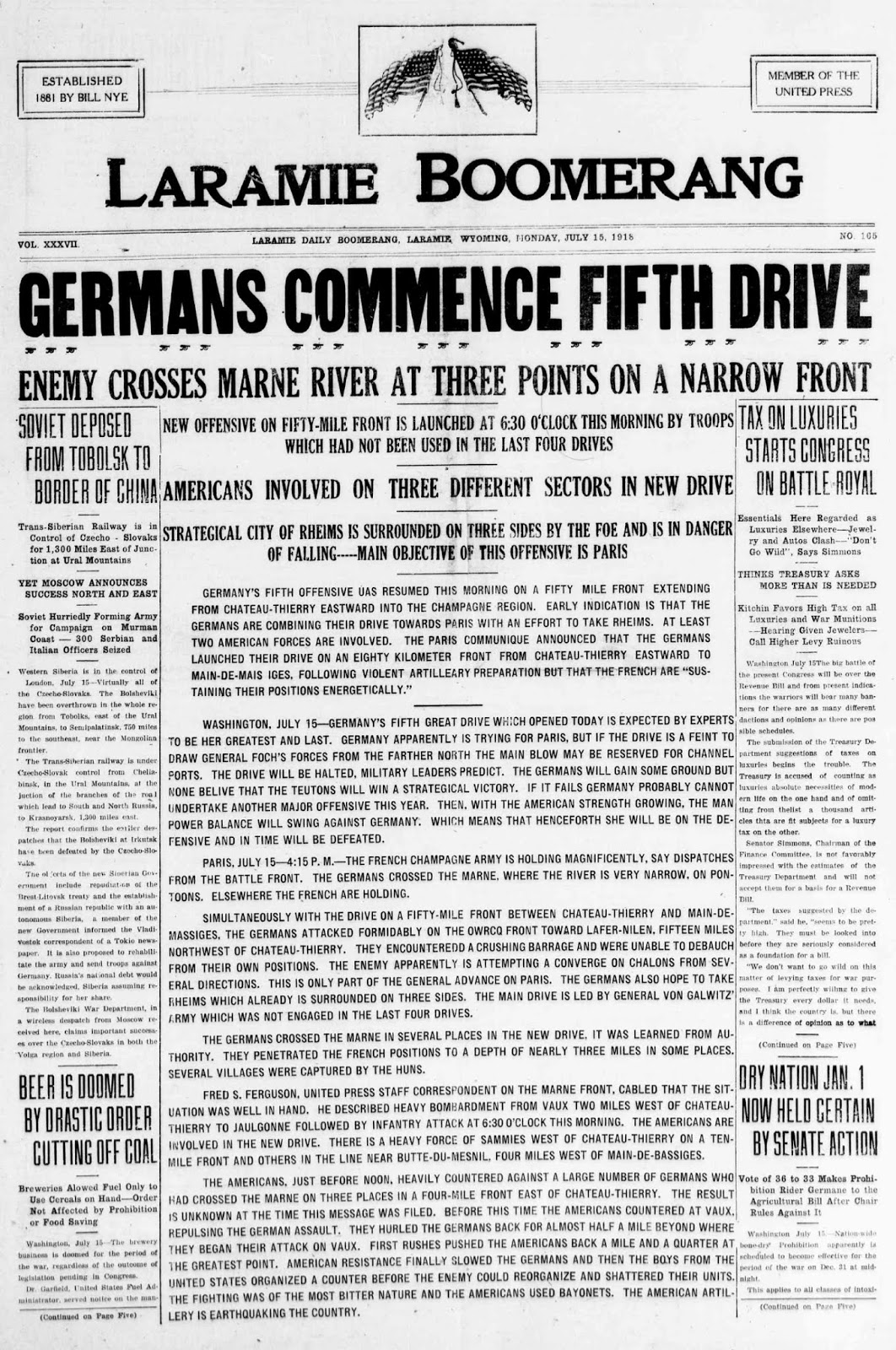
The headline says it all. Laramie Boomerang, July 19, 1918.


Oh, the humanity. July 19, 1918. Headline from the New York Times.

BASEBALL TEAMS MUST GO TO WORK; Baker Makes Final Ruling That the Players Are in a Nonessential Pursuit.AFFECTS ALL OF DRAFT AGEFew Stars Are Not Included in Order and the Big Leagues' Future Is in Doubt.OFFICIAL ADVICE AWAITEDSecretary Favors a Change in Regulations to Take in All WhoAre Only Entertainers. Text of Baker's Decision Recreational Value of Game. All Must Make Sacrifices.

Wednesday, July 18, 2018

Mid Week At Work: Filming the American Attack on Château-Thierry (Western Front, 1918)

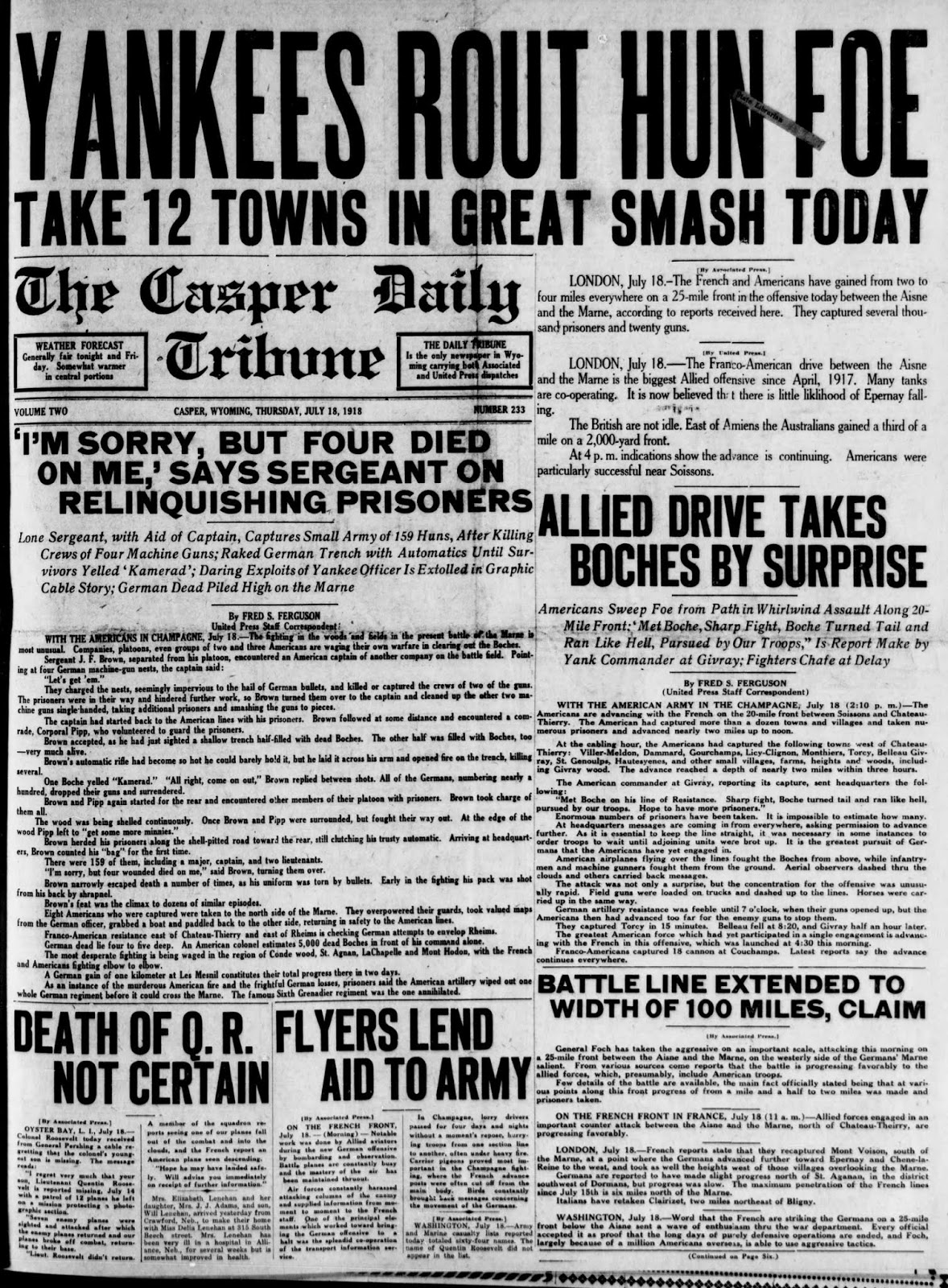
And one day later. . . the Battle of Soissons. July 18-22, 1918.

Yesterday we posted our item about the practical end of the 1918 German Spring Offensive.

American 155mm guns which participated in the Battle of Soissons.

Amazingly, today we're posting about a French Offensive.

Or, more accurately a Franco American Offensive.  Or indeed, a Franco American Offensive supported by the British.

The Battle of Soissons.


Tactically, Soissons was a French effort, but even at that, it had a heavily international flavor to it. Designed to push back the bulge in the French line created by the third phase of the German 1918 Spring Offensive, the carefully designed attack featured an initial line made up heavily of "Moroccan" French troops, who reality were not only Moroccan, but were recruited from all over the globe. Some of the troops had in fact been pre war French Legionnaires.  Next to them were two American Divisions, the 1st and the 2nd, with the 2nd launching out of Belleau Wood and Château-Thierry France (which would result in the Battle of Château-Thierry, fought on this date).  Over all command was French.


The launching of the fifth and final phase of the 1918 Spring Offensive caused some to sugget postponing this effort, but Foch was confident the German effort would fail and there was no reason to delay. The decision was risky, but proved warranted.  From 18 to 22 July the French and American forces pushed the line back to where it had been before the 1918 Spring Offensive had begun. American troops proved themselves again in a large scale effort.  American efforts to form a full American Army were supported by the results. . . and the German reversal of fortunes in 1918 had begun.


Like most offensive operations in large wars, the offensive itself is remembered by some not for the particular offensive, but for battles within it.  One such battle was the aforementioned Battle of Château-Thierry, which is a well remembered Franco American battle that took place on this day.  That effort was an aspect of the first day of the offensive and was notable, as was day one of the offensive in general, for the lack of a preparatory artillery bombardment, which aided in achieving surprise.

U.S. Artillery at Château-Thierry.

Intel, the semi conductor company, was founded

as NM Electronics by former Fairchild Semiconductor employees Robert Noyce and Gordon Moore on this day in 1968.

The rumblings of the computer revolution were beginning to be heard.

In Canada, the mailman wasn't being heard as the employees of Canada Post went on strike. For businesses near the US border this meant compensating by renting post office boxes in nearly by US locations.

Alexander Dubcek went on national Czech media to inform his people that he'd continue his democratic reforms as Prime Minister of Czechoslovakia in spite of pressure form the Soviet Union to stop it.

And Atlantic Richfield and Humble Oil announced the discovery of oil in Alaska's Prudhoe Bay, which the companies had made some months prior.

It was a busy day.

Punchy in the Ring?

The daily news has become so odd, it's nearly impossible to keep up with.  I actually had a thread that I was working on that I abandoned as the things noted in it became so rapidly obsolete.

And a lot of that is due to our President.

It's probably clear that while I have my own theories on why Donald Trump was elected which don't really involve the Russians that much, although I'll concede that was certainly an element that played into his victory, we can now safely say, and while I try not to discount the legitimacy of the views that got him elected, I"m not a Trump fan.  I basically think he was the gasoline and match that disgruntled rank and file Americans of both parties chose to throw into Washington as they were legitimately disgusted with both parties.

And I also think, on that score, that the Democrats, who have acted like a bunch of spoiled brats, have probably hurt themselves more than the Republican Establishment, which for the most part simply acts befuddled.

And I'll even credit Trump for being right on some things others just don't want to admit.  Our NATO partners, for example, really have been paying a lot less for their own defense (originally by American design) than they should. Europe really is losing its culture.  Trump is correct on those things.

But this whole thing with Putin?

NPR has it right when they start off an article:

The Big Picture: Trump Sides With Putin. But Why? 
At this stage in the game, President Trump’s outlook on international questions and Russian interference in the U.S. election in 2016 is almost predictable. Even so, many found his comments at his summit with Russian President Vladimir Putin in Helsinki on Monday jaw-dropping.
Why indeed?

The Russians are an international menace to democracies and they're messing with western elections in a major way. What they were doing in our election, in my view, is an act of war.  Poisoning people in the United Kingdom, if not an act of war, is a criminal act.  It's impossible to believe that these things do not come at the direction of the Russian state and a person has to be charitable in the extreme not to believe that Putin knows about them.

So what's wrong with Trump here?

Something sure is.

His statements on this are so bizarre that they lend credence to the accusations against him in this arena, accusations that are becoming more credible each day.  If he isn't actually outright favoring Putin as he owes him something, he's discrediting himself enormously by acting like he does.  Is this a punch drunk boxer reeling in the ring because he's punchy, or a stumbling poorly acted pro taking a dive?  It has the appearance of one or another.

Anyway you look at it, people close to the Administration have to come out at this point and put a stop to this utter nonsense.

And Trump would do well at this point to remember that Nixon's downfall didn't come because he ordered the plumbers to break into the Watergate Hotel. . . he conspired to cover it up.

_________________________________________________________________________________

Note:  I wrote this the morning of July 17.  Since that time President Trump backtracked on this stuff.

Not that that makes me feel that much better about his performance here.

Tuesday, July 17, 2018

Lex Anteinternet: The summer that wasn't.

Uff, and heavy duty rain storms two days in a row:
Lex Anteinternet: The summer that wasn't.: Great, two days of mild heat (seriously, 90s in July is normal, not abnormal) followed by, once again, torrential rains and freezing weather...
This has not been a normal summer.

Slain Russian Tsar, Family Commemorated On 100th Anniversary Of Executions

Perdue, July 17, 1918.


The Kaiserschlach Fails

The results

While it would theoretically go on to August 7, it was really this day in 1918 on which the Kaiserschlacht came to an end.

The Kaiserschlacht was a remarkable series of offensives that took place over six months, an amazing achievement for an Army facing the challenges that the Germans were in 1918.  This is all the more remarkable if it is considered that the Germans had just concluded a massive offensive, against much less daunting odds, in the East, prior to Russia quitting the war.  The German spring 1918 offensive destroyed the Portuguese commitment to the Allied cause and rocked back the British gains in the war completely.  The Germans nearly took Parish as part of a diversion. Everywhere the Allies lost significant amounts of ground and every German action took ground, including the famous battlefields that had been gained by the Allies in 1916 and 1917.  

And yet it failed, an in a way that the Germans could not recover from.

The offensive reduced the fighting strength of the German Army by 1,000,000 men.  By the end of the offensive German losses meant that the Germans had 207 division to the Allied 203, a near match but one which was evaporating in terms of parity as American troops came on line.  Many of those men lost by the Germans were elite German Storm troops who could not be replaced.  The German offensive itself ground down in large part through sheer exhausting of the German soldier who had to make up for the complete lack of German cavalry through extreme physical exertion on foot.


American combat units deployed in a major way for the first time, sending them to fill the gap that the French appeared unable to wholly fill. The Germans were defeated by the British fighting man's remarkable resolve, the commitment of French and American troops to a gap, the unexpectedly stout resistance of French troops, but most particularly by the horse.  The horse the that the Germans lacked.  Franklin's proverb proved true, although not quite because of the nail.
For the want of a nail the shoe was lost,
For the want of a shoe the horse was lost,
For the want of a horse the rider was lost,
For the want of a rider the battle was lost,
For the want of a battle the kingdom was lost,
And all for the want of a horseshoe-nail.
It was for the want of the horse that the German Empire was lost.

The Murder of the Romanov's, July 17, 1918.

On this day in 1918 the Russian Imperial Family was carried out by the Ural Regional Soviet.

The Russian Imperial Family.

It acted when it did as White Russian forces were advancing in the area at the time and it was feared that they would liberate the former Czar.

No matter what a person thinks of the Romanov's, and opinions do vary, their murder was barbaric, if wholly consistent with the Communist ethos.  It's amazing, in retrospect, that the Imperial Family remained alive at this point in 1918 and its frankly almost impossible to imagine a scenario in which they would have been allowed to remain alive by the Soviets.  It is possible to imagine the deposed Czar and Czarina being put on trial in a show trial, which of course did not occur. And I suppose it's possible, if you imagine that, to imagine the daughters being allowed to live either in internal exile or as external exiles, although the degree to which the Soviets were willing to track down their enemies makes that iffy.

At any rate, they were gunned down, which was the most likely end for them in any fashion. And hence the Russian monarchy concluded with a horrific personal tragedy.

Because of the tragic nature of their end, and because it occurred in wartime conditions in a remote region, speculation on that end and what it meant has never really ended.  And of course it was longed a myth that perhaps Anastasia had survived, a myth aided by pretenders to that claim.  Nobody survived and the details of the murder are now well known.

Among those who have never forgotten them is the Russian Orthodox Church.  The family was canonized in the Orthodox context in 1981 by the Russian Orthodox Church Abroad and by the Russian Orthodox Church in Russia in 2000.  A shrine has been built by the church at the location of their execution in the form of the Church On The Blood in Yekaterinburg, the site of their execution.

Russian Orthodox Icon of the Russian Imperial Family.  By Aliksandar - Own work, CC BY-SA 3.0, https://commons.wikimedia.org/w/index.php?curid=45616224

Monday, July 16, 2018

Why "Conservative" Judges aren't, and why "Liberal" Judges are. And why liberal angst over conservative judges is misplaced and not all that real, while the opposite is not true.


 Thomas Aquinas, who wrote on Natural Law. Liberal politicians and pundits like to imagine that a "conservative" justice means somebody like Aquinas, but it doesn't.

There is, on Reddit, a thread in which a self declared liberal lawyer (and most lawyers declare themselves to be that, whether they are or not) admits that he just isn't worried about Kavavnaugh.

Truth be known, probably few are.

For all the hoopla, feigned tumult, and shouting about it, the truth is that there's a huge difference between "conservative" and "liberal" judges and justices, and political liberals know that.  Moreover, they know that they don't really have to worry about conservative jurist doing something philosophically conservative.

Liberal judges are politically and philosophically liberals in the modern "progressive" sense.

Conservative judges are judicially conservative, but whatever their personal views are, as jurist they are not politically or philosophically conservative.  Or, if they are, they don't apply conservative philosophy by making it law.  Liberal jurist do.

And, indeed, that's why political liberals don't really care all that much about the courts as political issues, but political conservatives do.

For the most part, the biggest thing that political liberals really have to worry about, in the context of a modern judicial conservative being appointed to the court, is that there will be a majority that defers to the legislatures and the people.  That makes work for liberals, and liberals are well aware that a lot of "progressive" ideas are highly unpopular with average voters, let alone likely voters, but that's the fact of it.  Put another way, if the Supreme Court touched Roe v. Wade or Obergefell, all that would really mean, most likely, is that the Court would say "well. . . that's the sort of thing we don't decide as the Constitution doesn't say anything about it. . . take it up with your state legislators. . . "

Not exactly the end of the world, in spite of the way the way it is so often presented by liberals.

Put another way, modern conservative jurists aren't going to do anything in regards to a woman's "right to choose" or "reproductive rights". They would, at most, say "not our field, take it up with the voters".  Liberals do indeed fear that, as they fear that their ideas aren't all that popular with the voters.  But they will not do what liberal jurists do, which is to declare what must be done and make that the law.

And that is what liberal jurist do. They take their philosophical and political views and declare them to be the law.   That is what happened in Roe v. Wade and that's what happened in Obergefell.  Basically, in those cases, the Supreme Court made into the law what the liberal justices view of what the law ought to be.  Put the way Thorogood Marshall put it, they determined what the law ought to be, in their view, and decided to let the people catch up with it.

But it could work both ways, which is the irony of the Liberal Angst.

 Where conservative judges feel that the answers really ought to come from. . .ballot boxes.

It would be possible, albeit extraordinary unlikely, to appoint conservative jurists who were political and philosophical conservatives and who were prepared to act on it.  That won't happen, but the fact that it won't shows how the liberal position is hypocritical and the balance of arguments is, moreover, highly misplaced.

If this were to occur you could appoint, for example, the handful of conservative jurists or legal academics who were natural law conservatives and have a view of what the ultimate law is, just as liberal judges have a view of what the ultimate law ought to be.

Let's consider Roe v. Wade again.

In a modern context there is, in spite of what people whine and cry about, about 0 chance that any Supreme Court is going to reverse RoeRoe v. Wade is mostly about a right to privacy.  Where it may be modified, in a modern context, is on the bright lines it makes on weeks of pregnancy, which has always been scientifically suspect at best.  A court could uphold Roe's legal basis completely but, at the same time, find that the scientific and medical views on it are so obsolete that abortion was no longer sanctioned as a right by it at any point.  As a court could do that, a court could certainly move the decisions bright lines or modify them, which is widely regarded as not only likely, but frankly quite proper, by nearly everyone.

But what the court will not do is to make an overarching philosophical leap into the nature of life and what life counts and why.  It's not impossible to imagine that, and perhaps the Court should be bold enough to do that, but it won't.  At the very most you might imagine the Court stating that it was clear that life is viable far earlier than the Court had imagined in 1973, and that therefore it couldn't really tell when it was viable, and therefore it would err on the side of life and find abortions violated the right to be secure in your person, infants having that right as much as adults.

Indeed, such a finding would actually be consistent with Roe. Roe itself recognized that such a right existed, but found that it didn't exist early on in the case of the fetus but did in the mother and therefore it was throwing the weight to the mother. That's the part of the decisions, as noted, that' has always made people queasy as it frankly doesn't make very much sense.

But what won't occur is to have a Court declare that a right to your life is a natural right trumping everything else, at least for the innocent, which would be to find a right beyond which we normally conceive of it as being. Although only barely. Because that's a natural law concept it sounds familiar to us in a way, and it should, as it's basically what the framers of the Constitution set out as a natural right in the Declaration of Independence when they stated:
We hold these truths to be self-evident, that all men are created equal, that they are endowed by their Creator with certain unalienable Rights, that among these are Life, Liberty and the pursuit of Happiness.
That's a Natural Law declaration and it recognizes such a right.  As the concept to a right to life is still very  familiar to us, and as it finds expression among liberal and conservative justices in other areas, such as the Constitutionality of the death penalty, perhaps this musing isn't as far off as stated here.

But if we take the topic on to something like Obergefell we can really see where the difference between modern "conservative" justices and what a true conservative justice, the mirror image of a liberal justice, would be.  The declaration that same sex marriage is the same as heterosexual marriage was manufactured out of whole cloth with no basis in the law at all, the creation of liberal justices concepts of how the world and the law ought to be, rather than how it is.  By the same token, a truly conservative judge could write that natural law had created them "male and female" and that an institution endowed by its very nature with a recognition of that fact, and that therefore no law could be made to contravene or redefine that.  That would be much beyond what any conservative justice would do today.  If the question decided in Obergefell should suddenly reappear in the Supreme Court with five conservative justice, they might conceivably reverse it, but just to send it to the states. They wouldn't overturn any legislative act recognizing it.  But a Natural Law conservative theorist could.

Indeed, a Natural Law theorist and a modern liberal justice would actually recognize each other in that approach.  It wouldn't worry about the written law or the written Constitution, but rather some higher goal of how the law ought to be.

And that's the real difference and why its the case that liberals, in spite of their complaining, don't really care that much about the Supreme Court at the polls. They can still go to the polls and campaign, and they know that.  At most, conservative jurists just send things back to the ballot, they don't decide the issue with attempted philosophical finality, like liberal jurists do.

Karl Marx, who asserted that if people followed his views history would end in a man made paradise, a view that's much closer to what liberal jurists basically espouse, if not in the same exact fashion.

Sunday, July 15, 2018

The Kaiserschlacht Ends. July 15, 1918. Operation Friedensturm

Not very cheery news for a Monday.  Wyoming State Tribune for Monday, July 15, 1918.

Monday, July 15, 1918, brought discouraging, if not unexpected, news.
 
The map one final time, with the final German fifth drive.  This time the Germans attempted to exploit the earlier success of their drive on Paris with a new front to the east.  Over two days the effort gained ground, but the effort was rapidly halted and by this point the French were able to regain the initiative and counter.  The Germans were effectively blocked and gave up offensive efforts on August 7.

On July 15 the Germans resumed offensive operations, but not the Operation Hagen that was designed to be a final blow. Rather, they launched Friedensturm to exploit the earlier  Blücher–Yorck gains. While the offensive, like every other German offensive in this series of operations gained ground, the French were able to ultimately counterattack successfully and the German offensive operations came to an end on August 7.


Laramie residents not only read about the fierce fighting in France. . . they also got to read about how coal shortages were looking to bring an end to beer.

The final effort would see, as with the earlier efforts, some hard fighting.  The Second Battle of the Marne was part of the offensive, which would run from this day until August 6.  The Fourth Battle of Champaigne also started on this day. Both were launched against the French Fourth Army, the Germans having switched attention to them, of which the US 42nd Division was a part.  The 42nd was a division made up of National Guardsmen.  The French forces, moreover, were rapidly reinforced by British and American troops.  The US 3d Division would be back in action on this day and earn the nickname "The Rock of the Marine".  By the battles end eight American divisions would participate and the US would sustain 12,000 casualties.  The number of divisions contributed to the defense would be twice that of the British, with American divisions being twice as large, but even embattled Italy contributed two divisions and sustained 9,000 casualties.  Forty-four French divisions would fight in the battle and fifty-two German divisions.

Allied battlefield loses would be roughly equal to German ones in the campaign, but by this point the Germans did not have the troops to lose.


Meanwhile, in the Middle East . . .


. . . prisoners of war, including German prisoners of war, were coming into Jerusalem following yesterday's Battle of Abu Tellul, on the West Bank of the Jordan River, which had seen Empire troops defeat Turkish and German troops.


The action had featured significant cavalry action by both the Turks and the Empire forces.

With all that was going on in France and Italy at the time, you have to wonder how much attention this was getting now outside of Constantinople, Cairo and Jerusalem.

Sunday Morning Scene: Churches of the West: First Church, Oklahoma City

Churches of the West: First Church, Oklahoma City:


The First Church in Oklahoma City is so called as it was the first church established in Oklahoma City. The original wooden structure, very much added to and changed over the years, was first set out in 1889.  The Church is a United Methodist Church, and was directly across from the site of the Murrah Federal Building bombing, in which it was heavily damaged.

Saturday, July 14, 2018

Best post of the week of July 7, 2018.

The best post of the week of July 7, 2018.

July 9, 1968. North Vietnam raises its flag above Khe Sanh.

The University of Wyoming adopts an unneeded slogan and some faculty reveals themselves to be trendy twits

The 2018 Wyoming Election. Volume Four

Quentin Roosevelt shot down and killed in combat, July 14, 1918

U.S. Army marching in Lyon, Bastille Day, July 14, 1918.

U.S. Army marching in Lyon, Bastille Day, July 14, 1918.


Quentin Roosevelt shot down and killed in combat, July 14, 1918


Quentin Roosevelt, age 20, one of Theodore and Edith Roosevelt's son, was killed in aerial combat over France.

Quentin was the youngest of the Roosevelt boys, all of whom were serving in World War One (Kermit was serving in the British Army).  His death came as a terrible shock to his parents and his father never really recovered.  T.R.'s decline into death himself accelerated rapidly after Quentin's death and his fiery nature evaporated.

2nd Lt. Roosevelt was buried with full military honors but they were not above making a postcard out of the photograph of his dead body and wrecked airplane, a site that was sufficiently grisly that the German populace, which remained fond of Roosevelt, was shocked.

Quentin was by all accounts highly intelligent and very well liked.  He was engaged at the time of his death to the wealthy Flora Payne Whitney who was treated by the Roosevelt family in the immediate aftermath of his death as if she was one of the family.   She would go on to marry a fellow member of Roosevelt's squadron in 1920, although the marriage would be brief (she remarried in 1927).

Quentin as a boy at Sagamore Hill.

July 14, 1918 - Quentin Roosevelt Shot Down