This is one of those posts that start off and then sit around as a draft for a very long time. Looking at this, I started the post, or just the topic really, in 2012, and here it's 2015 and I'm writing on it again.
Anyhow, what motivated me to write it is the excellent photos posted this week on the theme of the Mexican Revolution on the Old Picture Of The Day blog. Or, rather, it was the comments that caused me to revive the post. The reason being is that people really don't grasp the Mexican Revolution at all.
Mexican refugee entering the United States. In spite of the caption, his wealth is probably all on this horse.
For one thing, people seem to think that the revolution was something like the Villistas against the Federales. Not hardly, or at least that's not the whole story by a long shot. So, let's take a look at what really happened, as its a significant story, and the long range impacts of it still very much impact us today.
Mexico has had an entire series of revolutions, as is well known, but they are not all of the same character. I don't intend to list each and every one, as that would be a book in and of itself, but it's important to realize that revolutions have been part of the Mexican story in a way that they have not been in regards to the United States. We had one revolution, or arguably two if you regard the Civil War as one, but in each instance ours had the feature of having the revolutionary side not even conceive of itself as being in rebellion, and featuring a democratic government. It would have been perfectly possible for a soldier to serve, for example, in a New York state militia during the Revolutionary War and not conceive of himself as being in rebellion against anything. Likewise, the Civil War, while a species of rebellion, wasn't quite regarded that way by either side that fought it.
Mexico's revolutions, however, have been real revolutions. They didn't arise with the concept of protecting a set of liberties and rights from trespass, but sought to overthrow a rule or government entirely.
The first successful revolution was against Spain, of course, and it set the pattern for a large number of them that came thereafter in that they were really revolutions by Spanish aristocracy in Mexico against, at first, Spain and then later against each other. The Mexican people had very little stake in them. It wasn't really until Juarez rebelled against the French and their installed Austrian Emperor that a different type of revolution, that being the people against an perceived oppressor, arrived in Mexico. Unfortunately for Mexico, and the Unites States, by that time a very pronounced political culture of having Caudillos, strong men, was well established, and in spite of a people's rebellion, it really couldn't be broken.
Caudillos, or strong men, aren't unique to Hispanic cultures by any means, and its worth noting that they almost seem to be the global rule, rather than the exception. They're the exception to us largely because we're heirs to English culture, where strongmen have not been appreciated very much. Indeed, perhaps the biggest single example of an English language strongman can be found in that of Oliver Cromwell. While the Lord Protector was a force during his life, not all that long after it the English Restoration occurred and Cromwell was posthumously sentenced to death, which required his body to be exhumed and beheaded.
A culture which feels so strongly about dictators that it'd dig one up to behead him isn't going to have very many.
In contrast, the example of a strongman whose is both a dictator while simultaneously being given as an example of the will of the people is surprisingly common in many cultures. In our view, this is always negative, but in some cultures we can still find examples of such a person being heroically viewed. Napoleon gives perhaps the best example. We think of him as a megalomaniac, but in France, and in much of the Latin world, he's viewed as a liberal hero. In order to do that you have to separate his actions from his declared values, to some extent, but then he actually was a liberalizing force while also being a dictator, an odd combination. That model is one which Maximilian I of Mexico, the unwelcome French installed Austrian "emperor" of Mexico himself sought to emulate.
In Mexico's case, pretty much every revolutionary leader prior to the rebellion against France was a Cauldillo or Caudillo wannabe from the Spanish aristocracy, with very little concern being exhibited for the average Mexican. About the only exception was Don Miguel Hidalgo y Costilla who lead a revolution from 1809 to 1811, and whom was a Catholic priest. He lead a rebellion against Spain, which failed, and which resulted in his execution, but he clearly sought to give voice to the peasantry and the onset of his revolution is today celebrated as the Mexican independence day, even though it didn't result in it. Subsequent rebellion against Spain was not such an egalitarian affair and following revolutions in Mexico were, for many years, simply power struggles between the landed military Spanish elite. It was not until Indian Benito Juarez successfully rebelled against Emperor Maximilian, the Austrian nobleman that France had installed as Mexican emperor, that a leader rose up through rebellion who was a member of the peasant class. Even then, oddly enough, Maximilian was himself a species of liberal Cauldillo, espousing the liberal views of the French Revolution even while acting as a foreign born emperor in Mexico, while Juarez would not always strictly adhere to democratic values. In essence, Maximilian was a foreign liberal dictator, much in the mold of Napoleon, while Juarez really started off as a liberal peasant rebel.
Benito Juarez, Mexico's first president of Indian ancestry.
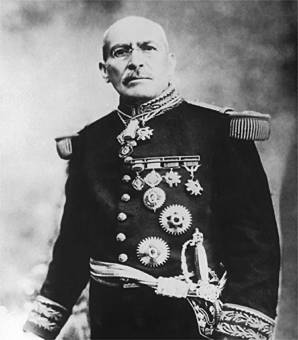
Juarez died in 1872, and from there things descended into confusion. As I don't intend to do a history of Mexican politics, I won't, but rather I'll simply note that one of Juarez's electoral opponents was Porfirio Diaz, who had been a member of Juarez's army. He entered politics thereafter, but rebelled against Diaz's successor, and like seemingly all failed Mexican revolutionaries, he took refuge for a time in the United States. Returning to Mexico he secured election to the presidency and evolved into a dictator, occupying that position for thirty years. He was another enigmatic figure in that he was a dictator, but a type of liberal, both repressing democracy and seemingly dedicated to the advancement of liberal ideas. Business did very well under his regime in Mexico, and he differed from prior liberal Mexican dictators in that he did not oppress the Catholic Church, which liberals often did in a seeming desire to crush the institution that the Mexican populace held closely. He also neither aided nor repressed the common population, something that was an unusual middle ground.
Porfirio Diaz in full military costume.
A person simply cannot rule for thirty years without being an autocrat, even accidentally, and at some point a revolution would become inevitable. But the way it came about was particularly odd. He gave an interview in an American magazine.
Porfirio Diaz in Pearson's Magazine
By the first decade of the 20th Century Mexico had seemingly settled into a comfortable business oriented dictatorship. Diaz was firmly installed in that role, and he ruled under the thesis that the Mexican people wanted him there, which some no doubt did. His downfall came, oddly enough, when he expressed the opinion that Mexico was a real democracy in an interview given to the American Pearson's magazine. That was in 1908. In that interview he stated that if the Mexican people wanted to replace him in an election, they could do it.
That an interview in an American magazine would spark a Mexican revolution is fairly amazing, but perhaps it shows how interconnected the world was, even then. That interview brought in Francisco Madero, one of the least likely Mexican revolutionaries a person could imagine to the forefront. Madero was an odd character, to say the least. Highly idealistic, he was very much given over to the spiritualism movement that was gaining ground at the time, and he believed he was in direct contact with the spirit of Benito Juarez. Taking Diaz at his word, he challenged him for election in the campaign of 1910. The Diaz regime, in the meantime, drew itself closer to the United States, with Diaz meeting with President William Howard Taft in a meeting in which he emphasized his role in boosting Mexican business and American business in Mexico. Ultimately Diaz had Madero arrested, but, given leave to move about the city of Monterrey, he escaped and fled to the United States, a move common for almost all Mexican revolutionaries.

Unlikely looking revolutionaries, the Maderos. Maderos entire family became involved in his efforts to bring about democratic reform in Mexico.
This sparked the revolution. Madero, not willing to give up, raised an Army and crossed back into Mexico. His supporters in other regions of the country rose up. Colorful figures like Emiliano Zapata and Francisco "Poncho" Villa appeared on the scene as Maderoistas.
More typically imagined in a sombrero, General Francico Villa. The colorful, erratic, and perhaps somewhat mentally unstable Villa would attempt to retire to a ranch he acquired after his surrender to Obregon and Carranza, but he ended up being assassinated under cloudy circumstances in 1923. His killer would live into the 1950s and declare at the end of his life that he'd rid the world of a "monster".
Emiliano Zapata and his staff. Zapata was an agrarian and looked the part, which we in turn tend to confuse with the look of the Mexican Revolution. As with many leaders of the Mexican Revolution, Zapata was assassinated, although unlike Villa he still commanded an army in the field at the time of his death.
That revolution sought to install Madero as the rightful democratic president of Mexico, and it was opposed by Diaz's government and its conservative backers. While it didn't have the expressed support of the United States, it had the implicit support of the US in that the local, highly conservative, American mission to Mexico viewed Madero as a species of dangerous radical, something akin to a socialist, and they feared both his movement and what it would mean for American business interest in Mexico. Nonetheless, Modero's forces prevailed and Diaz surrendered in May, 1911, agreeing to go into exile. Madero became the president of Mexico.
American soldiers observing the Battle of Juarez from the El Paso side of the border.
If only Madero could have been idealistic enough, and naive enough, to take on Diaz and win, he was also singularly unsuited to rule Mexico. Having just overthrown very entrenched interests, he seemed to believe that he could take over the mechanisms of government and simply rule. He therefore left the defeated Mexican army in place. Diaz's army had little interest in the liberal ideas of Madero, and the result was virtually inevitable. Moreover, Madero soon faced rebellions by his own former lieutenants, and a newly freed Mexican press exercised its voice for the first time in critizing Madero. Soon Madero was faced with a plethora of rebellions from the right and the left, and had to rely both upon those forces which remained loyal to him, and the Mexican federal army.
In 1913 Victoriano Huerta, a Mexican Federal general whom had been successful in putting down revolts against Modero, launched one of his own with the support of remaining Diaz supporters and the support of American Ambassador Henry Lane Wilson, who distrusted Madero. H. L. Wilson was not to be long in his role, as at that time Woodrow Wilson was already elected to the Presidency and coming in, so his actions not only were improper, but they came at the very time in which he was going out and a more progressive administration coming in.
Henry Lane Wilson, whose views proved to be a discredit to the United States and which did damage to Mexico.
Huerta was successful in his uprising against Madero and ultimately the victors acted to have Madero killed. Huerta was the new Mexican strongman.
Huerta looked every inch of the part he was to play in the Mexican Revolution. He died of natural causes in an American jail after being arrested for plotting to involve Germany and Mexico in a war with the United States.
Almost immediately significant figures in Madero's forces, including Pancho Villa and Emiliano Zapata rose up in rebellion against Huerta, and in many ways the revolution we typically think of as being the Mexican Revolution, which was really its third act, got started.
American soldiers of fortune in Mexico, serving in Villa's Division del Norte.
On this go around, revolutionary forces ultimately sort of coalesced around Venustiano Carranza, a Mexican revolutionary who was a rancher and a true radical. Carranza never had the level of support that Madero had, and his views were to the left of Madero's. In Carranza, the opponents of revolution in Mexico were faced with a man whom, while much weaker in support, was really much more of the man that they feared. With the various revolutionary factions supporting him, Carranza managed to quickly defeat Huerta, who went into exile in 1914. Ultimately, like deposed and losing Mexican forces and personalities seemed to do, he entered the United States in 1915, where he was cheeky enough to negotiate with German agents and Mexican revolutionaries in an effort to bring Mexico into a war with the United States. Arrested, he died in an American jail of unknown causes.
![Gen. Carransa [i.e., Carranza]](https://cdn.loc.gov/service/pnp/ggbain/14600/14619r.jpg)
Revolutionary, intellectual, and radical. General Carranza. His government fought Villa and Zapata successfully, but he'd go down in a coup lead by his own general, Obregon.
Before that could occur, however, the United States intervened, sort of, in the Mexican Revolution in the Tampico Affair. Woodrow Wilson, justifiably horrified by the actions of Henry Lane Wilson, declared Huerta to be an illegal occupant of the office and enacted a blockade, of sorts on Mexican ports, preventing them from receiving foreign arms. Soon enough, an American sailors and Marines ended up having to land, and fight, in Vera Cruz, where their superior numbers guaranteed their success in the landing.
Tower damaged by Naval gunfire in the Battle of Vera Cruz.
Sailor searches Mexican man in Vera Cruz.
Indicative of things to come, perhaps, Huerta was defeated and fled while the United States occupied Vera Cruz, but he was no more pleased about the American presence there than a disgruntled Huerta was, who went on to plot with German agents to bring Mexico into war with the United States, as noted. American forces withdrew in November 1914, but they'd be back, as we'll see, in a different location only shortly thereafter. The intervention at Vera Cruz, however, did prevent the Germans from supplying a shipment of arms to Huerta, which may or may not have had an impact on the Mexican Revolution. Ironically, the arms were actually American made as the Germans, in 1914, were not in a position to export arms to Mexico.
Carranza soon found himself fighting the two main stars of the Mexican Revolution, Pancho Villa and Emiliano Zapata. Zapata, while he receives less attention, is by far the most interesting of the two as he had a real political vision for Mexico, that being a distributist agrarian state. Villa was more of a peasant free agent, with less defined goals. Suffice it to say, however, both had been highly successful revolutionaries and a betting man would have bet against Carranza at that point.
However, Carranza was a radical as well, and that position allowed him to undercut support for a war weary Mexican population in the south. This began to undercut support for the agrarian Zapata, and he began to face supply problems and accordingly set backs in the field. Nonetheless Zapata was still in the field in 1919 when he was lured into a trap in an effort to secure supplies and assassinated.
In the north, Pancho Villa, who had been a very successful natural cavalry commander, found himself unable to adapt to the changes in battlefield tactics that were also being used in Europe. Constantly in battle against Carranzaista commander Alvaro Obregon, who used barbed wire and trenches, his fortunes rapidly declined.
Alvaro Obregon, whose competence and study of military tactics lead to the defeat of Pancho Villa and his Division del Norte. He'd ultimately become present of Mexico following his coup against Carranza. Obregon would serve one term as president of Mexico, and was elected to a second term to follow his successor Calles, but he was assassinated prior to taking office.
But before they did, Carranza, in spite of a dislike of the United States, approached the Wilson administration about transporting troops through Texas by rail to be used against Villa. Wilson had been horrified by H L. Wilson's actions in bringing about Madero's downfall, and he deeply desired to see an end to the fighting in Mexico. Deciding to recognize Carranza as the legitimate ruler of the country, he granted permission for this to be done in 1915. Traveling under arms, they were used against Villa. Villa retaliated against the United States for its entering the conflict in this fashion by raiding Columbus New Mexico on March 9, 1916.
The raid on Columbus has seemingly baffled American historians ever since, but the reasons for it couldn't be more apparent. Villa was a fairly simply man, not a diplomat, and he had been attacked by Carranza's forces after they'd crossed the United States by rail. By doing that, the US had taken a position in the war, which indeed it had whether President Wilson recognized that or not. Indeed, Wilson had been warned by those knowledgeable not to support Carranza, who deeply disliked the US, and when it wasn't clear who was going to win the civil war. Wilson's actions did nothing to engender love from Carranza but it did inspire Villa to retaliate against the US.
U.S. Army ambulances headed south as part of the Punitive Expedition.
This resulted in what's known to history as the Punitive Expedition, in which the United States briefly became a participating, again, in a Mexican Revolution. Designed only to punish, and perhaps capture, Pancho Villa, the United States ended up basically mobilizing its military infrastructure in order to send a force into Mexico, and in order to be prepared for war with Mexico, which seemed likely to break out any minute. An expedition under the command of General John J. Pershing was in the field in Mexico for nearly a year, penetrating ever deeper into northern Mexico, but never being able to catch up with Villa. The entire time relationships with Carranza's government deteriorated, and Carranza never viewed the US. as an ally in his fight against Villa. By the end of the expedition American forces had exchanged gunfire with Carranza's troops and it was unclear to the men in the field who the enemy was. As a purely accidental benefit, however, the expedition caused the United States to mobilize its military establishment prior to its entry into World War One and the Army had dusted out its cobwebs, used the National Guard on the border and conducted large unit maneuvers in field conditions for the fist time since the Spanish American War. March 9, 1916, was arguably the start of American participation in the Great War.

These soldiers are probably National Guardsmen. Their campaign hats are the previous type, not the M1911 campaign hat, which had just come into service and which went to Regulars first. Nearly the entire National Guard rotated to the border on border service during this period, out of a genuine fear that a war with Mexico was right around the corner.

New York National Guardsmen serving along the border. These officers are (self) equipped with the new pattern of campaign hat. Col. Wingate carries the newly adopted M1911 .45 ACP pistol, in the pattern of swivel holster adopted for cavalry. The officer on his left carries the prior pattern of revolver, probably a double action Colt .45, a pistol which came into emergency service due to the failure of the .38 during the Philippine Insurrection.
American serviceman in Mexico, probably serving in the Quartermaster Corps. This soldier is mounted on a stock saddle, not a McClellan saddle, which was a standard saddle for packers and quartermasters, and which would shortly be given an official designation of M1917 Packers Saddle. The saddle, however, had been in use since about 1905.
After Carranza died, Obregon took over. And that death came in the way that the Mexican Revolution featured. He was murdered in a conspiracy featuring one of his own general, Obregon.
Mexican civilians, potentially refugees, in U.S. Army camp in Mexico.
Obregon, in spite of his dispute with Carranza, continued to take Mexico leftward. He faced a rebellion in his single term as president, and then handed the reigns to Plutarco Calles, who likewise continued to head left. Calles and Obregon were, moreover, opponents of the Catholic Church, reviving an anti clericism of the left which became massive in some regions of Mexico. Ultimately at least one governor of a Mexican state was so far to the left as to be practically a communist, if not in name, and killings of clerics became a localized feature of Mexican rule. Suppression of the church and churchmen occurred, including closing of seminaries and a prohibition on wearing religious clothing in public. The Mexican revolutionary state had effectively gone to war against the church, and ultimately in 1926 another rebellion broke out.

Calles, unlike all of his predecessors going back to Madero, was not assassinated. After Calles' assassination, he continued on in power and became increasingly authoritarian, and he began to flirt with fascism. He was ultimately forced into exile in the United States in 1936 but was able to return in 1940. Ironically, given his hostility to the church,in his old age he joined Madero as a spiritualist.
Called the Cristero War, this war is properly recognized as one of the many wars of the Mexican Revolution, with this one again featuring peasantry against the government. The revolution failed, but not before the Cristeros lost 30,000 men, the government 50,000 and 250,000 Mexicans fled to the United States. This formed the last peasant rebellion against the state, but attempted military coups would occur as late as 1938. In the 1980s, Zapatista forces once again appeared on the scene, recalling the agrarian dreams of their founder and the Mexican army never was able to really put them down. By that time, however, Mexico was transforming, finally, into a true democracy, which it is today. Decades of rule by the PRI, the Institutional Revolutionary Party, dedicated to unending revolution, came to an end.
So, as we can see, the Mexican Revolution is something that, in at least the common American view, we don't quite recall accurately, which isn't to say t hat we get it all wrong. But it was a much, much longer struggle than we imagine, and a much more modern political struggle than we generally allow. It plays well, indeed, in the sense of an early 20th Century revolution, featuring forces of the right and the left, including the hard right and the hard left. Even Distributism, which also made an appearance with the Greens in the Russian Revolution, appears in the Mexican Revolution, where it went down to defeat as well.
And as a North American tragedy it stands amongst the most prominent and long lasting, a tragedy which the United States is more than a little responsible for. Our representation in Mexico during the Taft Administration proved to blinded by his own ideology and views not to see that a new day in Mexico had arrived, and indeed a new day was arriving in his own nation, and his closing act in his role was to be a participant in the overthrow of a democratic president who deserved our support. Would that have prevented the Mexican Revolution from descending into the radical cycle of violence it did? We can't know that, but we could have tried to avoid it. And for that matter, President Woodrow Wilson's act in supporting Carranza through the extraordinary allowance of troop transmission across the US was amazingly inept.
The relationship between Mexico and the United States, never an ideal one, would descend to its depths in the decades immediately following the Mexican Revolution, and wouldn't really start to improve until Mexico declared war on the Axis during World War Two, something that we were not to sure that the Mexican government didn't feel the other way about at first. Mexico itself, in spite of having a "revolutionary" government wouldn't be able to really address the needs of its impoverished people until it developed a true democracy, by which time a culture of conceiving of itself as poor was well entrenched. Today, the majority of Mexicans, for the first time in Mexican history, are middle class and the economy of the country is fully modernizing. Mexico itself is a true democracy, although violence now has resumed due to the crime wars between those seeking to have an orderly society and those seeking to export illegal drugs to the United States. Still, it is once again a new era, and a better one, for Mexico.


![[Benito Juárez, head-and-shoulders portrait, facing front]](https://cdn.loc.gov/service/pnp/cph/3a10000/3a10000/3a10500/3a10509r.jpg)


![[Mexican revolution against the Diaz government]](https://cdn.loc.gov/service/pnp/cph/3b20000/3b25000/3b25000/3b25093r.jpg)


![[U.S. Naval occupation of Vera Cruz, Mexico: Tower at Vera Cruz damaged by shells from U.S.S. CHESTER - Mexican War]](https://cdn.loc.gov/service/pnp/cph/3b30000/3b35000/3b35100/3b35155r.jpg)

![[U.S. Naval occupation of Vera Cruz, Mexico: Searching Mexican for weapons at Vera Cruz]](https://cdn.loc.gov/service/pnp/cph/3b30000/3b35000/3b35100/3b35154r.jpg)


![[U.S. Army in Mexico, 1914: soldier on horseback]](https://cdn.loc.gov/service/pnp/cph/3b10000/3b18000/3b18400/3b18469r.jpg)
![[U.S. Army in Mexico, 1914: Mexican refugees(?) cooking in camp]](https://cdn.loc.gov/service/pnp/cph/3b10000/3b18000/3b18400/3b18468r.jpg)


