Elections were held in Vietnam in areas controlled by the Democratic Republic of Vietnam with the nationalist but communist dominated Viet Minh Party, led by Ho Chi Minh, winning 230 of the 300 seats in the National Assembly. The ballot was not secret and ballot papers were filled out in the presence of aides who were "to help comrades who had difficulty in making out their ballots."
It was not a free and fair election, but its interesting that those who will engage in antidemocratic activities still crave the legitimacy of elections.
The election does illustrate the tense situation in Indochina. The 1945-46 War in Southern Vietnam was over, with the French in control, but in areas of North Vietnam the Viet Minh were. They had not yet fully evolved into an unabashed communist party, and there were non communists in it, but that would not last long.
The first shows were The World at War, which was truly excellent, followed by an episode of The Bob Newhart Show, which also was. South African TV was initially limited to five hours in the evening from 7 p.m. to midnight, with half of the programming in English and half in Afrikaans..
Would that such limitations applied everywhere today.
The scourge of no fault divorce was introduced to Australia.
Senator Fall drafted a resolution asking of Mexico had a government and demanding full information from President Wilson. Republicans were worried that Wilson intended to recognize Carranza, and with good reason.
Albert B. Fall.
Helen Keller, at the time a Socialist, delivered a speech at Carnegie Hall under the auspices of the Women's Peace Party and the Labor Forum
To begin with, I have a word to say to my good friends, the editors, and others who are moved to pity me. Some people are grieved because they imagine I am in the hands of unscrupulous persons who lead me astray and persuade me to espouse unpopular causes and make me the mouthpiece of their propaganda. Now, let it be understood once and for all that I do not want their pity; I would not change places with one of them. I know what I am talking about. My sources of information are as good and reliable as anybody else's. I have papers and magazines from England, France, Germany and Austria that I can read myself. Not all the editors I have met can do that. Quite a number of them have to take their French and German second hand. No, I will not disparage the editors. They are an overworked, misunderstood class. Let them remember, though, that if I cannot see the fire at the end of their cigarettes, neither can they thread a needle in the dark. All I ask, gentlemen, is a fair field and no favor. I have entered the fight against preparedness and against the economic system under which we live. It is to be a fight to the finish, and I ask no quarter.
The future of the world rests in the hands of America. The future of America rests on the backs of 80,000,000 working men and women and their children. We are facing a grave crisis in our national life. The few who profit from the labor of the masses want to organize the workers into an army which will protect the interests of the capitalists. You are urged to add to the heavy burdens you already bear the burden of a larger army and many additional warships. It is in your power to refuse to carry the artillery and the dread-noughts and to shake off some of the burdens, too, such as limousines, steam yachts and country estates. You do not need to make a great noise about it. With the silence and dignity of creators you can end wars and the system of selfishness and exploitation that causes wars. All you need to do to bring about this stupendous revolution is to straighten up and fold your arms.
We are not preparing to defend our country. Even if we were as helpless as Congressman Gardner says we are, we have no enemies foolhardy enough to attempt to invade the United States. The talk about attack from Germany and Japan is absurd. Germany has its hands full and will be busy with its own affairs for some generations after the European war is over.
With full control of the Atlantic Ocean and the Mediterranean Sea, the allies failed to land enough men to defeat the Turks at Gallipoli; and then they failed again to land an army at Salonica in time to check the Bulgarian invasion of Serbia. The conquest of America by water is a nightmare confined exclusively to ignorant persons and members of the Navy League.
Yet, everywhere, we hear fear advanced as argument for armament. It reminds me of a fable I read. A certain man found a horseshoe. His neighbor began to weep and wail because, as he justly pointed out, the man who found the horseshoe might someday find a horse. Having found the shoe, he might shoe him. The neighbor's child might some day go so near the horse's hells as to be kicked, and die. Undoubtedly the two families would quarrel and fight, and several valuable lives would be lost through the finding of the horseshoe. You know the last war we had we quite accidentally picked up some islands in the Pacific Ocean which may some day be the cause of a quarrel between ourselves and Japan. I'd rather drop those islands right now and forget about them than go to war to keep them. Wouldn't you?
Congress is not preparing to defend the people of the United States. It is planning to protect the capital of American speculators and investors in Mexico, South America, China, and the Philippine Islands. Incidentally this preparation will benefit the manufacturers of munitions and war machines.
Until recently there were uses in the United States for the money taken from the workers. But American labor is exploited almost to the limit now, and our national resources have all been appropriated. Still the profits keep piling up new capital. Our flourishing industry in implements of murder is filling the vaults of New York's banks with gold. And a dollar that is not being used to make a slave of some human being is not fulfilling its purpose in the capitalistic scheme. That dollar must be invested in South America, Mexico, China, or the Philippines.
It was no accident that the Navy League came into prominence at the same time that the National City Bank of New York established a branch in Buenos Aires. It is not a mere coincidence that six business associates of J.P. Morgan are officials of defense leagues. And chance did not dictate that Mayor Mitchel should appoint to his Committee of Safety a thousand men that represent a fifth of the wealth of the United States. These men want their foreign investments protected.
Every modern war has had its root in exploitation. The Civil War was fought to decide whether to slaveholders of the South or the capitalists of the North should exploit the West. The Spanish-American War decided that the United States should exploit Cuba and the Philippines. The South African War decided that the British should exploit the diamond mines. The Russo-Japanese War decided that Japan should exploit Korea. The present war is to decide who shall exploit the Balkans, Turkey, Persia, Egypt, India, China, Africa. And we are whetting our sword to scare the victors into sharing the spoils with us. Now, the workers are not interested in the spoils; they will not get any of them anyway.
The preparedness propagandists have still another object, and a very important one. They want to give the people something to think about besides their won unhappy condition. They know the cost of living is high, wages are low, employment is uncertain and will be much more so when the European call for munitions stops. No matter how hard and incessantly the people work, they often cannot afford the comforts of life; many cannot obtain the necessities.
Every few days we are given a new war scare to lend realism to their propaganda. They have had us on the verge of war over the Lusitania, the Gulflight, the Ancona, and now they want the workingmen to become excited over the sinking of the Persia. The workingman has no interest in any of these ships. The Germans might sink every vessel on the Atlantic Ocean and the Mediterranean Sea, and kill Americans with every one--the American workingman would still have no reason to go to war.
All the machinery of the system has been set in motion. Above the complaint and din of the protest from the workers is heard the voice of authority.
"Friends," it says, "fellow workmen, patriots; your country is in danger! There are foes on all sides of us. There is nothing between us and our enemies except the Pacific Ocean and the Atlantic Ocean. Look at what has happened to Belgium. Consider the fate of Serbia. Will you murmur about low wages when your country, your very liberties, are in jeopardy? What are the miseries you endure compared to the humiliation of having a victorious German army sail up the East River? Quit your whining, get busy and prepare to defend your firesides and your flag. Get an army, get a navy; be ready to meet the invaders like the loyal-hearted freemen you are."
Will the workers walk into this trap? Will they be fooled again? I am afraid so. The people have always been amenable to oratory of this sort. The workers know they have no enemies except their masters. They know that their citizenship papers are no warrant for the safety of themselves or their wives and children. They know that honest sweat, persistent toil and years of struggle bring them nothing worth holding on to, worth fighting for. Yet, deep down in their foolish hearts they believe they have a country. Oh blind vanity of slaves!
The clever ones, up in the high places know how childish and silly the workers are. They know that if the government dresses them up in khaki and gives them a rifle and starts them off with a brass band and waving banners, they will go forth to fight valiantly for their own enemies. They are taught that brave men die for their country's honor. What a price to pay for an abstraction--the lives of millions of young men; other millions crippled and blinded for life; existence made hideous for still more millions of human being; the achievement and inheritance of generations swept away in a moment--and nobody better off for all the misery! This terrible sacrifice would be comprehensible if the thing you die for and call country fed, clothed, housed and warmed you, educated and cherished your children. I think the workers are the most unselfish of the children of men; they toil and live and die for other people's country, other people's sentiments, other people's liberties and other people's happiness! The workers have no liberties of their own; they are not free when they are compelled to work twelve or ten or eight hours a day. they are not free when they are ill paid for their exhausting toil. They are not free when their children must labor in mines, mills and factories or starve, and when their women may be driven by poverty to lives of shame. They are not free when they are clubbed and imprisoned because they go on strike for a raise of wages and for the elemental justice that is their right as human beings.
We are not free unless the men who frame and execute the laws represent the interests of the lives of the people and no other interest. The ballot does not make a free man out of a wage slave. There has never existed a truly free and democratic nation in the world. From time immemorial men have followed with blind loyalty the strong men who had the power of money and of armies. Even while battlefields were piled high with their own dead they have tilled the lands of the rulers and have been robbed of the fruits of their labor. They have built palaces and pyramids, temples and cathedrals that held no real shrine of liberty.
As civilization has grown more complex the workers have become more and more enslaved, until today they are little more than parts of the machines they operate. Daily they face the dangers of railroad, bridge, skyscraper, freight train, stokehold, stockyard, lumber raft and min. Panting and training at the docks, on the railroads and underground and on the seas, they move the traffic and pass from land to land the precious commodities that make it possible for us to live. And what is their reward? A scanty wage, often poverty, rents, taxes, tributes and war indemnities.
The kind of preparedness the workers want is reorganization and reconstruction of their whole life, such as has never been attempted by statesmen or governments. The Germans found out years ago that they could not raise good soldiers in the slums so they abolished the slums. They saw to it that all the people had at least a few of the essentials of civilization--decent lodging, clean streets, wholesome if scanty food, proper medical care and proper safeguards for the workers in their occupations. That is only a small part of what should be done, but what wonders that one step toward the right sort of preparedness has wrought for Germany! For eighteen months it has kept itself free from invasion while carrying on an extended war of conquest, and its armies are still pressing on with unabated vigor. It is your business to force these reforms on the Administration. Let there be no more talk about what a government can or cannot do. All these things have been done by all the belligerent nations in the hurly-burly of war. Every fundamental industry has been managed better by the governments than by private corporations.
It is your duty to insist upon still more radical measure. It is your business to see that no child is employed in an industrial establishment or mine or store, and that no worker in needlessly exposed to accident or disease. It is your business to make them give you clean cities, free from smoke, dirt and congestion. It is your business to make them pay you a living wage. It is your business to see that this kind of preparedness is carried into every department on the nation, until everyone has a chance to be well born, well nourished, rightly educated, intelligent and serviceable to the country at all times.
Strike against all ordinances and laws and institutions that continue the slaughter of peace and the butcheries of war. Strike against war, for without you no battles can be fought. Strike against manufacturing shrapnel and gas bombs and all other tools of murder. Strike against preparedness that means death and misery to millions of human being. Be not dumb, obedient slaves in an army of destruction. Be heroes in an army of construction.
Funny what we choose to remember people for, and choose to forget. Not too many people today remember Keller as a Socialist, let alone one making the statement; "Every fundamental industry has been managed better by the governments than by private corporations."
A conscription act was introduced in Parliament for the first time in the United Kingdom's history.
The Montenegrin Army was ordered to defend the retreating Serbian army as Austria-Hungary launched an offensive against Montenegro.
The National League announced that it was revising its former minor league, the American Association. This was in response to the creation of the new American League.
American League President Ban Johnson told reporters in Cleveland, "You can poo-hoo that story right from the start. I don't know if the National League contemplates such a move, but if they do, it will never be born."
‘Medicare for All’ can fix a broken system: When everyone has health insurance, providers aren’t burdened with bad debt, charity care and overcrowded emergency departments, writes Barbara Sowada.
Trump crosses the Rubicon. ‘The die is cast.’: When President Trump bombed and invaded Venezuela, kidnapped the Venezuelan president and installed a new government to “run” the country, all without the the consent of Congress and in violation of our Constitution, he crossed his own Rubicon.
So, Marco was hitting the news shows today. I didn't listen to them all yet, and indeed I only heard Marco's part of This Week.
Marco was speaking, at first, with the Trump Admin Patented Arrogance, but he couldn't maintain it. We now know:
The US isn't occupying Venezuela.
Venezuela isn't cooperating with anything.
We don't have a plan, really.
We're going to keep pressuring the country by seizing oil tankers.
So the big raid was just using the military, under orders from one illegitimate ruler, to grab another.
King Donny probably believed his statement. He probably still does, sort of.
A prediction. The same justice system that never got around to prosecuting Donald Trump, insurrectionist, won't convict Maduro of anything, or even really try to.
Yesterday, early, the Armed Forces of the United States staged a commando raid and removed Maduro et ux from Venezuela.
The raid was loss free, which has caused one knowledgeable person I know to speculate that the Venezuelan military was in on it, and that it basically amounted to a coup in favor of Delcy Rodríguez of the United Socialist Party of Venezuela.
Pity poor Maria Corina Machado, the opposition leader we supposedly favored. I guess she's yesterday's news.
Anyhow, yesterday the senile illegitimate occupant of the White House, Donald Trump, came on and gave a rambling press conference full of weird diversions and babble, but he indicated "we", i.e., the United States, was going to run the country.
A commando raid an occupation does not make. Venezuela remains in control of the Venezuelan military and the United Socialist Party of Venezuela.
And Rodríguez rejected the assertion that Maduro has been replaced. No doubt a United Socialist Party isn't going opt accept the doddering old fool's suggestion that the country's oil is going to be taken back over by American oil companies, which aren't really American, but are international for the most part.
So what actually happened?
Well, if we look at it positively, a really bad guy was replaced by somebody we don't know all that much about, but who shows every sign as being just as much of a socialist as Maduro. Maybe she'll be better simply because she's educated. And perhaps she'll try to take Venezuela out of the drug business, although there are no doubt powerful forces that would resist that.
Maybe that's all we were trying to achieve, but based on the babble, Trump apparently believed that we were actually going to take over the country.
If the Administration was trying to do that, it fell way short of it, or so it would appear, and we're going to have to come up with some cover story for our failure, or we're going to have to outright invade the country.
I don't see that latter thing happening.
Which brings me to this. I don't think there was ever a plan to take over the country. I think the military needed a way out of this expensive endless project and this is what they came up with. Donny was told the results would be that he could install Marco Rubio as Maximilian I of Venezuela. Rubio probably went along with the whole thing as well.
Frenchy would be emperor of Mexico, Ferdinand Maximilian Josef Maria.
So now the project is divert Don while the sailors and soldiers are sent to new projects.
But, a military in the hands of the senile remains pretty dangerous to everyone, including the nation they are supposed to serve.
Yesterday the United States mounted an early morning military operation and removed the chief executive, arguably an illegitimate chief executive, from office and brought him to the United States to face criminal charges, even though the real ability of the US to charge somebody overseas with a crime is dubious and we ignore that when people do that to us.
Later in the day, Donald Trump, also an illegitimate chief executive, gave a press conference.
Congress passed the Native Races Act prohibiting the sale of alcohol or opium to "aboriginal tribes and uncivilized people"
The law replicated a situation which already existed in many states. For example, Wyoming's law provided;
§ 5814. Selling liquor to Indians. Any person who shall sell, barter or give away any spirituous or intoxicating liquor to any Indian or Indians, shall be deemed guilty of a misdemeanor, and shall be fined in any sum not more than one thousand dollars, to which may be added imprisonment in the county jail for any period not more than six months. [ L. 1890 , ch . 73 , § 147 ; R. S. 1899 , § 4974. ]
These laws are Unconstitutional.
Alcohol, which didn't exist in large quantities in Native American societies before the arrival of European Americans (it did exist, as did other intoxicants) was and remains a real problem. An anthropology professor I had at Casper College maintained that this was due to Native Americans being exposed to the worst European Americans, who were alcohol abusers themselves. However, it's now widely believed that there's a genetic component to this and to quote a scientific study of the matter:
Substance dependence has a substantial genetic component in Native Americans, similar in magnitude to that reported for other populations. The high rates of substance dependence seen in some tribes is likely a combination of a lack of genetic protective factors (metabolizing enzyme variants) combined with genetically mediated risk factors (externalizing traits, consumption drive, drug sensitivity/tolerance) that combine with key environmental factors (trauma exposure, early age of onset of use, environmental hardship/contingencies) to produce increased risk for the disorder.
Evidence for a Genetic Component for Substance Dependence in Native Americans, Cindy L Ehlersm Ian R Gizer.
This past week we did a big, but still not really complete, post on the end of the "1940s". And our senile, illegitimate Chief Executive deposed another illegitimate chief executive.
Ad from the Sheridan newspaper, December 31, 1945.
December 31, 1945, marked the first peacetime New Years in much of the world, although not all of the world was at peace.
1945 marked the end of what we consider the oddly nostalgically recalled, but undeniably bloody, 1940s. It's the operation of Yeoman's Eleventh Law of History, which provides:
1945 was the end of World War Two, and the beginning of the post war era, and era which we still live in. It was the penultimate year of the 1940s, and to some degree, the penultimate year of the long 20th Century.1 It was the year that the Second World War ended with a massive technological nuclear flash, but it was also the year that featured the bloodiest fighting in a unified war that began as a series of wars in 1937 and 1939.
The end of the Second World War determined, or seemed to determine, questions that had arisen with the end of the Great War in 1918. World War One had caused the death of the old order in much of Europe, an order that saw aristocracies dominate in varying degrees in many of the European, and indeed international, states. The strain on the old order was obvious even before World War One, but it remained strong nonetheless. The Great War killed it.
The death of the old order did not answer the question of what would replace it. Every nation that fought in the war, however, would see immediate political evolution due to the war, with all of it reflecting forces that had been at work before the war. In functioning democratic countries with stable governments, that resulted in an expanded franchise. The UK extended the vote to entire classes that had not had it before the war, allowed Ireland to go independent, more or less, allowed its dominions to be actually independent, and extended the vote to women. The US extended the vote to women and soon made Native Americans citizens, with new states being admitted to the union prior to the Second World War. Canada and Australia obtained true political independence.
In countries that had strong aristocracies that opposed democracy, however, radical elements of the far left that had been underground to some degree leaped forward, the prime example being Imperial Russia, which became the Soviet Union. As forces of the far left advanced, finding a great deal of support in in the formerly disenfranchised working class, forces of the far right appealed to the same base and to conservative aristocratic classes, crushing democratic forces in between, as in Germany, where the Nazis gained power. In unstable democracies without long histories of democratic behavior, forces of the left and the right contested for total control, as in France, Italy, Spain, Japan, and Mexico, with democracy faltering in many to some degree, sometimes totally.
World War Two was not, as some like to claim, a continuation of World War One, but rather a violent sorting out of the democratic, anti democratic, and populist forces it had unleashed. Starting in the late 1920s it seemed that the question the world was faced with was whether the future was democratic, fascist or communist. The Second World War determined, at least it seemed, that the world would not be fascist, but left the question of whether it would be communists or democratic undetermined.
Determining the question was bloody on a scale that we can no longer even imagine, although in terms of human history it was not all that long ago. The expenditure of lives in the war by all contestants was enormous, with the fascist and the communists states freely willing to waste the lives of men, and the democratic ones emphasizing technology where they could. All the combatants, however, acclimated themselves to conduct that at least the democratic ones would not have tolerated prior to the war, with mass bombing of urban targets being the most notable. By 1945 the US, arguably the most moralistic of the combatants, was willing to engage in fire bombing and ultimately the atomic bomb to bring the war to a conclusion.
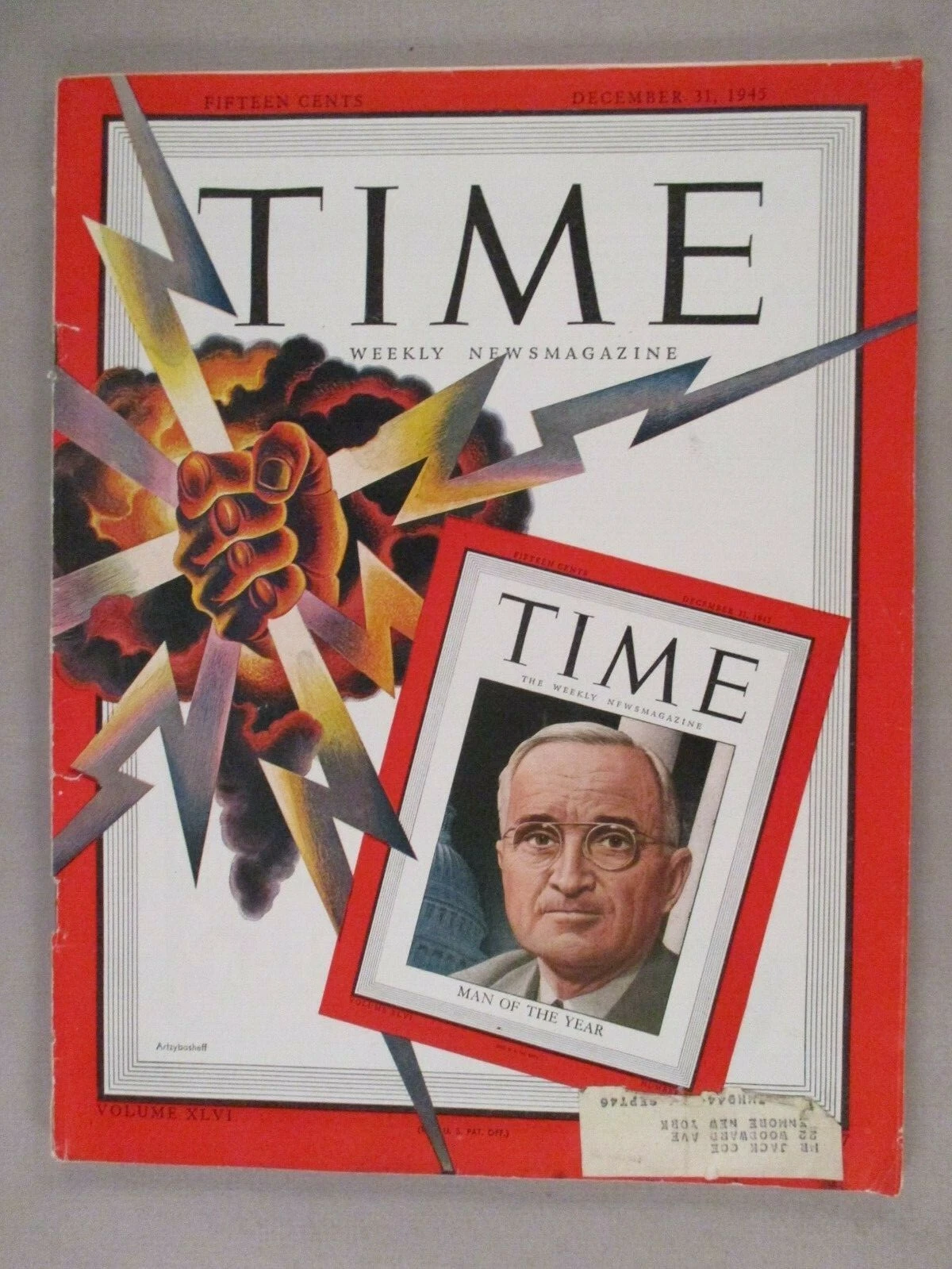
Truman as Time's Man of the Year, posted under fair use exception.
The significance of the atomic age, contrary to the way things are currently remembered, was appreciated immediately. Truman was Time magazine's Man of the Year, pictured in front of a fist grasping nuclear firebolts. Newspapers, even by late 1945, were pondering what atomic warfare would mean.
We've argued it here before, but the Second World War created the modern United States, and more than that, modern American culture, in both good, and bad, ways.
Tire rationing came to an end on this day in 1945.
The most oblivious, at first was the change to the economy, which was little understood. Pent up consumer demand dating back to the start of the Great Depression meant that the country did not slide back into the depression as nearly all Western economist had feared. Adding to this, however, was the fact that none of the European industrial powers, along with Japan, had not suffered some level of industrial destruction. The U.S.'s industrial base was not only left intact, it had expanded. Only Canada could claim to enjoy the same situation, although its economy was much smaller. American workers took advantage of the situation nearly immediately with a wave of strikes demanding higher wages, strikes that were in fact largely successful. The economic golden age that current Republican populists imagine to have existed in the past reached its most pronounced form in the 1950s which is still looked back upon fondly, if inaccurately, in the same way that singer Billy Joel imagined it to have been in his lamet Allentown
Well our fathers fought the Second World War
Spent their weekends on the Jersey Shore
Met our mothers in the USO
Asked them to dance
Danced with them slow
And we're living here in Allentown
The obliteration of European industry created the illusion of some sort of American economic uniqueness that remains to this day and which the country is presently attempting to sort out by restoring it, which will not and cannot work. Part of that also involves an imagined domestic perfection that doesn't' reflect what was going on in reality either.
Prior to the Second World War the domestic culture of the United States was different in nearly every fashion. Even the horrors of World War One had not changes that. Most Americans lived closer to the poverty line than they do today, even if most Americans lived in families. Most Americans did not attend college or university, and most men didn't graduate from high school. There was a minimum of surplus wealth on the part of the average, although that had started to change by imd 1920s, only to be retarded by the Great Depression. Most people did not move far from home. Most men and women married people who grew up near them and were part of the same class and religion, although a surprisingly large lifelong bachelor class existed, particularly in certain occupations.
The war changed nearly all of that, and even during the war itself.
The first peacetime Federal draft in the nation's history took thousands of young men away from their homes starting in 1940 and 41, and of course became the major wartime draft that continued on until after the war, and with some hiatus, basically until 1973. The country would not have tolerated a peacetime draft prior to 1940, and barely did in 1940 and 1941. The country's views on the military, which prior to the war was sort of a type of disdain but acceptance of it as necessary, as long as it was small, completely changed during the war so that by the war's end the concept of a large peacetime military was fully accepted, and even admired, although that would be disrupted again due to the Vietnam War for a time.
Prior to the war, soldiering was, for enlisted men and junior officers, a bachelor occupation with servicemen largely looked down upon as lazy. The enlisted ranks often contained large numbers of immigrants, although that is still true. After the war, the view of servicemen, many of whom for decades were conscripts on relatively short enlistments changed radically.
The expectation of marriage changed as well, even at a time that wartime marriages came into periods of great stress. Prior to the war a fair number of blue collar workers and nearly all non owner agricultural workers were lifelong bachelors.
Cowboys Out Our Way from December 31, 1945. The two working hands are discussing "Sugar", their former ranch cook, who just married a rich widow, and Stiffy, the oldest cowhand on the ranch.
This ended after the war for a variety of reasons, one simple one being that entire classes of men who had never really lived any other life now had seen at least much of the country, and some large sections of the globe. Men who had planned on a life of working on the farm or ranch and living in a bunkhouse no longer found that appealing and no longer believed they had to do that. For those who returned to their states of origin, and huge number of them did not, this often meant taking up a job in towns and cities, rather than in fields. Quite a few used the GI Bill to advance an education that benefited them at a time in which a university education guaranteed a white collar job. Regions that had large reservations found that many returning Native American veterans chose to live in towns and cities near the reservations they were from, rather than on them where living conditions remained comparatively primitive. Lots of men married who would not have otherwise. The average marriage age notably dropped for the first time in decades and remained depressed in the 1950s.
Lots of couples got divorced in fairly quick order as well.
This was because of a "marry in haste" situation that had broken out during the war. Couples who figured that the male's chances of surviving the great blood letting were fairly slim and were willing to accordingly gamble, where as previously they would not have been. Moreover, many of the couples that married were of different backgrounds and different regions of the country, and not the literal "girl next door" so often portrayed. A really good portrayal of the this sort of situation was given in the brilliant 1946 film The Best Years of Their Lives, which gave a dramatic, but fairly accurate, examination of the domestic situation of the post war years. Of note, 1946 also gave the country It's a Wonderful Life, which really portrayed the prewar, not the wartime or postwar, domestic ideal.
The amazing film The Best Years of Our Lives which captured the immediate impact of World War Two on Americans.
It's a Wonderful Life, also released in 1946, but which really portrayed the nature of American life from the 1910s until the late 1930s, although it was set in 1946. It's gone on to be a sentimental Christmas classic.
The Best Years of Their Lives also depicts fairly heavy drinking, and not in an accepting fashion, but in a relatively realistic one .That was also something that the war really brought in. Returning veterans were often very broken men, and alcohol abuse was an enduring feature of their lives, along with chronic cigarette smoking. This bled over into the culture in general and an increased acceptance of heavy alcohol use became common, and indeed is something often featured in post war films in a routine fashion. Men who had endured killing on a mass scale often never really adjusted back to a normal life, and resorted to the bottle in varying degrees.
At least by my observation, some of these men became downright mean. We hate to say that about "The Greatest Generation", but it's an enduring theme of the recollections of many of their children. Alcoholic fathers who were extremely demanding on their male children seems to have been routine. Again, by my observation, many of the same children, who went on to rebel during the 1960s, returned to their childhood roots and became mean demanding fathers to their own children, making World War Two the domestic abuse gift that keeps on giving.
While certainly most returning veterans did not become mean, or abusive, it has to be noted that the Second World War started the country off on a destruction of the natural relationship between men and women we're also still dealing with.
Not since the American Civil War had so many young men been taken away from their homes and never in the country's history had so many young men been kept in the company of young men overseas. War involves the ultimate vice, the killing of other human beings, and all other vices naturally come along with it, in varying degrees by personality, and by military culture.
All wars involve the abuse of women, the most spectacular example during the Second World War being the mass rapes, often accompanied by murder of the victims, by the Red Army late in the Second World War. There are some examples by Western armies as well, but they are much smaller in scale. Also notable, however, was the largescale outbreak of prostitution in Europe, some of which was conducted nearly publicly in places that would never have tolerated it before the war. Economic desperation caused much of it in some areas, which included underaged European women prostituting themselves in some instances and the military simply accepting it.2
Bill Mauldin in 1945. The diminutive Mauldin appeared a little younger than he actually was, being 24 years old at the time of this photograph. Indeed, Mauldin strongly resembled, oddly enough, Rockwell's Will Gillis depiction of an average GI. Mauldin's appearance contributed to a public view of the cartoonist that fit very much in with the public's image of "fresh faced American boys" in general, but he'd already lived a hard life by the time he entered the service. She son of New Mexican farmer/ranchers who were partially native American, Mauldin's early life had been somewhat chaotic and his teenage years were more so, being somewhat on his own by that time and living a somewhat odd life by the time he was in high school. While Mauldin is associated with the typical GI, his status as a member of the staff of two separate Army newspapers lead to an atypical existence including have a teenage Italian mistress when he was in Italy. In some ways Mauldin reflects the best and the worst of Army life in his cartoons and for that matter in actual service life.
Even where not completely sordid, plenty of misconduct occurred in all of the ranks. This is depicted in the recent series Master of the Air with at least one of the affairs depicted actually having occurred. In fictional form, it's portrayed in 1956's The Man In The Gray Flannel Suit.
The Man In the Gray Flannel Suit from 1956, but which starts off in World War Two and the moral failings in combat of the central character, including the violation of his marital vows.
This was bound to have some impact on the wider culture, and we've argued that it lead to the wider acceptance of the objectification of women. Indeed, thousands of men became acclimated to the centerfolds in Yank during the war, making the introduction of Playboy in 1953 not all that much of the big leap as its claimed to be.
Playboy often gets credit for firing the open shots of the disastrous Sexual Revolution, but it can be argued that Yank did. At any rate, by the wars end, millions of men had served in places were morality of all types was at a low ebb, and had ogled the girls in Yank, and perhaps painted topless or nude figures on government aircraft. That this would have some effect, particularly later when bogus sex studies were released as scientific texts, isn't too surprising. The major erosion of the natural order between men and women that came into full fruition after the late 1960s had some roots that went at least as far back as the 1910s, but World War Two gave it a major boost.
The war also gave a major boost to automobiles.
Prior to the war, and during it, the US relied on rail transportation. But new types of automobiles, notably 4x4s, were introduced during the war, and cars overall simply improved. By 1950 it was clear that road building and automobiles had become a major American obsession, spawned in part by the heavy road use, in spite of automobiles, that occurred during the war. 4x4s, which were strictly an industrial vehicle, were introduced into civilian use shortly after the war, with pickup truck variants ending the need for ranches to have cowboys in the high country during the winter, and allowing any part of the country to be accessed to some degree by sportsmen or agriculturalist year around.
1947 Sheridan newspaper advertisement for what was probably a surplus Dodge WC.
Reliance on equine transportation, in contrast, started to decline markedly.
December 31, 1945 brought the news that Hirohito had renounced claims to divinity, with the nature of the Japanese monarchical claim on that point never understood by Westerners in the first place. He did not ever claim to have been a god, and it was soon learned that the majority of the Japanese had never believed in the imperial family's claim to a unique divine status in the first place.
The war ended, seemingly for good, Japanese militarism. It also seems to have ended German militarism as well, something assisted by the fact that the Soviets ended up with Prussia, it's source.
The war, of course, also advanced the frontiers of Soviet domination beyond its 1940 status, something the Soviets had been working on since 1917. This would prove to be temporary, as would the Soviet Union itself, but that could not be foreseen in 1945. A world that had worried about whether fascism, communism, or democracy would prevail, now worried over whether communism or democracy would be the ultimate victors.
In China, where on this day an unsuccessful treaty between the Nationalist and the Communists would be signed, a contest more resembling the pre World War Two one was going on, revived from its 1927 start and temporary hiatus during the Second World War.
1945 was a fateful year. For Americans it started with American troops fighting the Germans in Bulge in Operation Wachts am Rhein and in Alsatia in Operation Nordwind. For the Soviets, January 1945 would be the bloodiest month of the war, as it would be for the Germans. For the Japanese, it marked pitched resistance to Allied advances everywhere, and a desperate effort to advance in China. It all came to an end in August, 1945, and by December 31, 1945, the world was trying to sort out where it was going. Much of it could be anticipated, but much could not be.
*I had typed out a very long and detailed look at the 1940s, and 1945, for the December 31, 1945 entry, before some computer glitch entirely wiped it out. It's completely gone.
I may try to reconstruct it a bit, but the fact that I started working on it some time ago is a deterrent to that. And even if I do, a reconstructed post is never as good as the original.
1. Like decades, centuries don't really track the calendar precisely either. The 20th Century arguably began around 1898 or so, and continued on, perhaps, to 1991, when the Soviet Union collapsed.
2. An interesting sympathetic depiction of a woman engaging in prostitution due to economic desperation in found in the 1946 Italian film Paisa'.




.jpg)
.jpeg)


