Ostensibly exploring the practice of law before the internet. Heck, before good highways for that matter.
Saturday, May 9, 2020
The Best Posts Of The Week Of May 3, 2020.
The best posts of the week of May 3, 2020.
Labels:
Coronavirus Pandemic,
Poster Saturday,
Posters
May 9, 1970. Strange Days.
President Nixon visited the Lincoln Memorial and chatted with protestors who were sleeping there in anticipation of a protest organized in reaction to the American and South Vietnamese invasion of Cambodia. The President encountered about nine protestors and chatted with then in the early morning hours.
Protests were occuring all across the country on this day in reaction to the Cambodian invasion and in reaction to the shooting at Kent State.
On this day, about 450 Canadian peace activist crossed into the United States at Blaine Washington, location of the Peace Arch, and committed acts of vandalism in the town. The presence of Canadian peace activist was completely nonsensical and their act of vandalism contrary to the claimed spirit of their actions. It reflected more on events in Canada than it did in the United States in which the formerly highly conservative country was rocketing into a state of liberalism in which it remains, although it is contested, that started under the leadership of Pierre Trudeau. Canada, in the less than one hundred years prior to 1970, had fought in the Boer War, World War One, World War Two and the Korean War. It opposed the Vietnam War in a way, although it's often forgotten that it contributed a hospital ship to the allied forces there at one time and its contribution in terms of military volunteers approximated the number of American draft evaders who sought refuge there.
Another Canadian protest occurred on the same day on Parliament Hill when Canadian pro abortion activist protested a recently passed Canadian law addressing abortion. This occurred three years prior to Roe v. Wade in the United States. At the time, just ten years following the advent of birth control pharmaceuticals, the direction things were going in seemed obvious. Canada would repeal its law eighteen years later and no Canadian federal law has passed since. Since that time, however, support for abortion in the United States has reversed to the point that the majority of Americans oppose it and its only a matter of time until the weakly reasoned case of Roe is repealed and the matter is returned to the states. Canada, which is highly liberalized, has been slower to follow but has started to, with there being a small resurgent conservative movement that has come about over issues such as this, but also due to really extreme social speech provisions enacted in Canadian law.
Showing how odd the times were, retrospectively, Vice President Spiro Agnew spoke to a disappointing crowd of 10,000. . . 100,000 had been expected, at Georgia's Stone Mountain Park. The Park is the location of a giant carving into natural stone depicting Confederate President Jefferson Davis, Gen. Robert E. Lee and Gen. Stonewall Jackson, all mounted. It's impossible to imagine an American politician speaking there today.
The memorial had first been proposed in 1914, which was in the midst of the boom in Confederate memorial building across the south. As we've discussed elsewhere, most of the now controversial monuments to Southern rebel figures and to the Southern Civil War cause in general date from this period. The monument itself does not, however, as its construction had an exceedingly odd history.
Land for the monument was purchased in 1916 but a sculptor was not hired until the early 1920s, with that sculptor being Borglum, of Mount Rushmore fame. He was fired over a financial conflict in 1925, however. Congress got into the act in 1926 with the approval of the sale of commeorative coins for the effort thereafter.
After Borlum departed he destroyed his models which lead to the Association dedicated to the effort seeking to have him arrested. In a sort of retaliation, the Association had the face of Lee that Borglum had partially completed blasted off of the mountain. Subsequent sculptors took up the work but it lingered until 1958 when the State of Georgia purchased the area in order to complete it in a reaction to Brown v. Board of Education. The state park was dedicated on April 14, 1965, 100 years plus one day after Lincoln's assassination in 1865. The dedication of the monument occured in 1970, with Vice President Agnew appearing for the event, but it wasn't actually completed until March 3, 1972. It's now the biggest tourist site in Georgia.
Now, of course, a lot of the smaller Confederate monuments have come down, but many more remain. It's amazing to realize that as late as the 1970s there were still Southern public efforts to put them up, and that they were very associated with protest over desegregation. The degree to which the support for the war had been lost was demonstrated by Agnew's failure to draw a crowed in the highly conservative south where opposition to the war had not been strong.
On the same day, Jimi Hendrix played in Ft. Worth and the Doors played in Columbus, Ohio.
Labels:
1910s,
1920s,
1960s,
1970,
1970s,
1972,
Canada,
Civil Unrest,
Civil War,
Georgia,
Ottawa Canada,
Vietnam War,
Washington,
Washington DC
Friday, May 8, 2020
May 8, 1945. Victory In Europe. Seventy Five Years Ago Today.
The mission of this Allied force was fulfilled at 0241, local time, May 7th, 1945.Dwight Eisenhower.
The official surrender, however, came today.
Today In Wyoming's History: May 8:
May 8
1945 The German surrender becomes official. President Harry S. Truman announced in a radio address that World War II had ended in Europe. End of the Prague uprising. Hundreds of Algerian civilians are killed by French Army soldiers in the Sétif massacre, ushering in what would ultimately become the French Algerian War. In day two of rioting, 10,000 servicemen in Halifax Nova Scotia loot and vandalize downtown Halifax during VE-Day celebrations.
Labels:
1940s,
1945,
Australia,
Belgium,
Blog Mirror,
British Commonwealth,
Canada,
Europe,
France,
Nazi Germany,
Netherlands,
New Zealand,
Norway,
Poland,
United Kingdom,
United States,
USSR,
World War Two
The Pandemic and Food, Part Two.
(Note, I actually thought I'd published this already. . . the Coronavirus is leading to a backlog of posts).
Until just the other day, I was apparently really naive about the degree to which Americans eat in restaurants.
And at that, I'm often amazed by the amount of food people eat outside of dinner, the American main meal I'll skip breakfast and lunch fairly routinely and not miss them, which means by extension I don't really eat much at those meals. But I'll find that even people who bring in meals for lunch often eat really big lunches, often as much as I eat for dinner. I couldn't do that.
All of which has lead me to being ignorant as to people's actual practices, even though they are there right out in the open for me to have observed. Indeed, my father always ate lunch downtown during the work week, which was, in his case, always a bowl of soup at restaurant that he and his friends ate at every day.
I definitely differ there. I hate soup.
Anyhow, waking up on this, it's now evident to me that a lot of people grab something from a fast food joint for breakfast, something else downtown at noon, and eat out at night a lot. Some people eat out three for dinner, in one fashion or another, three or more times per week, which is just stunning to me.
The net result of this has been strain on the food supply system and is contributing to the odd sense of there being a shortage on the production end when in fact the shortages are in the dual distribution system.
This ought to give us some pause, and part of that may be the extent to which we've really suspended cooking at home for eating out in a major way.
Now, I don't want to suggest anything that leads to a crisis for working people, and people who work in restaurants, restaurants of all types, are certainly working people. Indeed, right now, servers in restaurants are in a real state of crisis.
But relying on eating out to the extent that we do is not good. It contributes to an unhealthy diet, no matter what we may think about what we're ordering, and it dissociates ourselves with our food. No natural diet of any type is severed at the 50% rate through restaurants.
With all of this being the case, I wonder to what extent people will now reassess this part of their daily lives. As things open back up will people who have learned how to cook keep on doing it, or will they immediately given it up for something served through a drive up window on the way to work.
Beyond that, this really raises what we've called here the Distributist Lament from time to time. We have a system that's obviously better served through the local, but in the name of efficiency and a false economy, we've defeated it.
There was a time when restaurants bought their food, often daily, from local grocers. Now they don't do it at all. The extent to which they don't do it never occured to me until now.
Indeed, the only real familiarity that I have with restaurant supply chains, other than a brief stint at Burger King, a job I truly hated, comes from the National Guard and Army. The service bought its food locally when serving through GI kitchens, so I just assumed that restaurants did as well. I don't know why I assumed that, but I did. I know why the service did, it wanted locals to know the economic benefits of a military establishment in their municipalities.
And that benefit would exist elsewhere, if that's how this was generally done and there was a single, not a double, food distribution system.
Something to consider.
And we'll have more to ponder on this topic as well.
Related Threads
Until just the other day, I was apparently really naive about the degree to which Americans eat in restaurants.

Fourteen year old waitress, 1917. Nobody in my family has ever worked this occupation, and I was really clueless on the extent to which people dine out.
I probably shouldn't have been, as I'm well aware that lots of people eat out every day at noon, or a lot of days anyhow, and that a lot of people start the day with breakfasts from a fast food joint.
But I was.
That's likely because I never start the day at a fast food joint and never have. I don't know if I've ever had an Egg McMuffin and frankly the thought of starting off at McDonalds doesn't appeal to me at all. If I haven't eaten at home for breakfast, I just don't eat.
And I almost never eat lunch at a restaurant either. I have, of course, but it's almost always in some sort of context, such as meeting a friend or as part of a work meeting, or something like that. And for that matter, we don't eat out all that much for dinner either, although we do eat out a lot more than my parents did.
And at that, I'm often amazed by the amount of food people eat outside of dinner, the American main meal I'll skip breakfast and lunch fairly routinely and not miss them, which means by extension I don't really eat much at those meals. But I'll find that even people who bring in meals for lunch often eat really big lunches, often as much as I eat for dinner. I couldn't do that.
All of which has lead me to being ignorant as to people's actual practices, even though they are there right out in the open for me to have observed. Indeed, my father always ate lunch downtown during the work week, which was, in his case, always a bowl of soup at restaurant that he and his friends ate at every day.
I definitely differ there. I hate soup.
Anyhow, waking up on this, it's now evident to me that a lot of people grab something from a fast food joint for breakfast, something else downtown at noon, and eat out at night a lot. Some people eat out three for dinner, in one fashion or another, three or more times per week, which is just stunning to me.
The net result of this has been strain on the food supply system and is contributing to the odd sense of there being a shortage on the production end when in fact the shortages are in the dual distribution system.
This ought to give us some pause, and part of that may be the extent to which we've really suspended cooking at home for eating out in a major way.
Now, I don't want to suggest anything that leads to a crisis for working people, and people who work in restaurants, restaurants of all types, are certainly working people. Indeed, right now, servers in restaurants are in a real state of crisis.
But relying on eating out to the extent that we do is not good. It contributes to an unhealthy diet, no matter what we may think about what we're ordering, and it dissociates ourselves with our food. No natural diet of any type is severed at the 50% rate through restaurants.
With all of this being the case, I wonder to what extent people will now reassess this part of their daily lives. As things open back up will people who have learned how to cook keep on doing it, or will they immediately given it up for something served through a drive up window on the way to work.
Beyond that, this really raises what we've called here the Distributist Lament from time to time. We have a system that's obviously better served through the local, but in the name of efficiency and a false economy, we've defeated it.
There was a time when restaurants bought their food, often daily, from local grocers. Now they don't do it at all. The extent to which they don't do it never occured to me until now.
Indeed, the only real familiarity that I have with restaurant supply chains, other than a brief stint at Burger King, a job I truly hated, comes from the National Guard and Army. The service bought its food locally when serving through GI kitchens, so I just assumed that restaurants did as well. I don't know why I assumed that, but I did. I know why the service did, it wanted locals to know the economic benefits of a military establishment in their municipalities.
And that benefit would exist elsewhere, if that's how this was generally done and there was a single, not a double, food distribution system.
Something to consider.
And we'll have more to ponder on this topic as well.
Related Threads
The Pandemic And The Table, Part 1.
Burlington Northern to layoff 130 and to close two maintenance facilities in Wyoming.

The facilities are in Rozet and Guernsey.
The slow down in the economy is being cited for the reason, brought about by the COVID 19 pandemic. Combined with that, the BNSF heavily relies upon coal hauling, which has been in decline with the decline in coal.
Suffice it to say, bad news for the employees and for the state as well.
Labels:
2020,
2020s,
Coal,
Coronavirus Pandemic,
Economics,
Railroads,
Transportation,
Wyoming's boom and bust economy
Location:
Wyoming, USA
May 8, 1920 Endings
On this day in 1920, the Luftstreitkräfte, the World War One equivalent of the Luftwaffe, more or less, officially came to an end.
Disassembled German aircraft on display in London, 1918.
The organization, not surprisingly, had gone through several names and structures before achieving its final one in October 1916. It did not include naval flyers, who remained in the navy, and its association with the German army was organizational such that it was part of the army. It oddly did not include every German army pilot, however, as Bavaria retained an element of organizational control over men recruited from its territory, including at least theoretically its own air force.
After the German surrender it basically came to an end and its one and only commander, Ernst von Hoeppner, left his appointed position as its chief in January 1919 as part of the dissolution of the force in accordance with the Treaty of Versailles which prohibited the Germans from having military aircraft. After that point it existed on paper until this day in 1920.
Ernst von Hoeppner, the commander of the Luftstreitkräfte from October 1916 until January 1919. He returned to the cavalry branch from which he had come and retired in November 1919, dying from the flu at age 62 in 1922.
The German government did field aircraft as late as 1920 when it put down the Ruhr Rebellion, but those aircraft and their pilots were at least theoretically in the Freikorps.
On the German air arm and symbols, an interesting thing to note is how the stylized cross borrowed from the Teutonic Knights has evolved in the German air arm. From 1914 to 1915, it was the full cross pattée associated somewhat inaccurately with the Medieval crusading order that was painted on the sides and wings of German aircraft. In reality, the Teutonic Knights only occasionally employed this style of cross, but it was heavil adopted by the German crown after unification of the country during the Franco Prussian War.
German cross pattée originally used on German aircraft.
In 1915, the cross pattée was slimmed down a bit for some reason.
Cross pattée used from 1915 until March 1918.
In March 1918, it was made a simple straight cross.
German aircraft symbol from March 1918 until the end of the war.
The revived Luftwaffe continued to use the simple cross throughout its existence from 1935 until 1945, in a modified form that added emphasis to the lines, but when the post war Luftwaffe was recreated, it went back, with the rest of the German military, to the cross pattée.
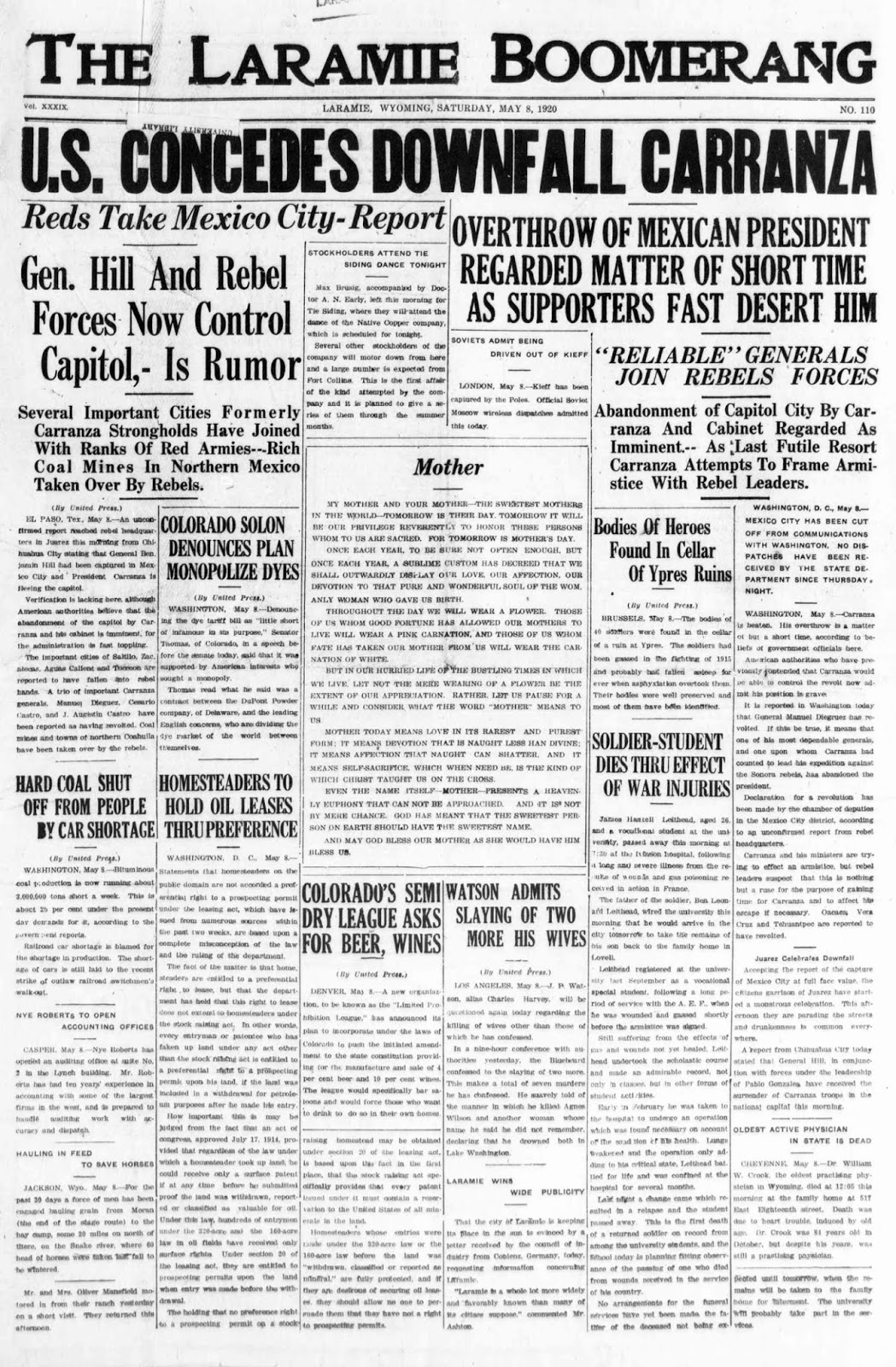
While the German air arm was disappearing, the Carranza government was as well.
What started as an effort to control who would be his successor was rapidly and obviously going down the tubes, although Carranza was not conceding anything. Forces were lining up against him, including those of the improbably named Gen. Benjamin Hill, who would die under suspicious circumstances that following December.
As Mexico was increasingly headed leftward, American leftists were on the front cover of the papers as well, claiming that Woodrow Wilson had broken faith with them. His government certainly hadn't been kind to them recently.
The news from the oil patch was strangely similar to today's.
Wyoming Oil World was reporting that petroleum prices had fallen to an all time low.
Washington D.C. was having a dog show and some well known names were going to it.
Seventh annual Dog Show of the Washington Kennel Club. Franklin Roosevelt and his daughter Anna in photo.
Labels:
1918-1919 Paris Peace Conference,
1920,
1920s,
German Luftwaffe,
It was because of World War One,
Mexican Revolution,
Mexico,
Petroleum,
World War One,
Wyoming's boom and bust economy
Thursday, May 7, 2020
May 7, 1920. Races
Collegiate airplane race activity at Mitchel Field, Long Island, May 7, 1920.
On this day in 1920 the first ever Collegiate Airplane Race occured in New York.
Collegiate airplane race participants J.T. Trippe (1899-1981) and George Willard Horne, who flew for Yale at Mitchel Field, Long Island, May 7, 1920.
Collegiate airplane race participants Robert K. Perry and Harry Goodman, who flew for Williams College at Mitchel Field, Long Island, May 7, 1920
Collegiate airplane race participants Lansing Colton Holden, Jr. (1896-1938) and Zenos Ramsey Miller (1896-1922), who flew for Princeton at Mitchel Field, Long Island, May 7, 1920.
collegiate airplane race participants Joseph Ferdinand Lersch and David Amos Royer, who flew for University of Pennsylvania at Mitchel Field, Long Island,
On the same day, Carranza gathered his troops and departed Mexico City for Vera Cruz, falling back on a tactic he'd previously used against Pancho Villa and Emiliano Zapata. While this was portrayed as a flight from the city, which was about to be attacked by rebel forces, it also at least partially acknowledged that Mexico City is difficult to defend.
A city which changed hands today was Kiev, which fell to Polish forces in the Russo Polish War.
Labels:
1920,
1920s,
Aircraft,
Mexican Revolution,
Mexico,
Mexico City,
Russo Polish War,
Sports,
Transportation,
Ukraine
The Reassessors. Smedly Butler
He entered the Marine Corps in 1898 and served until 1931, and saw action all over the world. He is one of the most decorated Marines in history, having won the Congressional Medal of Honor twice.
After his retirement the disillusioned Butler wrote a book called War Is A Racket. His views might be summarized by the following quote.
I spent 33 years and four months in active military service and during that period I spent most of my time as a high class muscle man for Big Business, for Wall Street and the bankers. In short, I was a racketeer; a gangster for capitalism. I helped make Mexico and especially Tampico safe for American oil interests in 1914. I helped make Haiti and Cuba a decent place for the National City Bank boys to collect revenues in. I helped in the raping of half a dozen Central American republics for the benefit of Wall Street. I helped purify Nicaragua for the International Banking House of Brown Brothers in 1902–1912. I brought light to the Dominican Republic for the American sugar interests in 1916. I helped make Honduras right for the American fruit companies in 1903. In China in 1927 I helped see to it that Standard Oil went on its way unmolested. Looking back on it, I might have given Al Capone a few hints. The best he could do was to operate his racket in three districts. I operated on three continents.
Wednesday, May 6, 2020
Mid Week At Work. Their careers and lives. Lex Anteinternet: May 5, 1920. The Contest
Yesterday and the day before we ran this item:
Lex Anteinternet: May 5, 1920. The Contest:
So who were they? And what became of them?
Did they join the Army?
Well, not in so far as I know, but it turns out that Donald L, Campbell had quite the career.
I posted this photo on Reddit's 100 Years Ago subreddit, and somebody followed up with the details on Campbell. He became a significant chemical engineer and has a place in the Inventors Hall of Fame. He lived to age 98, dying in 2002. He holds a patent pertaining to the refining of petroleum.
Marjorie Sheetz lived with her grandparents up until 1910, but that doesn't let us know what happened to her after 1920. She apparently went to university and became a librarian. She was secretary of the Missouri Library Association under that name in 1940, twenty years after this photo was taken. She worked as a librarian for the University of Missouri and the later a public library, before retiring in 1955. She died in 1964, having never married. She would have only been 58 years old at the time.
Betty Bowen Eason did marry, and lived until 1992. Her married name was Cantwell. Which is all that I'm able to find about her.
Did they every meet again?
I doubt it, but it's interesting to know, if only as a snipped, how things went after this.
Lex Anteinternet: May 5, 1920. The Contest:
May 5, 1920. The Contest
The essay contest was on the benefits of enlisting in the Army.
Awarding of prizes in the Army Essay contest by the Secty. of War, General March, and General Harris.
Two out of the three winners were young women, an irony in that women hadn't been allowed to join the Army on a regular basis prior to World War One, and during the Great War it was only on a temporary basis. That would really only changed during World War Two.
"Awarding of prizes in the Army Essay contest by the Secty. of War General March and General Harris. Elaborate exercises were held at the Stadium of the Central High School."
So who were they? And what became of them?
Left to Right Betty Bowen Eason, Age 16, Olive Branch Miss. Donald L.Campbell, age 15 Clinton Iowa, Marjorie Sheetz Age 14 Chillicothe Mo. Congressman Hubert D. Stephens Miss. Hull, Harry E. Iowa. Wm W. Rucker Mo
Did they join the Army?
Well, not in so far as I know, but it turns out that Donald L, Campbell had quite the career.
I posted this photo on Reddit's 100 Years Ago subreddit, and somebody followed up with the details on Campbell. He became a significant chemical engineer and has a place in the Inventors Hall of Fame. He lived to age 98, dying in 2002. He holds a patent pertaining to the refining of petroleum.
Marjorie Sheetz lived with her grandparents up until 1910, but that doesn't let us know what happened to her after 1920. She apparently went to university and became a librarian. She was secretary of the Missouri Library Association under that name in 1940, twenty years after this photo was taken. She worked as a librarian for the University of Missouri and the later a public library, before retiring in 1955. She died in 1964, having never married. She would have only been 58 years old at the time.
Betty Bowen Eason did marry, and lived until 1992. Her married name was Cantwell. Which is all that I'm able to find about her.
Did they every meet again?
I doubt it, but it's interesting to know, if only as a snipped, how things went after this.
Labels:
1920,
1920s,
Mid-Week at Work,
Work
Tuesday, May 5, 2020
The Tragedy At Kent State
Yesterday, as we noted below, was the 50th anniversary of the Kent State, Ohio, incident.
The incident, to put it briefly, occured when students at Kent State University staged a protest over the invasion of Cambodia which had been announced by President Nixon on April 30 and which for the US commenced on May 1.
This blog isn't a day by day anything, but we do commemorate certain events, most frequently those of 100 years past, when they occur. Starting in 2018 we started picking up some fifty years past events mostly to mark the epicoal year of 1968. We've continued with that a bit, as that is in some ways the continuation of the original story.
I marked the 1970 invasion of Cambodia, an event that I can personally recall as I noted in a post about that, but I managed to almost miss the 50th anniversary of the Kent State Shootings. I marked it, but only with a post nothing it:
I nearly missed this somehow.
The point at which the Vietnam War took on a new, tragic, aspect, as a protest resulted in a unforeseen bloodshed.
This deserves a much better post than this, but unfortunately, it'll have to wait a bit.
The event was a huge one in the story of the war as it was the point where protests over the war resulted in bloodshed, something they had not up until then. As the anti war movement had developed some real radicals, it would have some violent incidents after Kent State, but the protest at Kent State itself was never intended to be that sort of confrontation.
It's easy to over explain what happened there, but the real oddity of it is that National Guardsmen, who were drawn from the local area and largely not reflected in the student body of Kent State, were deployed as a riot detail to the protest. That's not surprising but frankly, as a former National Guardsmen, that sort of duty is always dangerous for Guardsmen and the public, to a degree. Guardsmen are trained as soldiers, not as riot police, and the instinct of soldiers is to fire when confronted, no matter how well trained they may be. There are plenty of such incidents all around the globe that have occured when soldiers, even very well trained soldiers, fall back on their training in that fashion.
With that being the case, the shocking thing is that the Guardsmen had been issued ammunition. Normally this wouldn't be the case and I heavily doubt that even regular active duty soldiers who were deployed in similar roles in the 1950s and 1960s were issued ammunition. Likely even those men deployed to disperse the bonus marchers carried nothing more dangerous than than their sabers (they were cavalrymen) in that effort, with sabers making a pretty effective non lethal crowd control weapon in the hands of somebody who knows how to use their flats.
But at Kent State the Guardsmen were issued ammunition for their M1 Garands and at some point, they used it.
What happened remains extremely unclear. The protests had been running for several days as it was so it had grown tense. An effort was made to disperse the crowed and as part of that the Guardsmen advanced with bayonets fixed to their M1 Garands. Some students began throwing rocks and return throwing tear gas canisters. At some point the Guardsmen fired a 13 second volley, which is a long sustained volley. Sixtyseven shots were fired by the 77 Guardsmen, but slightly less than half fired at all.
That seems clear enough, but from there things deteriorate. Forensic examination of audiotape suggests that three shots were fired shortly before any others. Some witnesses claimed a sergeant opened fire with a sidearm first, but the FBI's expert stated that the first three shots were from a M1 Garand. An FBI informant inside the student body was revealed to be later armed and some have claimed that he fired the first shots, but this now seems discounted.
In the end, nine students were wounded and four killed. None of the killed was any older than 20 years old. Given the volume of shots, and the weapons used, it's amazing that only 13 people were hit, which has to lead to some speculation on whether the 29 Guardsmen who all fired actually aimed at anything or even attempted to, or even intentionally did not.
The entire matter was a national tragedy, to say the least. It put protests on the war on a new footing, even though the United States was already withdrawing from South Vietnam at the time, something not entirely evident to Americans given the recent news. It was also a local tragedy, however, which is rarely noted as like a lot of university towns, the residents of Kent Ohio, whose families had contributed those who were in the National Guard, never saw the incident in the same light.
The incident, to put it briefly, occured when students at Kent State University staged a protest over the invasion of Cambodia which had been announced by President Nixon on April 30 and which for the US commenced on May 1.
This blog isn't a day by day anything, but we do commemorate certain events, most frequently those of 100 years past, when they occur. Starting in 2018 we started picking up some fifty years past events mostly to mark the epicoal year of 1968. We've continued with that a bit, as that is in some ways the continuation of the original story.
I marked the 1970 invasion of Cambodia, an event that I can personally recall as I noted in a post about that, but I managed to almost miss the 50th anniversary of the Kent State Shootings. I marked it, but only with a post nothing it:
May 4, 1970. Kent State
I nearly missed this somehow.
The point at which the Vietnam War took on a new, tragic, aspect, as a protest resulted in a unforeseen bloodshed.
This deserves a much better post than this, but unfortunately, it'll have to wait a bit.
The event was a huge one in the story of the war as it was the point where protests over the war resulted in bloodshed, something they had not up until then. As the anti war movement had developed some real radicals, it would have some violent incidents after Kent State, but the protest at Kent State itself was never intended to be that sort of confrontation.
It's easy to over explain what happened there, but the real oddity of it is that National Guardsmen, who were drawn from the local area and largely not reflected in the student body of Kent State, were deployed as a riot detail to the protest. That's not surprising but frankly, as a former National Guardsmen, that sort of duty is always dangerous for Guardsmen and the public, to a degree. Guardsmen are trained as soldiers, not as riot police, and the instinct of soldiers is to fire when confronted, no matter how well trained they may be. There are plenty of such incidents all around the globe that have occured when soldiers, even very well trained soldiers, fall back on their training in that fashion.
With that being the case, the shocking thing is that the Guardsmen had been issued ammunition. Normally this wouldn't be the case and I heavily doubt that even regular active duty soldiers who were deployed in similar roles in the 1950s and 1960s were issued ammunition. Likely even those men deployed to disperse the bonus marchers carried nothing more dangerous than than their sabers (they were cavalrymen) in that effort, with sabers making a pretty effective non lethal crowd control weapon in the hands of somebody who knows how to use their flats.
But at Kent State the Guardsmen were issued ammunition for their M1 Garands and at some point, they used it.
What happened remains extremely unclear. The protests had been running for several days as it was so it had grown tense. An effort was made to disperse the crowed and as part of that the Guardsmen advanced with bayonets fixed to their M1 Garands. Some students began throwing rocks and return throwing tear gas canisters. At some point the Guardsmen fired a 13 second volley, which is a long sustained volley. Sixtyseven shots were fired by the 77 Guardsmen, but slightly less than half fired at all.
That seems clear enough, but from there things deteriorate. Forensic examination of audiotape suggests that three shots were fired shortly before any others. Some witnesses claimed a sergeant opened fire with a sidearm first, but the FBI's expert stated that the first three shots were from a M1 Garand. An FBI informant inside the student body was revealed to be later armed and some have claimed that he fired the first shots, but this now seems discounted.
In the end, nine students were wounded and four killed. None of the killed was any older than 20 years old. Given the volume of shots, and the weapons used, it's amazing that only 13 people were hit, which has to lead to some speculation on whether the 29 Guardsmen who all fired actually aimed at anything or even attempted to, or even intentionally did not.
The entire matter was a national tragedy, to say the least. It put protests on the war on a new footing, even though the United States was already withdrawing from South Vietnam at the time, something not entirely evident to Americans given the recent news. It was also a local tragedy, however, which is rarely noted as like a lot of university towns, the residents of Kent Ohio, whose families had contributed those who were in the National Guard, never saw the incident in the same light.
Labels:
1970,
1970s,
Cambodia,
Cambodian Civil War,
Civil Unrest,
Disaster,
Kent State Incident,
National Guard,
Ohio,
Vietnam,
Vietnam War
Location:
Kent, OH, USA
May 5, 1920. The Contest
The essay contest was on the benefits of enlisting in the Army.
Awarding of prizes in the Army Essay contest by the Secty. of War, General March, and General Harris.
Two out of the three winners were young women, an irony in that women hadn't been allowed to join the Army on a regular basis prior to World War One, and during the Great War it was only on a temporary basis. That would really only changed during World War Two.
"Awarding of prizes in the Army Essay contest by the Secty. of War General March and General Harris. Elaborate exercises were held at the Stadium of the Central High School."
Labels:
1920,
1920s,
Army,
Men,
The roles of men and women,
The written word,
Women
Monday, May 4, 2020
May 4, 1970. Kent State
I nearly missed this somehow.
The point at which the Vietnam War took on a new, tragic, aspect, as a protest resulted in a unforeseen bloodshed.
This deserves a much better post than this, but unfortunately, it'll have to wait a bit.
Labels:
1970,
1970s,
Civil Unrest,
Kent State Incident,
Vietnam War
Location:
800 E Summit St, Kent, OH 44240, USA
May 4, 1920. Best laid plans. . .
Winners of the Army Essay Contest tour Congress, May 4, 1920.
Carranza's attempt to dictate who his successor would be were going badly.
And Californians were determining who would line up for the Oval Office in the Fall.
Female secretaries of Congressmen, then a new innovation, and Congressional Gym physical fitness instructor, May 4, 1920.
Labels:
1920,
1920 Presidential Election,
1920s,
Mexican Revolution,
Mexico,
Sports,
The written word
Sunday, May 3, 2020
And as the race heats up, mud files, and Twitter tweats. . .
it's worth remembering the Russians.
Eh?
Yes, remember the Russians.
Or at least recall that the Russians were messing around in our election in 2016, and they did that in no small part through Facebook and Twitter.
See a lot of extreme stuff coming from those quarters, and people rising to the bait?
Well, it's worth recalling where extreme political stuff on the net tends to come from. And just skip it.
Eh?
Yes, remember the Russians.
Or at least recall that the Russians were messing around in our election in 2016, and they did that in no small part through Facebook and Twitter.
See a lot of extreme stuff coming from those quarters, and people rising to the bait?
Well, it's worth recalling where extreme political stuff on the net tends to come from. And just skip it.
Labels:
2020 Election,
Facebook,
Russia,
Twitter
Lex Anteinternet: Lex Anteinternet: Trouble in the Red Hermit Kingdo...
Last week I posed this:
COVID 19 is in North Korea and Kim Jong-un is terrified of getting it. He's "self quarantining".
Now, Kim Jong-un has reappeared.
Hmmm. . . .
Lex Anteinternet: Lex Anteinternet: Trouble in the Red Hermit Kingdo...: We posted this a couple of days ago about Kim Jong-un, the Communist monarch of North Korea: Lex Anteinternet: Trouble in the Red Hermit K...In it, I posted this theory:
COVID 19 is in North Korea and Kim Jong-un is terrified of getting it. He's "self quarantining".
Now, Kim Jong-un has reappeared.
Hmmm. . . .
Labels:
2020,
2020s,
Coronavirus Pandemic,
Korea,
North Korea,
You heard it here first
Location:
North Korea
Sunday Morning Scene: Churches of the West: Eden Valley Baptist Church, Farson Wyoming
Churches of the West: Eden Valley Baptist Church, Farson Wyoming:
Eden Valley Baptist Church, Farson Wyoming
Labels:
Architecture,
Blog Mirror,
Christianity,
Churches,
Churches of the West,
Farson Wyoming,
Protestant,
religion,
Sunday Morning Scene
Location:
Farson, WY 82932, USA
The Best Posts Of The Week Of April 24, 2020
The best posts of the week of April 24, 2020.
Trains, Planes and Automobiles. . . and the Coronavirus Pandemic
Lex Anteinternet: Trouble in the Red Hermit Kingdom. A Viral Explanation?
Panoramic Photograph Equipment?
Blog Mirror: The Dumbest Blog Ever; The Burden of Proof.
Pondering the 1918/1919 Influenza Pandemic
April 30, 1970. The Incursion into Cambodia
I remember it.
Exit Mia.
Saturday, May 2, 2020
Exit Mia.
On July 8, 1921, Minnesota Cooperative Creameries Association, a dairy cooperative, formed for the purpose of marketing their products. They didn't like the name, however, and held a contest that ended up selecting a submission made in 1926, that being Land O Lakes, noting the nature of Minnesota itself, although we don't associate lakes much with dairy. In 1926 the coop received a painting of an Indian woman holding a carton of their butter, looking forward at the viewer, with lakes and forests in the background. They liked it so much they adopted it as their label and while they had it stylized by Jess Betlach, an illustrator, the image itself remained remarkably consistent with the original design, which says something as illustrations by Betlach sometimes approached the cheesecake level and depictions of Indian women in the period often strayed into depictions of European American models instead of real Indian women.
For reasons unknown to me, the depiction of the young Indian women acquired the nickname "Mia" over time.
And now she's been removed from the scene, quite literally.
In 1928 the Land O Lakes dairy cooperative hired an advertising agency to come up with a logo for them. The logo that was produced featured an Indian woman kneeling in front of a lake scene, with forests surrounding the lake, and holding a box of Land O Lakes butter in a fashion that basically depicted the woman offering it to the viewer. From time to time Land O Lakes actually changed the logo on a temporary basis, but it always featured Mia, but not always in the same pose. On at least one occasion she was shown in profile near a lake and seemingly working (churning) something in a pot. On another, she was rowing a canoe.
Frederic Remington nocturn, The Luckless Hunter. This is a fairly realistic depiction of a native hunter in winter, on the typically small range horse of the type actually in use on the Northern Plains.
The adoption of Indian depictions and cultural items as symbols in European American culture goes a long ways back, so Land O Lakes adopting the logo in 1928 was hardly a novelty. In ways that we can hardly grasp now, European American culture began to admire and adopt Indian symbols and depictions even while the armed struggle between the native peoples and European Americans was still going on. Frontiers men dating back all the way to the 18th Century adopted items of native clothing, which may be credited to its utility as much as anything else. In 1826, however, a tribe was romantically treated in Cooper's Last of the Mohicans, which virtually defined the "noble" image of the Indian even as the "savage" image simultaneously kept on keeping on. The popular genre of Western art continued to do the same in the last half of the 19th Century, and often by the same artists (with Russel being an exception, as he always painted natives sympathetically, and Shreyvogel being the counter exception, as always did the opposite). Cities and towns provided an example of this as their European American settlers used Indian geographic names from fairly early on, after the original bunch of European place names and honorifics ceased to become the absolute rule, with some western towns, such as Cheyenne, being named after Indian tribes that were literally being displaced as the naming occured.
William F. "Buffalo Bill" Cody and Tȟatȟáŋka Íyotake, i.e., Sitting Bull, in 1885, the year he joined Buffalo Bill's Wild West Show. Sitting Bull received $50.00 per week, as sum that's equivalent to $1,423.00 in current U.S. Dollars. He worked for the show for four months, during which time he made money on the side charging for autographs. This came only nine years after he was present at Little Big Horn and only five years before his death at the hands of Indian Police at age 59, just two weeks before Wounded Knee.
The entire cultural habit took on a new form, however, in the late 19th Century, just as the Frontier closed. Oddly, the blood was hardly frozen at Wounded Knee when a highly romanticized depiction of American Indians began. Starting perhaps even before the last major bloodletting of the Frontier had occurred, it arguably began with Buffalo Bill Cody's Wild West Show, which employed Indian warriors who had only lately been engaged in combat with the United States.
The principal Indian performers, if we wish to consider them that, were men, as were most of the performers. But women had a role in Wild West shows as well, as did children. As Cody was not unsympathetic to Indians in general, his portrayals of Indian women and children were not likely to have been too excessive, but this is not true of all wild west shows of the era, some of which grossly exaggerated female Indian dress or which dressed them down for exploitative reasons.
Nonetheless, as this occurred, a real romantic view of Plains Indians arose and white performers affected Indian dress or exaggerated Indian dress and an entire romanticization of a people who were still very much alive and not living in the best of circumstances oddly took off. White performers made the circuit performing as romantic Indian couples and an adopted romanticized Indian culture seeped into the general American culture in various ways, including in the form of depictions and ritual.

Camp Fire Girls in 1917. The first half of the 20th Century saw the rise of the scouting movment and in the English speaking world this spread to girls after it has become very successful with boys. The Boy Scout movement had military scouting and hence military men as the model for its idealized muscular Christianity movement, but no such equivalent existed for girls. In the US this came to be compensated for, however, by the adoption of the Indian woman as the model, as she was outdoorsy and rugged by default.
This saw its expression in numerous different ways, including in its incorporation into the Boy Scout inspired female scouting organizations and in popular "Indian maiden" literature. But it also saw the development of the use of depictions of Indians in advertising and popular culture.

Out of uniform Girl Scouts in 1912 in clothing and hair styles that were inspired by presumed native female dress.
In 1901 one of the legendary American motorcycle companies simply named itself "Indian", for example. Savage Firearms named itself that in 1894, with there being no intent to demean Indians but rather to name itself after Indian warriors. Cleveland called its baseball team the "Indians". The NFL being a late comer to American professional sports, the Washington football franchise didn't get around to naming itself the "Redskins" until 1932 in contrast.
The psychology behind this cultural adaption is an interesting one, with a conquering people doing the rare thing of partially co-opting the identify of the conquered people, even as those people remained in a period of trying to adopt to the constantly changing policy of the post frontier American West. Celebrated in their pre conquest state, and subject to any number of experiments in their day to day lives, it was as if there were two different groups of people being dealt with, the theoretical and the real, with the real not doing so well with the treatment they were receiving. Indeed, that's still the case.
Following World War Two this began to be reconsidered, with that reconsideration really setting in during the 1970s. Books and films, and films based on books, that reflected this reconsideration became widely considered. Thomas Berger's brilliant Little Big Man remains in its brilliant and accurate reflection of Plains Indian culture what True Grit is to the culture of the southern American European American West. Bury My Heart At Wounded Knee destroyed any remaining claim the Army had to the event being a battle definitively. The 1973 American Indian Movement occupation of Wounded Knee brought the whole thing into sharp focus. Kids who had gone to school their entire lives with Big Chief writing tablets would finish the decade out with Son Of Big Chief, who looked a lot more like he'd been with AIM at Wounded Knee or maybe even at Woodstock.
American Indian Movement flag.
As this occured, people questioned the old symbols and depictions. But it wasn't really until the late 1990s that the commercial and popular ones began to go.
Slowly, and sometimes controversially, after that time, people began to reconsider the depiction of people it had used in advertising where those people had been minorities. It didn't just apply to Indians, of course, but too all sorts of things. Sombrero wearing Mexican cartoon characters and bandits disappeared from Tex-Mex fast food signs. Quaker Oats' "Aunt Jemima went from being a woman who was clearly associated with Southern household post civil war servants, who had only lately been slaves, in an undoubtedly racist depiction, to being a smiling middle aged African American woman whom Quaker Oats hoped, probably accurately", would cause people to forget what being an "aunt" or "uncle" meant to African Americans. As late as 1946 Mars Inc. would feel free to do something similar but without the racist depiction and use the "uncle" moniker and a depiction of well dressed elderly African American for Uncle Ben's Rice, something they've kept doing as they'd never gone as far as Quaker Oats. And these are just common well known examples. There are leagues of others.
But removing labels and depictions has been slow. The Washington football team remains tagged with the clearly offensive name "the Redskins". Cleveland finally retired the offensive Chief Wahoo from their uniforms only in 2018.
So what about Mia?
Slowly, and sometimes controversially, after that time, people began to reconsider the depiction of people it had used in advertising where those people had been minorities. It didn't just apply to Indians, of course, but too all sorts of things. Sombrero wearing Mexican cartoon characters and bandits disappeared from Tex-Mex fast food signs. Quaker Oats' "Aunt Jemima went from being a woman who was clearly associated with Southern household post civil war servants, who had only lately been slaves, in an undoubtedly racist depiction, to being a smiling middle aged African American woman whom Quaker Oats hoped, probably accurately", would cause people to forget what being an "aunt" or "uncle" meant to African Americans. As late as 1946 Mars Inc. would feel free to do something similar but without the racist depiction and use the "uncle" moniker and a depiction of well dressed elderly African American for Uncle Ben's Rice, something they've kept doing as they'd never gone as far as Quaker Oats. And these are just common well known examples. There are leagues of others.
But removing labels and depictions has been slow. The Washington football team remains tagged with the clearly offensive name "the Redskins". Cleveland finally retired the offensive Chief Wahoo from their uniforms only in 2018.
So what about Mia?
She started leaving, sort of, in 2018 when the logo was redesigned so that the knees of the kneeling woman were no longer visible, in part because in the age of easy computer manipulation she became a target for computer pornification by males with a juvenile mindset. That fact, however probably amplified the criticism of the logo itself, which was changed to being just a head and shoulder depiction. Now, she's just gone.
But did that really make sense, or achieve anything, in context?
A literal association between Native Americans and dairly would be odd and was probably never intended. While native agriculture varied widely, no Indian kept cattle until after they'd been introduced by European Americans and cattle are, of course, not native to North America. Indians did adapt to ranching in the West, something that's rarely noted for some reason, and indeed the entire Mexican ranching industry is a mestizo one and therefore a blending of two cultures by definition. On the northern plains some Indians were working as cowboy and even ranchers by the early 20th Century and Southwestern tribes had adopted livestock in the form of sheep by the mid 19th.
But dairy cattle are a different deal and there's no, in so far as I'm aware, Native American association with it. Indeed, 74% of Native Americans are lactose intolerant.* This isn't surprising as its fairly well established that lactose tolerance is a product of evolutionary biology. By and large, the vast majority of cultures have had no reason over time to consume the milk of cattle they were keeping, which were kept first for food, and then for labor, and then as things developed, for labor until they could not, at which time they became food. Milk wasn't high on the list. And for Native Americans, being one of the three inhabited continents in which cattle were not native, it was obviously off the list.**
Some critics have called the imagery racist. North Dakota state Rep. Ruth Buffalo, a member of the Mandan, Hidatsa and Arikara Nation, says it goes “hand-in-hand with with human and sex trafficking of our women and girls, by depicting Native women as sex objects". But that comment seems misplaced with this logo. She's definitely not the odd blue eyed "Navajo" woman wearing blue beads that still appears on the doors of the semi tractors of Navajo Express.
Indeed, the irony of Mia is that in her last depictions she was illustrated by Patrick DesJarlait, who was a Red Lakes Ojibwe from Minnesota. He not only painted her, but he painted her wearing an Ojibwe dress. So she was depicted as an Indian woman, by an Indian artist.
It's hard to see a man panting a woman of his own tribe, fully and appropriately dressed, as being a racist or exploitative act.
Indeed, the opposite really seems true. The original dairy co-op was really trying to honor their state in the name and they went the next step and acknowledged the original owners. Mia was the symbol of the original occupants.
And now she's gone, and with that, the acknowledgment of who was there first.
Which doesn't seem like a triumph for Native acknowledgment.
________________________________________________________________________________
*As are 70% of African Americans and 15% of European Americans. Surprisingly 53% of Mexican Americans are, in spite of dairy products being common to the Mexican dietary culture. A whopping 95% of Asian Americans are lactose intolerant.
Just recently I've come to the conclusion that I'm somewhat lactose intolerant myself, something I seem to be growing into in old age. Only mildly so, and I've only noticed it recently. My children, however, have problems with dairy. My wife does not. So they must get that via me.
***Cattle are not native to the new world or Australia, but are found just about everywhere else.
Labels:
1920s,
1921,
2020,
2020s,
Advertisements in history,
Advertising,
Art,
Commentary,
Ethnicities,
Food,
Indian Wars,
Indians,
Sic transit Gloria Mundi,
trends
Subscribe to:
Comments (Atom)