Sunday, January 31, 2016

The fustrating nature of biographical snippets.

Yesterday, an event occurred meriting this update on our Today In Wyoming's History blog:
Today In Wyoming's History: January 30: 2016.  Kenny Sailors, inventor of basketball's jump shot while a student at the University of Wyoming, died at age 95.  Sailors had a spectacular university basketball career and went on to play professional basketball after graduating from US.   Sailors went on to become an outfitter in Alaska before returning to Wyoming in retirement.  He was living in Laramie, where his fame commenced, at the
time of his death.
I had to hunt for the details on his post basketball career, although I think I've posted that on that particular blog before.

Okay, even a non sports fan like me knows that the jump shot is a big deal.  But even Wikipedia doesn't  detail Kenny Sailor's 35 year career as an Alaskan outfitter. That's interesting, darn it, and says a lot about the man.

This sort of neglect of the post "big event" careers of people is aggravatingly common.  A person will show up in an obituary of this type, or in a book, as a snippet, as though their entire lives are that event. They aren't.

I'm always interested in what came after, and before.  We often get the before, but we often do not get the after, which quite often defines a person more than the singular big event does.  It's sad that such details are so commonly omitted.

Sunday Morning Scence: Churches of the West: House Of Our Shepard, Powder River Wyoming

Churches of the West: House Of Our Shepard, Powder River Wyoming:


Friday, January 29, 2016

The rise and fall of the Standard Oil Refinery in Casper. . .and an observation on the lack of personal observation to contemporary events.


 The Standard Oil Refinery at its peak.

Recently I posted this item on our website dedicated to memorials, even though I was admittedly not really sure if it belonged there. The text and the photos for that entry appear below, but as noted following that, this caused me to ponder another topic.

___________________________________________________________________________________
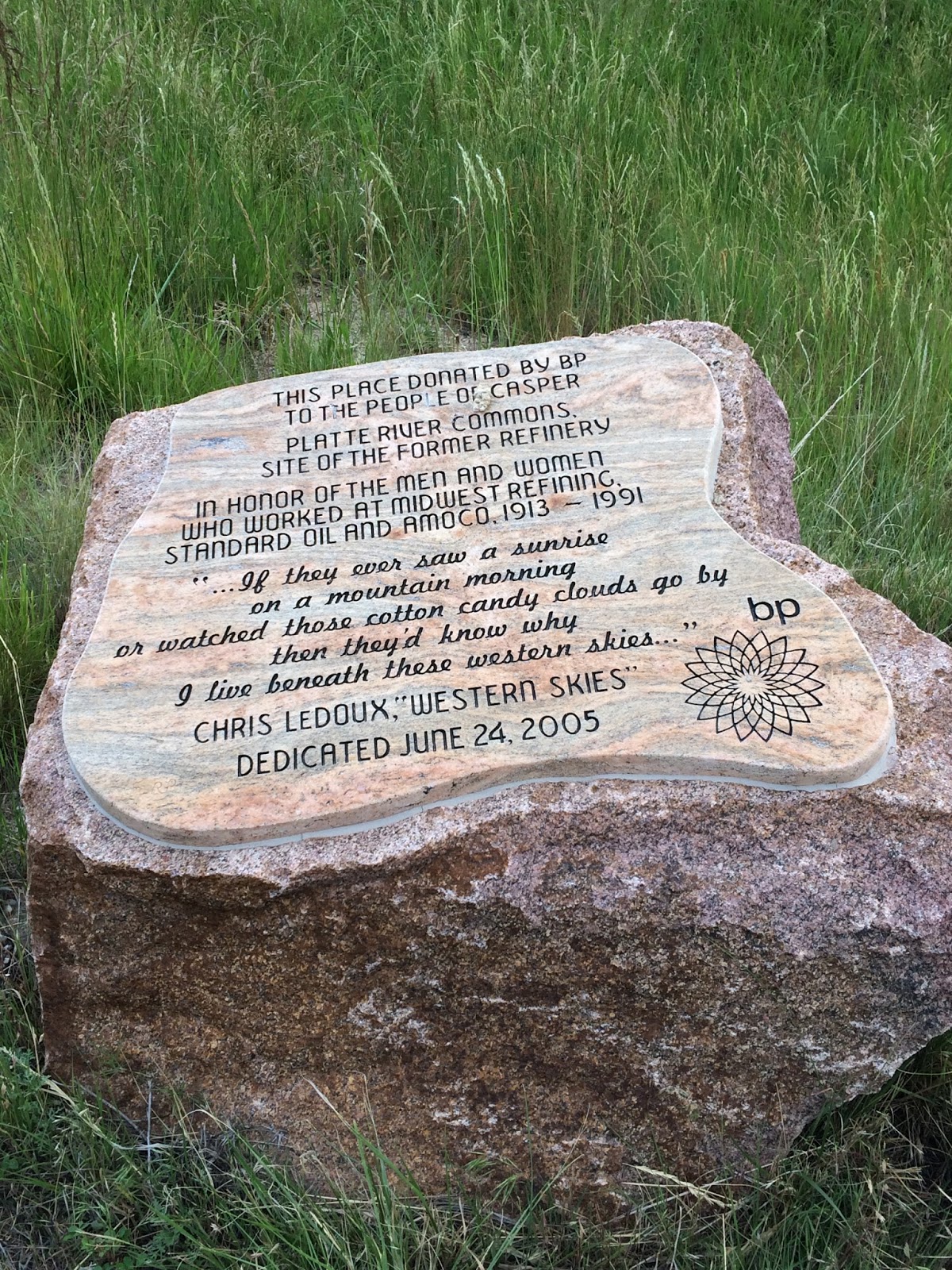
Some Gave All: Standard Oil Refinery Building, Casper Wyoming:

Headquarters for the former Standard Oil Refinery in Casper Wyoming. 
This building, with additional new construction is now a branch of
branch of tbe University of Wyoming's Wyoming
Technology Business Center.
Every once in awhile I'll have some of these photos, taken for one of my blogs, that I end up not being sure what to do with. This is an example of that.
I took these sometime during the summer of 2015, while down on the Platte River Commons pathway.  I was probably riding my bicycle down there.  After that, I didn't put them up as I wasn't quite sure where they belonged.  My original thought was that they should go on Painted Bricks, our blog dedicated to signs painted on buildings, but there aren't any signs painted on this building, and the old Standard Oil sign has been removed.  Having said that, there is a major sidewalk feature here, and I do put sidewalk features on our Painted Bricks blog, so there will probably be an entry there after all.


Instead, I decided to put this up here because of this somewhat sad memorial at this location.

Now, there were people who died one way or another at the refinery over the many years it was in operation, but this monument is simply to people who worked there from 1913 up until it closed in 1991.  When it closed, it came somewhat close to being a mortal blow to the city, which was already really hurting at that time.  Having said that, the decline of the refinery, which had at one time been enormous and one of the prime economic engines of the city, was obvious for years.


When the refinery was operating, this building was on the edge of the refinery, along the old Yellowstone Highway, prior to that highway being moved across the river. As a kid I must have ridden as a passenger in my parents vehicle past it countless times.  I can remember it quite well, and frankly it looks newer now than it did then.


I don't know when the building was built, but as the refinery opened in 1913, chances are that it was right around then.  The substantial refinery, now a golf course, was a major Natrona County employer and its closure really nearly ended an era in the town.  The town had three refineries up until about that time, but only one of them, the  Sinclair refinery, remains today.  The Standard Oil refinery was the largest of the three.
 __________________________________________________________________________________

Okay, that's all well and good, but in re-reading this, what it made me realize is the strange phenomenon of not really noticing the importance of something while it is actually occurring.  That is, I was a witness to the last days of the refinery, but it didn't make the impression on me that it really should have, given that it had been such a major feature of the town's existence up until then. And I was an adult at that time.

Now, part of that was due to the long, slow and fairly apparent decline that was in fact going on with the refinery. And it was also due to the fact that it came at a point in time during which we were already in a decade long slump here and all economic news was by default bad news.  But not everyone was similarly lacking in reaction to the event.  Indeed, I can recall some people being quite mad.  It's an interesting situation to look back on it.

 The Franco American Refinery in Casper, waste oil from which was handled as late as the 1980s.  It was closed by 1910.

The Standard Oil Refinery was not the first refinery in Casper. The Franco American Refinery, which is located near where the city recreational facilities are now located, has that distinction.  That refinery was already closed, although barely so, when Standard built its refinery in 1913.  That refinery went on to be a large refinery, by Wyoming standards, and in its heyday it had facilities on both sides of the North Platte River.  

It's odd to think that I've missed mentioning this so far, as the refinery was a really big deal in town, and it was a really big deal in the era which this blog was formed to study. So this is a pretty significant omission to date.  We've dealt with a lot of Western themes here, but this refinery was already here in the end final area of the "Old West" here in Wyoming, keeping in mind that the Old West in Wyoming kept on later than in other areas, and arguably into the 1920s really.  Suffice it to say, the era that this blog supposedly focuses on, 1900 to 1918 or so, includes the opening era of the Standard Oil Refinery.

And indeed, Casper has always identified more with the oil industry than with agriculture, which most people think of when they think of the West.  It can be a bit irritating to some stockmen, and I've heard them comment on it.  Ranching was part of the local economy here starting in the 1880s and it still is.  Wool production for the county was, at one time, simply enormous.  Beef production was so significant that the county had a packing house at least as early as the 1930s, located in Evansville, and it continued to have one until the 1970s.  My family owned it during the 1940s, up until my grandfather Lou Holscher died in his late 40s, at which time the family had to sell it.  

Be that as it may, the county has always heavily identified with oil, rather than livestock, in terms of its identity.  The newspaper used to claim, on its front page, that Casper was "The oil capitol of the world".  Casper's nickname is "The Oil City" (although leaning on the cartoon there are also many businesses that use "Ghost Town" as a reference.  The new internet news source for the town is called The Oil City News.  The local hockey team and the teams for the town of Midwest are called "The Oilers".  On maps featuring drawing references for the town or the county, as tourist maps and the like will do, the county always has something that reflects oil production.  

And at one time it was indeed refined production that was a major industry here, as opposed to crude production and exploration, which remains significant.

The refinery was joined over time by two others, those being the Sinclair Refinery and the Texaco Refinery. Those refineries were built next to each other, in what is actually Evansville Wyoming, east (and downwind) of where my family had its packing house, and east and downwind of any of the local municipalities.  The Standard Refinery was west, and upwind, of Casper itself.  It's being upwind contributed to the very common petroleum smell that the city had when I was a kid.  Smelling "the refinery" was pretty common.  "That's the smell of money", people use to say.

And I suppose it was. The refinery was a major employer from the point at which it was built up in to the 1980s.  It was such a factor in the town's economy that one addition to the city was known as The Standard Oil Addition, either because the titles went back to Standard Oil or the company participated in getting the subdivision rolling so that its workers would have a place to live.  My parents house, built in the 1950s, bordered the Standard Oil Addition.  And it was a fair distance from the refinery.

But not so far that if you gained any height you could see it.  But that would be true of any refiner in Casper from any height.  But the Standard refiner was a big one.

It never seemed impressive to me as a kid growing up that the town was basically surrounded by refineries.  That was normal.  Now, you wouldn't think that normal.  But we did.  And anyone my parents age knew people who worked at the refineries.  I did, but they were people my parents age.

And that was because nobody my age worked there. Which must say something about how the refineries were going.  Not one person I knew in school ever worked at any of the refineries.  The only people I knew who I didn't know by way of my parents were older soldiers I knew in the National Guard. A few of them worked at the refineries.  It's odd to think of, given as they were such major features in the town's economy.

Oil collapsed as part of the economy here in the early 1980s.  Standard's refinery already didn't look like something they were keeping up.  In my memory, I thought the refinery must have closed around 1983 or so, and was surprised in these photos to see that it kept on until 1991.  That means an institution that I could see from the window of some of my classes in high school died almost without my noticing it.  I must have been pretty distracted when I first came back from law school and started working, or its death was predicated, known and inevitable by that point. That's more likely it.

Or maybe I was influenced by the large number of people around here who were somewhat mad at Standard Oil.  Not much notice was given when things started going bad, and we felt that there should have been. By the time the refinery closed it was a run down eyesore and while that didn't equate with people being mad at the oil industry, it did lead to a certain "well good riddance to you then" feeling about Standard Oil.  And of course, I'd just been through a lot of college, and being an outdoorsman and a geology student I may have picked up a bit of that anti industry feeling that's common amongst young outdoorsmen and young geology students (who ironically have only the industry to look to for employment).  Perhaps, but I don't really think so.  Maybe it just seemed inevitable, the way that the decline of coal feels right now.  An inevitability, being that, can be lamented or endured.

I can recall the effort to clean it up, as well as the legal battle (which we were not part of) that developed after British Petroleum, then the owner, closed it.  I've always felt a bit odd about the post refinery legal battle as it well know that when we were growing up you knew that smelling the oil, and seeing the grit that would end up automobiles, meant you were breathing stuff that was bad. But you accepted it.  A person could simply look at the grounds of a refinery that had been producing petroleum for 80 years and know that a lot of stuff was under that ground.  But that is probably neither here nor there.

Now, it's a golf course.  That came about in part by way of the settlement of the legal woes left by the long presence of the refinery.  It took a long time to establish, and for quite a while I could watch the heavy equipment reshaping the old grounds from our front conference room window, followed by watching the dust rise off the shaped grounds in the wind. But the grass did take, in spite of what skeptics thought (and I was skeptical that it would) and it looks very nice now. The walking paths within it are nice, and it's a nice park, really, next to the North Platte River.  Probably oddly, the visage would now be more familiar to the departed spirits of Frontier cavalrymen now, who were stationed at nearby Ft. Caspar, than at any time since 1913.

So, from major industry, employing more here locally than anything else in its heyday, to a golf course that costs a lot for its operators to run.  

And from an economic anchor of the town to a non entity, in that fashion, in a town that has only one surviving refinery.

A real change.  You would have thought that I would have paid more attention to it.

Thursday, January 28, 2016

Results of the Storm of January, 1916

LOC Title:  RESULTS OF STORM OF JANUARY, 1916; VIEW TO SOUTH FROM NEAR SOUTH END OF PLANT. NOTE SANTA ANA CANAL TUNNEL PORTAL. SCE negative no. 3505, January 28, 1916. Photograph by G. Haven Bishop. Lower photo: SAR-2, RESULTS OF STORM OF JANUARY, 1916; VIEW OF PLANT SITE FROM THE HIGH ON CANYON WALL. SCE negative no. 3506, January 28, 1916. Photograph by G. Haven Bishop. - Santa Ana River Hydroelectric System, Redlands, San Bernardino County, CA

Tuesday, January 26, 2016

Wyoming Fact and Fiction: The Diet of a Mountain Man

Wyoming Fact and Fiction: The Diet of a Mountain Man: We read and watch daily opinions about our overweight society, “Americans are too fat,” we are continually told. Maybe so, today anyway, bu...

Confessions of a Writer of Westerns: Now How Is This Supposed To End?

Confessions of a Writer of Westerns: Now How Is This Supposed To End?: I see so many posts lately about writers block. Writers who get stuck and cannot seem to go on. Seems like I have so many projects going on...

Monday, January 25, 2016

The Big Picture: Some Gave All: Bridger Trail, Wyoming

Some Gave All: Bridger Trail, Wyoming


Monday at the Bar: Courthouses of the West: United States Post Office and Courthouse, Oklahoma...

Courthouses of the West: United States Post Office and Courthouse, Oklahoma...:


This is the 1912 vintage Federal courthouse and post office in Oklahoma City.  This classic courthouse is no longer used for civil or criminal ntrials, having been replaced by a new courthouse nearby, but it is still used for bankruptcy proceedings.  I've been told that the most famous trial to have been held here was the criminal trial of Machine Gun Kelly.

The courthouse was a courthouse of the Western District of Oklahoma, and for a time was used by the 8th Circuit Court of Appeals prior to Oklahoma being reassigned to the 10th Circuit.

Sunday, January 24, 2016

The United States Supreme Court upholds the Income Tax: January 24, 1916

The United States Supreme Court upheld Federal Income Tax in Brushaber v. Union Pacific Railroad.

Chilly weather in Browning Montana, Januaryy 24, 1916

In Browning Montana the temperature dropped from 44F to -56F in one day, the greatest such temperature change ever recorded for a 24 hour period.

And more proof that I'm out of the national stream of thought on national sports.


A conversation with a Massachusetts lawyer by telephone last week.

Me:  Okay, well thanks for taking my call.

He:  No problem. Go Pats!

Me:  Huh,. . . um heh heh yeah. (thinking, did he say go Pat?  What the crap).

Only later it dawned on me, the Patriots.  They're one of teams in the playoffs somehow.

At home:

Me:  Are the Patriots in the playoffs?

Long Suffering Wife:  Yes, they're playing the Broncos on Sunday.

Me:  Thinking, oh duh. No wonder.  I'm in Wyoming so I'm supposed to be a Bronco's fan.

Sunday Morning Scene: Churches of the West: Immaculate Conception Church, Rapid City South Dakota

Churches of the West: Immaculate Conception Church, Rapid City South Dakota


This particular church, on our Churches of the West Blog, is the most viewed church on the site.

Saturday, January 23, 2016

M26 Pershing

The M26 was really the U.S. Army's first modern tank, and the tank that would establish the pattern for at least three other models. These two videos do a good job of showing the ins and outs of the Pershing.


The M26 saw some use in World War Two, albeit extremely limited.  By the time of the Korean War their teething problems were being noted, but they were already slated for replacement by that time.

Friday, January 22, 2016

Meeting the Mental Image: The RG Barn

The RG Barn


The reason I'm posting this here is that not only is this ranch yard exceptionally attractive, it's about the only Wyoming ranch yard I've ever seen that actually meets the Hollywood mental image of a ranch yard.

The barn, with the founding date of the ranch under the brand, is the text book version of a barn. The ranch house, which I negligently failed to photograph, is a huge old-fashioned ranch house.  An attractive late 19th Century house, it's a perfect cube in shape (two stories) with a covered porch that goes all the way around the house.  Very nice.  

Even the cows looked perfectly content.

I'm only noting this as the mental impression was so significant, that it really stands out.  I'm not criticizing other Wyoming ranches by any means, but this ranch that borders the town of Burlington (this yard literally is on a Burlington street) is really unique in this fashion.

Thursday, January 21, 2016

Distances in rural areas, Churches of the West: Unknown abandoned church, Otto Wyoming

A long time ago on this blog I had a couple of items about local churches, noting the many Catholic churches that exist in downtown Denver serving what had once been distinct ethic neighborhoods. A post I made earlier this week on churches on one of our other blogs; Churches of the West: Unknown abandoned church, Otto Wyoming: calls to mind something similar, if not identical.  The big change in the practicality of distances in rural life.


Those photographs depict an abandoned church in Otto Wyoming, a very small Wyoming farm town in the Big Horn Basin.  I don't know anything about the history of the church at all, other than that it once existed and based on a reference I found to it, it was at there at least as early as the 1920s.


Now Otto is just a few miles from Burlington (eleven miles) and Basin (twelve miles).  Both Basin and Burlington are larger towns, which isn't to say that they're enormous by any means.

 
General store in Burlington Wyoming.

 
 Big Horn County Courthouse, Basin Wyoming.

Basin is the more substantial of the two, and is the county seat.  Basin isn't far from Greybull, another fairly small town, and Worland, a much larger town.

Now, Basin and Burlington all have churches.  Burlington, however, is quite limited in those regards, at least at the present time.  It has an Episcopal and a Mormon church.  Basin, on the other hand, has a larger representation of denominations.


St. Philip's Catholic Church & ELCA Peace Lutheran Fellowship, Basin Wyoming, while joint use of a church is unusual, nearby Thermopolis Wyoming has a combined Presbyterian and Methodist congregation  Currently the  Catholic community is being served by the nearby church in Greybull, however, and Masses are apparently not being offered here at the present time.  
 

Now, their could be a lot of explanations for this, but still you have to wonder when it was that tiny Otto required its own church?  Perhaps the denomination of the church explained it.  Or perhaps 11 or so miles was a long ways not all that long ago, really.  Certainly, eleven miles by horse or cart is a very long ways, particularly if you have to turn around and go back the other way, and that's even if the weather is nice.  And eleven miles by Model T isn't a short trip either.


Wednesday, January 20, 2016

And the Economic news gets starker.

Lex Anteinternet: Lex Anteinternet: Lex Anteinternet: Lex Anteintern...: And now the price of oil is down to. . . $29.00 bbl.
Wyoming sweet crude is down to about $19.00 bbl.  Wyoming sour crude is now down to about $9.00 bbl.  It was at $76.00 bbl in June 2014.

Fairly clearly, those are not economically sustainable prices.

Mid Week At Work: English women planing artillery shells. 1915


English women planing artillery shells in a factor in 1915.  Once again, Rosy the Riveter wasn't new to the world in World War Two.

Tuesday, January 19, 2016

More proof that I'm clueless on the popular culture

David Bowie (born David Jones, but adopted the Bowie stage name due to Davy Jones of the Monkeys already using that name) died of cancer this past week.


I know very little about Bowie.  I wasn't a fan of his music, but I was as distant casual observer of his transformation from Ziggy Star Dust in to the Thin White Duke. That is, from somebody who affected a weird alien stage personal to somebody who affected, and perhaps genuinely adopted, a personal reflecting the English upper middle class of the 1930s.

And that, and the public outpouring of sympathy over his death, is what makes his death relevant to the historical topic of this page.  In Bowie we see a highly successful example of a modern pop music career, which is in no small part why I'm caught off guard by the massive public reaction to his death.  That he had a stage persona epitomizes modern pop music to me, which is to say that, in its early stages, it was . . . fake.

Now, don't take me wrong.  I'm not condemning Bowie And I'm not even saying that he lacked musical talent, which would not be true, or that his music was bad, which also wouldn't be true even if I don't care for it.  Indeed, I admire the fact that he transformed out of the fake personal into a seemingly real one, when the nutty Ziggy Star Dust one no longer served, or perhaps even in advance of that.  He got away with appearing in regular street clothes after awhile.  But what we see here has become a type of pop norm.  In order to get popular musicians adopt shocking persona's and sport them everywhere.  Female singer often go for the absolutely trashiest ones they can affect, to the point now where they are so personally exposed, figuratively and literally, its questionable if they can go back or forward once their youth wears off.  That tends to be the attempted time line, however. Shocking personal, that grows more shocking, then softens, then morphs into something trying to recall dignity, as the artist popular in part (at least) for appearance yields to time and nature and tries to base a career on music alone.  Not all succeed.
But that this is what is done is very telling.

This wasn't always the case.  Musicians have been around forever, and they've always been on the dicier edge of culture to some extent.  And they often dressed flashier than others. But the adoption of a completely fake persona is something that has only really been around since the 1970s, although the roots of it were appearing by the 1960s.

It's important to keep in mind in this discussion that I'm not claiming that musicians and singers were the models of civic virtue up until the 1970s, or 60s, or 50s.  That would be absurd.  On the contrary, most of the vices we associate with the preforming life today were around at least as far back as the 1920s.  In the 1920s, when Jazz was edgy, and blues fueled it ,there were plenty of songs written reflecting that. And a study of the lives and wrecked lives of musicians would amply illustrate that.  Chances are pretty high that there were as many performers who had messed up wrecked lives then as now, including some whose music I really admire.

But what is different is that there wasn't an attempt to adopt fake persona's as part of the art, until the 1970s.  Or, if a fake personal was adopted, it was adopted to hide a vice, rather than declare it as a virtue.

All through the 1920s through the 1940s we rarely see performers, particularly female performers, adopting a stage presentation that departed hugely from the urban dress of the day. There are some exceptions, including at least one huge one I can think of, but the exceptions tended to be fairly mild, and constitute an exaggeration of high class dress of the day, or in the one exception I can think of it reflected something going on in another culture that was in high society regard.

It wasn't until the 1950s that this began to change very much, and even then the change tended to be an exaggeration of standard middle class dress.   In the early 60s, however, somebody thought to take that one step further with The Beetles and dress them in a fairly infantile fashion, which didn't last long, but which reflected across the musical scene of the time. That yielded, however, pretty quickly to the really funky style of the 1960s, which musicians took up, as well as a really blue collar looking, or something, style affected by some.  

While that change didn't result in many really weird costumes (there were some however) it did lay the ground work for the 1970s.  And at that time the totally fake persona took off, and we've had it ever since.  Musical artist have launched their careers in some instances by appearing as shocking as they could.

Which all makes it pretty darned phony.

If a person goes to a performance in party to look at weird dress, or bizarre makeup, they're really going to a sort of American and English Kabuki Theatre, but without the cultural background and content backing it up.

And that's sad, really.

Which is, I guess, why I'm continually caught off guard by the post death lauding of figures like David Bowie as cultural icons.  I just don't get it.  I don't dislike him, but I'm not seeing the contribution to the arts that others see here.  I just don't.

Indeed, I fear that we've reached the point where this sort of thing truly reflects the culture in some scary ways. . . i.e., maybe a lot of it is now fake.


Monday, January 18, 2016

M56 Scorpion.

A friend of mine sent me this one, on the M56 SPAT.  Interesting stuff.